Unusual Things To Do In Poznan
Poznan, the capital of the Wielkopolskie voivodeship in western Poland, hides a goat clock, a cipher-breaking museum, a free zoo and an Iron Age fort within day-trip range. This is the odd stuff.

Short answer
Poznan's unusual side includes the two mechanical goats that face off on the Town Hall facade at noon and 3 pm, the Enigma Cipher Centre, the free Old Zoo, the Srodka mural, the Croissant Museum's English show at 14:00 and day trips to Biskupin and the Morasko meteorite reserve.
Poznan, the capital of the Wielkopolskie voivodeship (Greater Poland) in western Poland, on the Warta river, is a city that trains on the Berlin to Warsaw route pass through. That is a mistake with a strange payoff. This is a city where two metal goats face off on the Town Hall facade every day at noon and, since recently, also at 3 pm, where three Polish mathematicians broke the German Enigma cipher, and where a croissant holds EU legal protection. The Poznan Travel Guide editorial desk has assembled the odd corners here from what the museums, the city portal and the zoo themselves publish, with the prices and hours they print.
What Makes Poznan Different From Other Polish Cities?
Poznan runs on a set of quirks no other Polish city shares: mechanical goats on the Town Hall facade at noon and 3 pm, a croissant protected in the EU register, three pre-war codebreakers commemorated in a museum on Sw. Marcin, and a free zoo in a park west of the centre. The goats first appeared with a clock installed in September 1551 by the clockmaker Bartel Wolff of Gubin, and the current tradition was restored with a new clock in 1913. The croissant, the rogal swietomarcinski, was entered in the EU register as a Protected Geographical Indication by Commission Regulation (EC) No 1070/2008 of 30 October 2008. The city portal counts 534,239 residents, so none of this is a big-city machine; it is a compact, walkable oddity.
The goats are the headline act. The National Museum's own page on them states the show runs every day at noon and, since recently, also at 3 pm. One honest caveat belongs here: the Town Hall facade is under conservation works, and no official page confirms whether the goats run on any given day during the works, so treat the show as likely rather than guaranteed and check the museum's site before you build a lunch around it.
The croissant is the other signature oddity. It is not a generic pastry: the rogal swietomarcinski is a legal, geographically protected product tied to 11 November, St Martin's Day, when the street of that name celebrates its name day. The Croissant Museum on the square even stages an English-language show about it at 14:00, daily in July and August and on weekends all year.
Where To Find Poznan's Strangest Sights Right In The Centre?
The strangest sights sit inside a fifteen-minute radius of the Old Market Square: the goats and their clock on the Town Hall, the Croissant Museum at Stary Rynek 41/2, the Srodka mural at ul. Srodka 3, and the Fara church on Golebia, open daily 6:00 to 19:30 with free entry. The Town Hall's museum interior is closed for renovation and the National Museum's visit page lists no reopening date, but the facade, the square and the goat clock are separate from that closure and remain the reason most people look up at noon. The Croissant Museum's English show starts at 14:00, includes tasting, and asks visitors to arrive ten minutes early; a second English show at 15:30 opens only when the 14:00 one is full.
Cross the river to Srodka, a small district squeezed between two arms of the Warta, and look up at the tenement at ul. Srodka 3. The mural there, "Opowiesc srodecka z trebaczem na dachu i kotem w tle", is a whole painted legend spread across the facade, and the city marked its tenth anniversary on 4 October 2025, which dates it to 2015. It is the kind of thing a guide walks you past with a story; the Check availability link beside our Old Town Poznan walking area guide covers a guided version of exactly this route.

The Fara, the Collegiate Basilica of Our Lady of Perpetual Help, St Mary Magdalene and St Stanislaus, is the counterweight: a baroque interior that costs nothing to enter, open daily 6:00 to 19:30, with the only rule being no sightseeing during Mass. None of these three stops needs a ticket, which is itself unusual for a European old town.
What Can You Do In Poznan That Costs Nothing?
Genuinely free options include the Old Zoo on ul. Zwierzyniecka 19, which charges no admission, the goats at noon and 3 pm, the Srodka mural, the Fara, and free Tuesdays at the National Museum branches and the Independence Museum branches, while the Gniezno Origins museum is free on Sundays. The Old Zoo is the underrated one: the zoo's own page states entry is free, with hours of 9:00-16:00 from November to February, 9:00-17:00 in March and October, and 9:00-19:00 from April to September. It is a small, historic zoo in a park, not the large New Zoo across town, and the two do not share a ticket or a gate.
Tuesday is the day the museum network opens its doors without a ticket. The National Museum's visit page lists Tuesday as the free day for its branches, including the Royal Castle (Museum of Applied Arts) and the Museum of Musical Instruments on the square, and the Independence Museum network's price page does the same for the Museum of Armaments in Citadel Park. One caution: the Ethnographic Museum at Grobla 25 is closed for renovation, so cross it off any free-Tuesday plan.

The free list has a shape to it, so here it is in one table:
| Free thing | Where | When it is free |
|---|---|---|
| Old Zoo | ul. Zwierzyniecka 19 | Entry always free, daily |
| Town Hall goat show | Stary Rynek, facade | Noon and 3 pm daily |
| Srodka mural | ul. Srodka 3 | Always, it is a wall |
| Fara basilica | ul. Golebia 1 | Daily 6:00-19:30, no ticket listed |
| National Museum branches | Royal Castle, Musical Instruments and others | Tuesdays |
| Museum of Armaments | Citadel Park | Tuesdays |
| Museum of the Origins of the Polish State | Gniezno, ul. Kostrzewskiego 1 | Sundays |
Our fuller free things to do in Poznan guide expands this list, and the Poznan City Card guide explains the other side of the coin: the card costs 65 zl for 24 hours with transport (59 zl without), gives free entry to most museums, but partners such as Enigma and Porta Posnania give discounted rather than free entry at 21 zl.
Which Poznan Museums Are Actually Unusual?
The unusual museum trio is the Enigma Cipher Centre at ul. Sw. Marcin 78, the Museum of Musical Instruments at Stary Rynek 45, and the Genius Loci archaeological reserve at ul. Posadzego 3, with the Museum of Armaments in Citadel Park as the fourth pick. The Enigma Cipher Centre is the one with an international story: its own timeline names Marian Rejewski, Jerzy Rozycki and Henryk Zygalski, the three Polish mathematicians who reconstructed the German cipher machine before the war. The centre is closed Mondays, runs Tue-Fri 9:00-18:00 and Sat-Sun 10:00-19:00, charges 35 zl normal and 29 zl reduced, and offers exhibition and audio guides in Polish, English, German, Russian and Ukrainian.
The Museum of Musical Instruments is one of the few of its kind in this part of Europe, and it sits right on the square at number 45: Monday closed, Tue-Wed 10:00-16:00, Thu 10:00-18:00, Fri 10:00-20:00, Sat-Sun 10:00-17:00, 15 zl normal, 10 zl reduced, free on Tuesdays. Genius Loci, on the cathedral island of Ostrow Tumski, is an archaeological reserve you view from walkways above the excavated remains; its price page lists 20 zl normal, 15 zl reduced and a 50 zl family ticket.

Here is the odd-museum shortlist with what each one charges and when it shuts:
| Museum | Address | Normal / reduced | Closed | Free day |
|---|---|---|---|---|
| Enigma Cipher Centre | ul. Sw. Marcin 78 | 35 / 29 zl | Monday | None listed |
| Museum of Musical Instruments | Stary Rynek 45 | 15 / 10 zl | Monday | Tuesday |
| Genius Loci reserve | ul. Posadzego 3 | 20 / 15 zl | Hours unsourced | None listed |
| Museum of Armaments | Park Cytadela | 15 / 10 zl | Monday | Tuesday |
| Royal Castle (applied arts) | Gora Przemysla 1 | 20 / 13 zl | Monday | Tuesday |
The Royal Castle deserves a word because it is easy to mistake for a standard art museum. Its current programme is the odd part: the National Museum's page lists a display of Japanese ukiyo-e woodblock prints called "Japonska Fala" running 1 September to 15 November 2026, and a medal and plaque exhibition by Anna Krzymanska from 25 September 2026 to 10 January 2027. A Polish provincial castle showing Edo-period prints is exactly the kind of pairing this page exists for. More options are catalogued in our Poznan museums guide.
Where To Eat Something You Won't Find Anywhere Else?
The two foods that exist properly only here are the rogal swietomarcinski, the St Martin's croissant with EU Protected Geographical Indication status, and pyry z gzikiem, potatoes with a curd cheese spread, and both are cheap, everyday eating rather than restaurant occasions. The croissant's legal registration, Commission Regulation (EC) No 1070/2008 of 30 October 2008, means a genuine rogal swietomarcinski can only come from Poznan bakers working to the registered recipe.
Pyry z gzikiem is the other local signature: plain boiled potatoes served with gzika, a curd cheese mixed with cream, chives, radish and seasoning. It is peasant food that survived into every milk bar menu in the city, and it costs a few zloty. Our Poznan food guide and the pyry z gzikiem page cover where the dish comes from and how it is built.

The Croissant Museum is the eat-and-learn version. Its English "croissant and goat show" runs about 65 minutes at 14:00, daily in July and August and on Saturdays and Sundays all year, with other days shown in the booking calendar; Polish shows run at 11:00, 12:30, 14:00 and 15:30, plus 17:00 on Saturdays. The show that starts at 14:00 ends with a view of the Town Hall goats from the museum windows, and tasting is included in the price. Ticket prices are not published on the site, only in the booking widget, so check the calendar before you go.
For the sit-down version, the Michelin Guide Poland 2026 lists 25 restaurants from Poznan and surroundings, with Muga holding one Michelin star and Bib Gourmand awards for Fromazeria, POSTO, SPOT., TU. REStAURANT and Farmer & Sons in Skorzewo. That is the conventional end of the scale; the milk bars are the unconventional one, and our Poznan milk bars guide explains how they work.
What Unusual Day Trips Work From Poznan?
The standout odd day trips are Biskupin, a reconstructed Iron Age fortified settlement about an hour out, the Morasko meteorite reserve on the city's northern edge, Gniezno with its cathedral hill, and Kornik Castle with its arboretum of roughly 3,000 species and varieties. Biskupin is the most genuinely unusual: an archaeological museum built on the site of a fortified settlement on a peninsula, with a museum season of 9:00-18:00 May to September, 9:00-17:00 in April and October, and 9:00-16:00 November to March, closed 1 January, Easter Sunday, 1 November and 25 December, at 28 zl normal and 19 zl reduced. Its XXXI Archaeological Festival ran 12-16 September 2026, so the site hosts living-history events, not just ruins.
The Morasko meteorite reserve is the one almost nobody outside Poland knows: a field of impact craters from a meteorite fall, reachable by city transport on the northern edge of town. Our Morasko meteorite reserve guide covers getting there. Kornik works as a half-day: the castle is closed Mondays, runs the low season of 1 October to 30 November at 10:00-15:15 with last entry 14:30, closes its 2026 tourist season on 14 December, and charges 40 zl normal and 20 zl reduced, while the arboretum next door is open daily 10:00-16:00 from November to March at 10 zl adult entry.

Gniezno has a scheduling quirk worth knowing in advance: on Sundays from May to October the cathedral and its museum are closed to tourists, and only the viewing terrace opens, at 13:00-15:00 and 16:00-17:30. The Museum of the Origins of the Polish State there is free on Sundays, daily 9:00-16:00 from October to April. The all-inclusive pass for the cathedral hill, with audio guide, is 48 zl normal and 42 zl reduced.
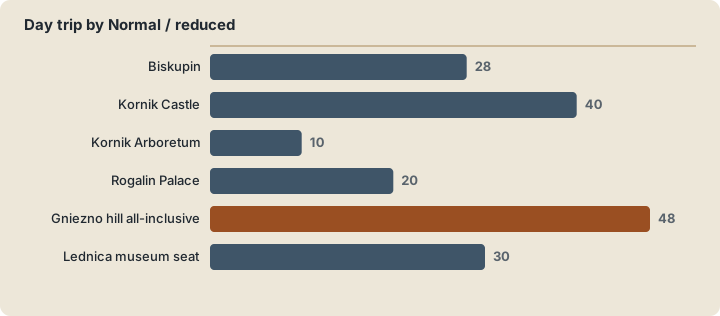
Here is the day-trip table with the figures that matter:
| Day trip | Normal / reduced | Season note | Monday |
|---|---|---|---|
| Biskupin | 28 / 19 zl | Nov-Mar 9:00-16:00 | Open Mondays |
| Kornik Castle | 40 / 20 zl | Season ends 14 Dec 2026 | Closed |
| Kornik Arboretum | 10 / 7 zl adult / reduced | Nov-Mar 10:00-16:00 daily | Open daily |
| Rogalin Palace | 20 / 13 zl | Nov-Feb 9:00-16:00 | Closed |
| Gniezno hill all-inclusive | 48 / 42 zl | Sundays May-Oct: terrace only | Open Mon-Sat |
| Lednica museum seat | 30 / 20 zl | Ferry season unsourced | Hours unsourced |
Rogalin, with its ancient oaks in the park, is covered in our Rogalin Palace guide, and the combined Rogalin and Kornik excursion above bundles the two in one guided day. For the practical side of the city itself, the Poznan public transport guide explains the ticket system: timed tickets at 5, 7 and 9 zl for 15, 45 and 90 minutes, valid in all zones with transfers allowed.
When Do The Odd Events Happen In Poznan?
The calendar of odd events runs from St Martin's name day on 11 November, through the Betlejem Poznanskie Christmas markets from 14 November 2026 to 6 January 2027, to the POZnan Ice Festival on 11 to 13 December 2026, with its ice sculpture contests and children's workshops. The Christmas market is not one market but three: the MTP fair grounds host theirs 14 November to 20 December 2026, Plac Wolnosci runs from 20 November 2026 to 6 January 2027, and the Old Market Square itself from 21 November 2026 to 6 January 2027. The Ice Festival's 20th edition stages a small sculpture contest on 11 December from 16:00, Speed Ice Carving on 12 December from 11:00, and the main competition with children's workshops on 13 December from 9:00.
St Martin's Day deserves its own warning. The street celebrates its name day on 11 November alongside Poland's Independence Day, and the event has been organised by CK Zamek, but the 2025 edition had no parade at all. Do not plan around a parade; plan around the croissants, which every bakery on the street bakes to the protected recipe that week, and check the CK Zamek programme for what the current year actually holds. Our St Martin's Day guide and Poznan Christmas market guide carry the detail.

What Should You Know Before Chasing The Odd Stuff?
Three practical facts shape an unusual-Poznan day: the city has no bike-share system (the old one ran 2012 to 2022 and has not returned), trams and buses take timed tickets rather than card taps, and the fine for travelling without a valid ticket is 350 zl, cut to 175 zl if paid within 7 days. Timed tickets cover all zones: 5 zl up to 15 minutes, 7 zl up to 45 minutes, 9 zl up to 90 minutes, with transfers allowed inside the window. A 24-hour ticket is 18 zl for zone A or 24 zl for all zones, and a weekend promotion keeps a ticket validated between 20:00 Friday and 24:00 Saturday valid until 24:00 Sunday.
The weather matters more than visitors expect, because the odd stuff is mostly outdoors. WMO's 1991-2020 climate normals for the Poznan station put July as both the warmest and the wettest month, with a mean daily high of 25.2 C and 84.4 mm of rain, while April is the driest at 28.6 mm and January's mean low sits at -2.9 C with 19.7 frost days. In plain terms: the goat show at noon in January is a two-minute exposure, so dress for it, and the mural in Srodka is best in the long evenings of May and June. Our weather by month guide and best time to visit guide break this down month by month.

For the indoor backup plan, the Poznan rainy day guide lists what still works when the Warta valley turns grey, and the Poznan with kids guide pairs the free Old Zoo and the New Zoo with family pricing: the New Zoo charges 20 zl for every visitor from November to the end of February, against 45 zl normal on weekdays in the March-to-October season.
A final table to close the planning loop, the one that decides most of the above:
| Practical item | Figure | Where it applies |
|---|---|---|
| 15-minute ticket | 5 zl | All zones, transfers allowed |
| 90-minute ticket | 9 zl | All zones, transfers allowed |
| 24-hour all-zone ticket | 24 zl | Trams and buses |
| Fine, no ticket | 350 zl | 175 zl if paid within 7 days |
| New Zoo, winter | 20 zl everyone | November to end of February |
| Old Zoo | Free | Daily, year round |
Common Questions About Unusual Things To Do In Poznan
What time do the goats come out in Poznan?
The National Museum's page on the goats states they appear every day at noon and, since recently, also at 3 pm. The clock with goats was first installed in September 1551 by Bartel Wolff of Gubin, and the current clock dates from 1913. Because the Town Hall facade is under conservation works, no official source confirms the show runs on any given day, so check before you go.
Is the Old Zoo in Poznan really free?
Yes. The zoo's own page for the Old Zoo at ul. Zwierzyniecka 19 states entry is free, with opening hours of 9:00-16:00 from November to February, 9:00-17:00 in March and October, and 9:00-19:00 from April to September. It is a separate site from the New Zoo at ul. Krancowa 81, which is ticketed, and the two do not share a ticket.
What is unusual about the St Martin's croissant?
The rogal swietomarcinski is registered in the EU as a Protected Geographical Indication under Commission Regulation (EC) No 1070/2008 of 30 October 2008, which means only bakers in Poznan working to the registered recipe can sell it under the name. The season peaks around 11 November, when St Martin Street celebrates its name day.
Can you visit the Enigma Cipher Centre in English?
Yes. The centre's visit page lists exhibition and audio guides in Polish, English, German, Russian and Ukrainian. It is closed on Mondays, open Tue-Fri 9:00-18:00 and Sat-Sun 10:00-19:00, with last admission one hour before closing, and tickets at 35 zl normal and 29 zl reduced.
Is the Palm House in Poznan open?
No. The Palm House at ul. Matejki 18 is temporarily closed to visitors for modernisation and rebuilding, under a notice dated 31 August 2026. The city's plan is that part of the rebuilt pavilions reopens towards the end of 2028, with remaining works running until 2030.
What is the strangest day trip from Poznan?
Biskupin, a reconstructed Iron Age fortified settlement with an archaeological museum, is the most unusual: open 9:00-16:00 from November to March, closed 1 January, Easter Sunday, 1 November and 25 December, at 28 zl normal and 19 zl reduced. The Morasko meteorite reserve, a group of impact craters on the city's northern edge, is the other candidate and needs no ticket office at all.
The odd side of Poznan is not hidden behind velvet ropes: it is goats on a clock face, potatoes with curd cheese, codebreakers on Sw. Marcin and a free zoo in a park, all reachable on a 5 zl tram ticket.