St Martin's Day In Poznan
On 11 November Poznan celebrates the name day of its best-known street with pastry, street culture and a national holiday, and this guide covers every part of the day with verified opening times, prices and dates.

Short answer
St Martin's Day in Poznan falls on 11 November and combines Poland's Independence Day with the St Martin Street Name Day, organised by CK Zamek. There is no parade to promise: the 2025 edition replaced it with an all-day street village. The signature pastry is the rogal swietomarcinski, an EU Protected Geographical Indication since 2008.
On 11 November the city of Poznan, the capital of the Wielkopolskie voivodeship (Greater Poland) in western Poland, on the Warta river, gives its best-known street a birthday party. Swiety Marcin, the avenue that runs from the Old Market Square towards the Imperial Castle, celebrates its name day, and the whole city eats pastry. The date matters twice over: it is also Poland's Independence Day, a national holiday, so the street festival and the patriotic ceremonies share one calendar page. This guide lays out what the day involves, what is verified about the current format, where the famous croissant fits in, and how to plan the practical side, from November weather to tickets, museums and day trips. Nothing here is padded with folklore that cannot be checked: every hour, price and date below comes from an official source, and where a detail is not published, this guide says so plainly.
What Happens On November 11 In Poland?
On November 11 Poland marks Independence Day with solemn morning ceremonies, flags, and, in a normal year, a ceremonial change of the honour guard in the city centre. From midday onwards the name day takes over, with CK Zamek filling its street with a programme of music, food and family activities, while bakers sell the St Martin's croissant, protected in the EU as a Protected Geographical Indication since 2008.
The double character of the date is the key to understanding the crowds. Independence Day is solemn in the morning: official ceremonies, flags, and in a normal year a ceremonial change of the honour guard in the city centre. The name day takes over from midday onwards, when CK Zamek, the cultural centre inside the Imperial Castle, fills the street it sits on with a programme of music, food and family activities. The city portal frames the event as a street celebration run by the castle's own city-space programme, and that is the honest description to hold on to: a festival with a programme, not a single scheduled spectacle.
For visitors, the practical consequence is that 11 November feels different from an ordinary Wednesday in Poznan. Public offices and most shops follow the holiday rules, museums run their own schedules, and the street itself becomes the main attraction. Anyone planning to build a whole trip around the date should read the next two sections carefully, because the format of the celebration changed recently and one long-standing assumption about it no longer holds.

Why Does Swiety Marcin Street Celebrate Its Name Day?
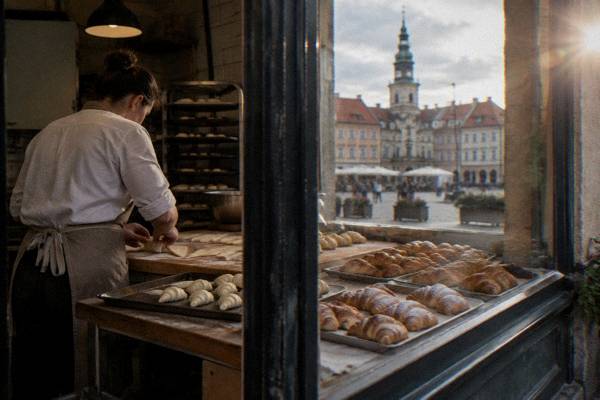
CK Zamek, the cultural centre housed in the Imperial Castle on Swiety Marcin, has organised the St Martin Street Name Day since 1994, and the event runs alongside Poland's Independence Day on 11 November. The street's patron gives the day its name and its pastry: bakers across the city sell rogale swietomarcinskie, the croissant registered as a Protected Geographical Indication by Commission Regulation (EC) No 1070/2008 of 30 October 2008.
The name day idea is a Polish tradition transposed onto urban geography. Streets, like people, have patron saints and name days, and Swiety Marcin, named for St Martin, is the street Poznan decided to celebrate at scale. The Imperial Castle is open for visiting Monday to Sunday from 12:00 to 19:00, with tickets sold until 18:00, so a visit to the building that hosts the festival slots neatly into the day itself.
The geography rewards a little planning. Swiety Marcin runs from Plac Wolnosci, at the Old Market Square end, up to the castle, and the celebration spreads along it. Plac Wolnosci is also one of the three sites of the Christmas market later in the season, which opens from 20 November 2026, so the square is worth learning on this visit. A half-day private tour is one way to cover the street and the surrounding Old Town with a local guide, and the operator's live listing shows current availability: Check availability.
The name day is also the moment when Poznan's baking tradition takes centre stage. Bakeries across the city, not just on Swiety Marcin, sell the croissant through the season around 11 November, and the pastry has its own protected status in EU law, which the next section unpacks. For the wider festival calendar across the year, the site's guide to Poznan events and festivals collects the dates that are officially published.
Is There A St Martin's Day Parade In Poznan?
The 2025 edition had no parade: on police safety recommendations it was replaced by an all-day Miasteczko Imieninowe, a name-day street village, and the 2026 programme was not yet published on the CK Zamek page. Nobody can honestly promise a parade for 11 November. The safe plan is to treat the street festival as the headline and check the CK Zamek programme for the current year before travelling.
This is the single most important correction this guide can make. Many older write-ups of the day describe a parade with a mounted St Martin figure handing out croissants, and that format did exist in past editions. The city's own culture portal, however, records that the 2025 edition dropped the parade on police safety recommendations and replaced it with an all-day Miasteczko Imieninowe, a name-day town of stalls and activities spread along the street. The change was a safety decision, not a cancellation of the celebration itself.
What that means for a visitor is simple. Come for the street, the stalls, the music and the pastry, and let the programme be the surprise rather than the promise. The 2026 programme had not been published when this guide was prepared, so the current year's format should be confirmed on CK Zamek's own pages before anyone books travel around a specific event. Travellers who want a guaranteed structure for the day can pair the street visit with fixed-opening sights: the Imperial Castle's visiting hours are daily 12:00 to 19:00, and the Enigma Cipher Centre at Sw. Marcin 78, two doors down from the castle, is open Tuesday to Friday 9:00-18:00 and Saturday to Sunday 10:00-19:00, closed Mondays, with last admission an hour before closing.

What Is A Rogal Swietomarcinski?
The rogal swietomarcinski, the St Martin's croissant, is the sweet symbol of the day and of the city itself: the Polish agricultural ministry calls it the sweetest symbol of Poznan. It is registered in the EU register as a Protected Geographical Indication, entered by Commission Regulation (EC) No 1070/2008 of 30 October 2008, a status confirmed on the ministry's own page. The Croissant Museum on the Old Market Square tells its story in a theatre show, with tasting included in the ticket.
The protected status is worth understanding, because it is often misreported. The croissant is a Protected Geographical Indication, or PGI, registered by a Commission regulation dated 30 October 2008. It is not a PDO, and it did not gain protection in 2013, two claims that circulate in tourist copy. The Polish ministry's page on the registration uses the Polish abbreviation ChOG for the status, and its title calls the pastry the sweetest symbol of Poznan, which is a fair hint at how seriously the city takes it.
Around 11 November the croissant is everywhere: bakery windows fill with it, and the legend attached to the day says the shape echoes a horseshoe, a nod to the story of St Martin and his horse. The legend is a story told about the pastry, not a verified fact, and this guide keeps it in that category. What is verifiable is the legal protection and the season: the croissant belongs to November, and the name day is its moment. For the pastry's full story, the site has a dedicated guide to the St Martin croissant, and for the broader table Poznan sets in November, the guide to pyry z gzikiem covers the city's other signature bite.
What Can You See At The Croissant Museum?
The Croissant Museum, Rogalowe Muzeum Poznania, at Stary Rynek 41/2, entered from Klasztorna Street 23, runs Polish shows at 11:00, 12:30, 14:00 and 15:30, plus 17:00 on Saturdays. The English show is the 14:00 Croissant and goat show, about 65 minutes, daily in July and August and on Saturdays and Sundays all year; a 15:30 English show, about 60 minutes, opens only when the 14:00 show is full.
The museum is a theatre rather than a display case: actors run a show about the croissant's history, and the tasting at the end is included in the ticket. The goat shows, those starting at 11:00 or 14:00, end with a view of the Town Hall goats from the museum's windows, which makes the museum a weatherproof alternative to waiting in the square below. The museum's own site asks visitors to arrive 10 minutes before the start, and the printed hours run Sunday to Thursday 11:00-15:30 and Saturday 11:00-17:00. Friday hours are not printed on that page, so this guide does not state them. The wider set of guides lives on Poznan Travel Guide.
| Show | Language | Time | Notes |
|---|---|---|---|
| Croissant show | Polish | 11:00 | Ends with a view of the Town Hall goats |
| Croissant show | Polish | 12:30 | Standard weekday show |
| Croissant and goat show | English | 14:00 | About 65 minutes, daily in July and August, weekends all year, other days per the booking calendar |
| Croissant show | Polish | 14:00 | Standard afternoon show |
| Extra English show | English | 15:30 | About 60 minutes, opens only when the 14:00 show is fully booked |
| Croissant show | Polish | 15:30 | Standard late show |
| Saturday show | Polish | 17:00 | Saturdays only |
Ticket prices appear only on the museum's booking widget, so this guide prints none. The one planning rule that matters: English shows are not hourly. The 14:00 English show is the anchor, and it runs daily only in July and August plus weekends year round, with other days filled per the booking calendar. A visitor in mid-November should treat the Saturday or Sunday 14:00 show as the safe slot and book ahead. The museum sits on the Old Market Square, whose own guide covers the square's buildings and the goat clock: the Old Market Square and the Town Hall goats.
One caution belongs here, because the square is the city's biggest draw. The Town Hall museum, the branch of the National Museum inside the building, is listed by the museum's own visit page as closed on every weekday, with no official reopening date published. The facade, the square and the goats are separate from the museum interior, and the goats appear on the facade every day at noon and, since recently, also at 3 pm, though whether they run during the current facade works is not officially stated, so no single day's show can be promised.

What Is The Weather Like In Poznan In November?
WMO's 1991-2020 climate normals for the Poznan station show a November mean of 4.4 C, with an average daily high of 7.1 C and an average low of 1.8 C, 33.6 mm of precipitation spread over 7.3 days with 1 mm or more, and 9.2 frost days. The month is cool and damp rather than harsh: pack layers, a warm coat and something waterproof, and plan indoor backups for the evenings.
The numbers come from the World Meteorological Organization's climate normals for station 12330, Poznan, covering 1991 to 2020, and they describe a month that is genuinely autumnal. Frost is common at night, with the normals showing 9.2 frost days across the month, but deep cold is not: the average low sits just above freezing. Rain is frequent but not heavy, and November is neither the wettest nor the driest month of the year. July holds the wettest title at 84.4 mm, and April is the driest at 28.6 mm, so a November visitor should expect changeable, damp, cool weather rather than a specific wet season.
| Month | Mean daily high C | Mean daily low C | Mean C | Precipitation mm | Days with 1 mm+ | Frost days |
|---|---|---|---|---|---|---|
| October | 13.3 | 5.4 | 9.1 | 35.4 | 7.8 | 3.8 |
| November | 7.1 | 1.8 | 4.4 | 33.6 | 7.3 | 9.2 |
| December | 3.2 | -1.4 | 0.9 | 40.1 | 9.1 | 17.5 |
| Year | 13.8 | 5.2 | 9.4 | 538.8 | 97.6 | 87.3 |
The comparison with the neighbouring months is the useful part. November is the month when the frost-day count roughly triples from October's 3.8 to 9.2, and December doubles it again to 17.5, so 11 November sits at the start of the real cold rather than inside it. For the street celebration, that means a coat, a hat for the evening and shoes that can handle wet pavement. For the rest of the day, it means the city's indoor options matter, and the guide to rainy day Poznan collects them.
How Do You Get Around Poznan On The Day?
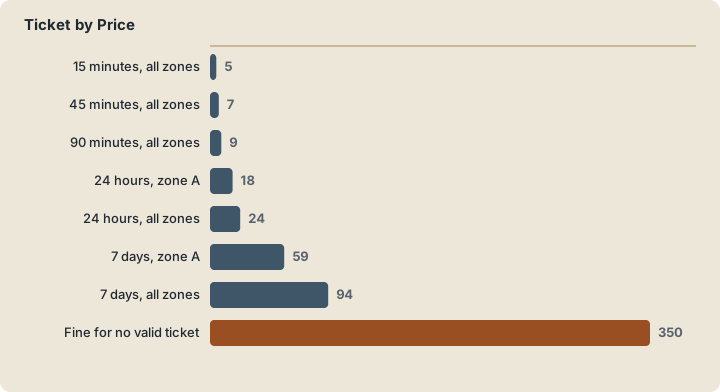
ZTM timed tickets cover all zones and allow transfers: 5 zl buys up to 15 minutes, 7 zl up to 45 minutes and 9 zl up to 90 minutes, while a 24-hour ticket costs 18 zl for zone A and 24 zl for all zones. Contactless bank-card payment on trams and buses is not available yet; the PEKA modernisation that will allow it is expected to show effects in 2028. Buy tickets in an app, from a machine or with a PEKA card.
The ticket system is simpler than it looks from abroad. Timed single tickets are valid in every zone, A through D, and transfers are allowed within the ticket's time, which makes them a better deal than they first appear: a 90-minute ticket can cover a tram ride, a museum visit and the ride back. The 24-hour options suit a festival day of hopping between the Old Market Square, the castle and the cathedral island. A weekend promotion is worth knowing: a 24-hour ticket validated between 20:00 Friday and 24:00 Saturday stays valid until 24:00 Sunday.
| Ticket | Price | Reduced | Notes |
|---|---|---|---|
| 15 minutes, all zones | 5 zl | 2.50 zl | Transfers allowed, real travel time counts |
| 45 minutes, all zones | 7 zl | 3.50 zl | Transfers allowed |
| 90 minutes, all zones | 9 zl | 4.50 zl | Transfers allowed, tickets cannot be combined |
| 24 hours, zone A | 18 zl | 9 zl | Weekend promotion extends to Sunday |
| 24 hours, all zones | 24 zl | 12 zl | Covers the whole network |
| 7 days, zone A | 59 zl | 29.50 zl | For longer stays |
| 7 days, all zones | 94 zl | 47 zl | For longer stays |
| Fine for no valid ticket | 350 zl | 175 zl if paid within 7 days | Up to 5 minutes over: 175 / 87.50 zl |
Two warnings from the operator's own pages. First, there is no city bike system: the Poznan city bike ran from 2012 to 2022 and has not returned, with only a council discussion about reviving it. Second, tapping a bank card on a tram does not work yet, despite what older travel copy may say; the PEKA modernisation contract that will enable contactless payment was signed with effects expected in 2028. Until then, the app, ticket machines, the PEKA card or a bearer card, sold at 27 zl including a 12 zl refundable deposit and 15 zl of travel credit, are the options. The site's transport guide covers all of this in depth: Poznan public transport.

What Should You Know Before You Go?
Poznan keeps its own currency, the zloty: Poland is in the EU but not in the euro area, so card bills and cash machines work in PLN. The EU Entry/Exit System is fully operational at all external Schengen borders since 10 April 2026, so visa-exempt visitors may have fingerprints and a photo registered at the border. Two well-known sights are closed right now: the Palm House for rebuilding and the Town Hall museum interior for renovation, with no reopening date published.
The currency point catches out first-time visitors every year. Prices in Poznan are quoted in zloty, abbreviated zl, and the euro has no legal role in Polish shops. Exchange rates move daily, so this guide prints none; a card that charges in the local currency is the practical answer. The entry rules have also changed recently: EES, the Entry/Exit System, has been fully operational at all external Schengen border crossing points since 10 April 2026, and visa-exempt travellers, including UK and US passport holders, may need to register fingerprints and a photo, with no fee for registration. UK visitors stay visa-free for up to 90 days in any 180-day period, with passport validity rules on top. ETIAS, the separate travel authorisation, has no start date this guide can verify: check the EU's official ETIAS site before you travel.
One border detail matters for anyone arriving by train from Berlin. Poland has notified temporary internal border controls at its land borders with Germany and Lithuania, running from 2 October 2026 to 30 March 2027, so carry a passport or national ID on that route. Direct trains from Berlin take about four and a half to five and a half hours, and the intercity planner is the place to check the day's times, since this guide quotes only ranges. The rail route has its own page: Berlin to Poznan by train.
For history-minded visitors, the city's wartime story runs deeper than one street festival, and a guided WWII heritage tour by army car is one way into it: the operator's live listing shows what is currently bookable, and Check availability. The Enigma Cipher Centre, on Swiety Marcin itself, names the three codebreakers on its timeline, Marian Rejewski, Jerzy Rozycki and Henryk Zygalski, and its exhibition runs with audio guides in Polish, English, German, Russian and Ukrainian.
Which Day Trips Work Around 11 November?
Four classic day trips fit a November stay. Kornik Castle is open Tuesday to Sunday, 10:00-15:15 with last entry at 14:30 in the low season, and the 2026 season closes on 14 December; Rogalin Palace Museum is closed Mondays and open Tue-Sun 9:00-16:00; the Museum of the Origins of the Polish State in Gniezno is open daily 9:00-16:00 October to April, with free admission on Sundays; Biskupin is open 9:00-16:00 November to March.
The name day is one day, but a stay can easily stretch beyond it, and the region around Poznan carries some of the oldest history in Poland. November hours are shorter than summer's, so the table below matters more than it does in July. Kornik deserves a double look: the castle closes its 2026 tourist season on 14 December, and the arboretum next door stays open daily 10:00-16:00 from November to March with adult tickets at 10 zl and reduced at 7 zl.
| Day trip | Open days and hours (autumn/winter) | Tickets | Notes |
|---|---|---|---|
| Kornik Castle | Tue-Sun 10:00-15:15, last entry 14:30 (low season) | 40 zl normal, 20 zl reduced | 2026 season closes 14 December; closed 1 November, open 11 November 10:00-15:00 |
| Kornik Arboretum | Daily 10:00-16:00 (Nov-Mar) | 10 zl adult, 7 zl reduced, family 25 zl | About 3,000 species and varieties |
| Rogalin Palace Museum | Tue-Sun 9:00-16:00, Monday closed | 20 zl normal, 13 zl reduced, Tuesday free | Park Nov-Feb 9:00-16:30; closed 1 November |
| Gniezno, Museum of the Origins of the Polish State | Daily 9:00-16:00 (Oct-Apr) | Sunday free admission | Ticket prices not published on the museum page |
| Biskupin Archaeological Museum | 9:00-16:00 (Nov-Mar) | 28 zl normal, 19 zl reduced, family 2+2 75 zl | Closed 1 January, Easter Sunday, 1 November, 25 December |
Note the 1 November closures in that table: several of these museums close on All Saints' Day, which falls ten days before the name day, so a late-October arrival needs to plan around that date too. On 11 November itself, Kornik Castle opens 10:00-15:00, a shorter day than standard. Each destination has a full page on this site: Kornik Castle, Rogalin Palace, Gniezno and Biskupin.
Torun, the Gothic brick city a couple of hours away, is another candidate, and a guided sightseeing day tour from Poznan runs there with a local lead; the operator's live listing carries current times and availability, and Check availability. For a wider loop through the region, the site's long itinerary weaves several of these stops together: seven days in Poland via Poznan.
Between the name day and the day trips, a realistic budget for the whole stay is easier to frame, and the site's money guide does the arithmetic: how much money you need per day in Poland.

What Else Is On Around 11 November?
Betlejem Poznanskie, Poznan's Christmas market, opens for the 2026/27 season while the name-day crowds are still in the city: the MTP grounds run 14 November to 20 December 2026, Plac Wolnosci from 20 November 2026 to 6 January 2027, and the Old Market Square from 21 November 2026 to 6 January 2027. Visitors who stay a few days longer can also reach Kornik, Rogalin, Gniezno and Biskupin, each a workable day trip.
The calendar stacks up nicely in mid-November. The name day lands on the 11th, the Christmas market's first site opens at the MTP grounds on the 14th, and by the 21st the Old Market Square itself is in market mode. Anyone in Poznan for a week around 11 November gets the street festival, the croissant season and the opening of the Christmas market in one stay, which is a fair argument for choosing these dates over a summer visit.
| Betlejem Poznanskie 2026/27 site | Opens | Ends |
|---|---|---|
| MTP grounds | 14 November 2026 | 20 December 2026 |
| Plac Wolnosci | 20 November 2026 | 6 January 2027 |
| Stary Rynek (Old Market Square) | 21 November 2026 | 6 January 2027 |
Beyond the markets, the indoor calendar fills the short afternoons. The Royal Castle, on Gora Przemysla, is open Tuesday and Wednesday 10:00-16:00, Thursday 10:00-18:00, Friday 10:00-20:00 and weekends 10:00-17:00, closed Mondays, with tickets at 20 zl normal and 13 zl reduced and free admission on Tuesdays. Its temporary exhibitions run at 7 and 5 zl, and two current shows, a medals and plaquettes exhibition to 10 January 2027 and a display of ukiyo-e woodblock prints to 15 November 2026, give the castle a fresh reason to visit. The Enigma Cipher Centre charges 35 zl normal and 29 zl reduced, with a family ticket at 75 zl. The museums below share the Tuesday-free rule at the National Museum's and Independence Museum's branches, which makes Tuesday the bargain hunter's day.
| Museum | Hours (autumn/winter) | Normal / reduced | Free day |
|---|---|---|---|
| Imperial Castle visiting | Daily 12:00-19:00, tickets until 18:00 | 10 / 7 zl with map, 20 / 15 zl with audio guide | None listed |
| Enigma Cipher Centre | Tue-Fri 9:00-18:00, Sat-Sun 10:00-19:00, Mon closed | 35 / 29 zl | None listed |
| Royal Castle (Museum of Applied Arts) | Tue-Wed 10:00-16:00, Thu 10:00-18:00, Fri 10:00-20:00, Sat-Sun 10:00-17:00 | 20 / 13 zl | Tuesday |
| Museum of Armaments, Citadel | Nov-Feb Tue-Sun 10:00-16:00, Mon closed | 15 / 10 zl | Tuesday |
| Museum of Musical Instruments, Stary Rynek 45 | Tue-Wed 10:00-16:00, Thu 10:00-18:00, Fri 10:00-20:00, Sat-Sun 10:00-17:00 | 15 / 10 zl | Tuesday |
| Greater Poland Military Museum, Stary Rynek 9 | Nov-Feb Tue-Sun 10:00-16:00, Mon closed | 15 / 10 zl | Tuesday |
The evening side of the city is not forgotten either: the guide to Poznan nightlife maps the bars of the Old Town and Jezyce, and the Michelin Guide's 2026 Poland edition lists 25 restaurants from Poznan and its surroundings, with Muga holding one star and Bib Gourmands for Fromazeria, POSTO, SPOT., TU. REStAURANT and Farmer & Sons in Skorzewo. A food-focused plan for the whole stay starts with the site's restaurant guide: the best restaurants in Poznan.

Common Questions About St Martin's Day In Poznan
What happens on November 11 in Poland?
The 2025 edition ran as an all-day Miasteczko Imieninowe street village rather than a parade, and the current year's programme should be checked on CK Zamek's pages. Bakeries across the city sell the St Martin's croissant, a Protected Geographical Indication since 2008.
Is there a parade on St Martin's Day in Poznan?
The 2025 edition had no parade: it was replaced by an all-day Miasteczko Imieninowe on police safety recommendations. The 2026 programme was not yet published on the CK Zamek page, so no parade can be promised for any given year. Treat the street festival itself as the headline event.
What is a rogal swietomarcinski?
It is the St Martin's croissant, the pastry Poznan bakers sell around 11 November. It is registered in the EU as a Protected Geographical Indication under Commission Regulation (EC) No 1070/2008 of 30 October 2008, and the Polish agricultural ministry calls it the sweetest symbol of Poznan.
Where can you see a show about the croissant?
The Croissant Museum at Stary Rynek 41/2, entered from Klasztorna Street 23, runs Polish shows at 11:00, 12:30, 14:00 and 15:30, plus 17:00 on Saturdays. The English Croissant and goat show runs at 14:00, about 65 minutes, daily in July and August and on weekends all year, with other days per the booking calendar. Tasting is included, and the museum asks visitors to arrive 10 minutes early.
What is the weather like in Poznan in November?
WMO's 1991-2020 normals for the Poznan station show a November mean of 4.4 C, an average daily high of 7.1 C, an average low of 1.8 C, 33.6 mm of precipitation over 7.3 days with 1 mm or more, and 9.2 frost days. Pack a warm coat, layers and waterproof shoes, and keep indoor backups for the evenings.
Do trams in Poznan take contactless bank cards?
Not yet. ZTM's PEKA modernisation contract, which will allow contactless bank-card and phone payment, was signed with effects expected in 2028. Today the options are timed tickets, the app, ticket machines or a PEKA card: 5 zl for 15 minutes, 7 zl for 45 minutes, 9 zl for 90 minutes, or 18 zl for a 24-hour zone A ticket.

St Martin's Day in Poznan rewards visitors who arrive with the right expectations: a street in party mode, a legally protected pastry, a national holiday layered on top, and a city that keeps its museum doors open around all of it. Plan around the published hours, keep the parade out of the itinerary until the CK Zamek programme confirms one, and let the croissant carry the day.