Poznan Milk Bars
The milk bar, or bar mleczny, is Poland's working canteen: a self-service eatery where the menu hangs on the wall, the portions are generous, and the bill rarely stings. Poznan, the capital of the Wielkopolskie voivodeship in western Poland, keeps the tradition alive alongside a food scene that now reaches the Michelin Guide.

Short answer
A milk bar in Poznan is a self-service canteen serving hearty Polish dishes at low prices. You read the menu board, order and pay at the till, collect your food when your number is called, and return your tray. Expect dumplings, soups, potato pancakes and compote rather than table service.
Poznan, the capital of the Wielkopolskie voivodeship (Greater Poland) in western Poland, on the Warta river, is a city of 534,239 residents that eats well and charges modestly for it. The clearest expression of that habit is the milk bar, the bar mleczny, a self-service canteen that has fed students, workers and pensioners since the middle of the last century. This guide explains what a milk bar actually is, how the ordering ritual works, what belongs on your tray, and how to fold one into a day of museums, markets and walks around the city. Nothing here is written from a personal visit: every figure comes from an official source, and where a number is not verified, this page stays silent rather than guessing.
What Is A Milk Bar In Poznan?
A milk bar, in Polish a bar mleczny, is a self-service canteen serving traditional Polish dishes at low prices, with no table service and no tipping expectation. The format dates from the state canteens of the communist era, when subsidised meals fed workers and students, and it survives today as a cheap, fast, unpretentious place to eat. Poznan, in western Poland, keeps several of them running across the city centre and beyond.
The name is literal. The original menus leaned on milk-based dishes: cheese dumplings, semolina, milk soup, egg cutlets, pancakes with sweet cheese. The concept was born in the 19th century as dairy lunch rooms for workers, then spread on a huge scale after the Second World War as state-subsidised canteens. When the subsidies faded, many closed, but a hard core survived on the strength of one proposition: a hot, filling plate of food for the price of a coffee elsewhere.
What has not changed is the mechanics. There is no waiter. The menu hangs on a wall or stands on a counter, in Polish, with prices in zloty. You order at the till, pay, receive a receipt, and wait until your number or dish is called. You carry the plate to a formica table, eat, then return the tray. Lunchtime fills with office workers and students; the pace is quick and the atmosphere entirely functional.
A milk bar is not a restaurant and should not be reviewed like one. It is closer to a time capsule with a kitchen attached, and that is precisely what makes it worth a visitor's lunch hour. The Poznan Travel Guide food coverage treats the city's dining in full elsewhere; this page concentrates on the canteen counter.

Why Do Milk Bars Still Matter In Poznan?
Milk bars matter because they are the cheapest hot meal in a city that already eats cheaply by Western standards, and because they preserve a piece of everyday Polish life that no museum recreates as vividly. They sit inside the same story as the post-war decades, the shortage economy and the food that carried families through it. Eating in one is a small act of historical tourism with a spoon.
The dishes tell the story. Pierogi, potato pancakes, dumplings, barley soup, breaded cutlet, buckwheat groats with cottage cheese and kefir: this is peasant and canteen cooking, built from flour, potato, cabbage, egg and milk because those were the dependable ingredients. Nothing on the standard board needs importing. Nothing needs explaining to a Polish grandmother.
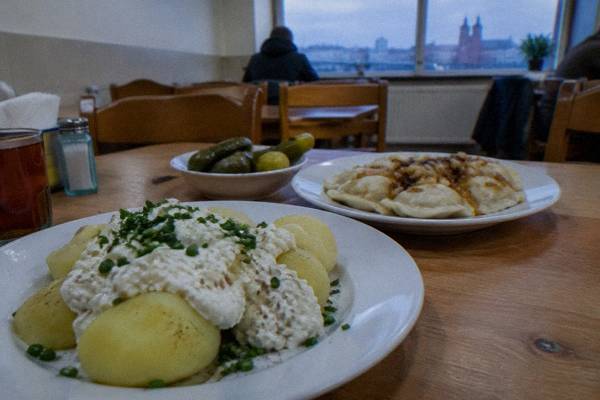
Poznan adds its own items to that national repertoire. The city's signature plate is pyry z gzikiem, boiled potatoes with a cold cottage cheese and scallion mix, a dish so local it has its own entry on this site. The St Martin's croissant, rog swietomarcinski in local spelling, is the sweet bookend: a crescent pastry with a white poppyseed filling, protected across the EU as a Protected Geographical Indication under Commission Regulation (EC) No 1070/2008 of 30 October 2008. It is a festival pastry rather than a milk bar staple, but it belongs to the same tradition of honest, filling food.
For a visitor, the practical value is simple. A milk bar lunch costs a fraction of a sit-down restaurant, the portions are large, and the kitchen turns food over fast because the clientele would walk out if it did not. For the flavour of the era behind these canteens, the interactive PRL museum in Poznan reconstructs everyday life in communist Poland, and its entry ticket can be booked online.
What Should You Order At A Poznan Milk Bar?
Order the staples the format was built on: pierogi filled with cheese, potato or meat; a soup such as barley or tomato; potato pancakes with sour cream; a breaded cutlet with potatoes and cabbage; and a glass of kompot, the sweet stewed-fruit drink, on the side. Sweet cheese pancakes or noodles with poppyseed make the standard dessert. Portions are large, so two dishes are usually enough.
The board is the menu and it changes daily. Soup is near-certain, because a milk bar without soup is barely a milk bar. The dumpling selection depends on the kitchen's mood: ruskie, filled with potato and cheese, are the safest order for a first-timer, and meat-filled ones satisfy anyone wanting something heavier. Potato pancakes, placki ziemniaczane, arrive fried and hot with cream or goulash on top.
Do not expect translations or dietary menus in every location. Some boards are Polish only, with prices in zloty. Pointing works. So does knowing a handful of words: pierogi, zupa means soup, ziemniaki means potatoes, schabowy is the pork cutlet, kompot is the fruit drink. The person behind the till has seen every level of tourist Polish.
A few practical notes worth keeping. First, milk bars are not fast food in the corporate sense: dishes are cooked on the spot, so a plate of pierogi can take ten minutes after ordering. Second, the sweet options, noodles with sweet cheese, semolina with jam, pancakes, are genuinely part of the tradition, not an afterthought. Third, the Poznan plate of pyry z gzikiem may appear on some boards, and if it does, order it: it is the city's own contribution to cheap eating, and this site covers it in detail in its own guide.
| Dish | What It Is | How To Read The Board |
|---|---|---|
| Pierogi ruskie | Dumplings filled with potato and cottage cheese | The default dumpling order for most regulars |
| Pierogi z miesem | Dumplings filled with meat | Heavier, usually a few zl more than ruskie |
| Zupa | Soup of the day, often barley or tomato | Listed first, cheapest hot item |
| Placki ziemniaczane | Fried potato pancakes, served with cream or goulash | Sometimes a separate line for the goulash version |
| Kotlet schabowy | Breaded pork cutlet with potatoes and cabbage | The full dinner plate, the largest portion |
| Pyry z gzikiem | Boiled potatoes with cold cottage cheese and scallion | Poznan's own dish, appears on local boards |
| Kompot | Sweet stewed-fruit drink | Sold by the glass, the standard companion |

The PRL museum ticket above pairs naturally with this food: it is one thing to read about ration cards and queue culture, another to eat the cuisine that came out of it. If the evening opens up after a day of canteen eating, Poznan also runs a guided pub crawl with bar and nightclub entry, free shots and games, bookable in advance.
How Does Ordering And Paying Work At A Poznan Milk Bar?
The ritual is fixed: read the menu board, order and pay at the till, take the receipt, wait for your number or dish to be called, carry the plate to a table, and return the tray when finished. There is no table service, no bill at the end, and no tipping expectation. Payment is in Polish zloty, cash or card depending on the location.
Start with the board. It is usually on the wall above or beside the till, in Polish, with each dish and its price in zloty listed. Decide before you reach the counter, because the queue behind you is on a lunch break. Order, pay, and keep the receipt: some places stamp or check it when you collect the food.
Collection differs by kitchen. Some hand you the plate immediately if it is ready, others call a number. Soups and drinks come fastest; anything fried waits. Cutlery and napkins sit in a dispenser near the counter or the tray stack. Water is sometimes free from a jug, sometimes a line item; kompot is the standard pour.
When you finish, the rule that surprises visitors is the tray. You return it. There is a rack or a hatch for dirty dishes, and leaving a tray on the table marks you as a tourist faster than any accent. The whole cycle, from door to street, can run well under half an hour at off-peak times.
| Step | What You Do | What To Watch For |
|---|---|---|
| 1. Read the board | Choose dishes and note prices in zloty | Boards are often Polish only |
| 2. Order at the till | Say or point to your dishes, pay, keep the receipt | Decide before the counter; queues move fast |
| 3. Collect | Wait for a number or dish name to be called | Soups arrive first, fried dishes later |
| 4. Eat | Carry the plate to any free table | Cutlery from the dispenser, not the table |
| 5. Clear up | Return the tray and dishes to the rack | The step locals notice most |
Poland's currency is the zloty (PLN), not the euro, even though the country is in the EU and the Schengen area. Rates move daily, so no fixed conversion belongs in evergreen copy. If a card terminal is absent, cash solves it, and a milk bar is exactly the kind of low-ticket purchase where coins matter.
Where Can You Find Milk Bars Around Poznan?
Milk bars cluster where workers and students cluster: around the Old Market Square's edge streets, near the university buildings, by the main railway station's approaches, and inside the residential districts of Jezyce, Lazarz and Wilda. None of the major chains occupy the Old Market Square itself, which belongs to restaurants aimed at visitors. Walk one or two streets out and prices drop.
The geography is easy to read. The Stary Rynek, the Old Market Square, is the tourist core, and its ring of tenements holds the pricier tables. Step off it towards Sw. Marcin street or the streets behind the Fara church and the character changes within a block. The Imperial Castle on Sw. Marcin, open daily from 12:00 to 19:00 with tickets sold until 18:00, sits in exactly this transitional zone: the castle's own page lists entry at 10 zl, or 7 zl reduced, with a map included.
Jezyce, north-west of the centre, is the district to combine with a canteen lunch. Its market hall, Rynek Jezycki, trades Monday to Saturday from 6:00 to 20:00, and only some florists open on Sunday, so time a weekend visit accordingly. The market operator's own page is the source for those hours. Around the hall, Jezyce's streets carry the kind of small eateries that survive on regulars rather than footfall from the Old Town.
Srodka, just across from Ostrow Tumski, is another pairing. The district's famous mural, "Opowiesc srodecka z trebaczem na dachu i kotem w tle" on the tenement at ul. Srodka 3, dates from 2015: the city marked its tenth anniversary in October 2025. Srodka today leans more towards destination restaurants than canteens, but its position between the cathedral island and the centre makes it a natural stop on a walking loop that ends at a milk bar.

For transport between districts, the city's trams and buses run on a timed-ticket system that covers all zones with transfers allowed, which makes a multi-stop food walk cheap to build. The details of tickets, prices and the PEKA card sit in this site's Poznan public transport guide, and the verified fares appear in the budget section below.
How Do Milk Bars Fit Into A Budget Day In Poznan?
A milk bar anchors the cheap day: a hot lunch for the price of a museum's reduced ticket, reached on a 7 zl forty-five-minute tram ticket that covers every zone with transfers. Add Poznan's free museum Tuesdays, the free Old Zoo and the free walking areas, and a full day out can run on very little. The Poznan City Card, 65 zl for 24 hours with transport, only pays off around the paid museums.
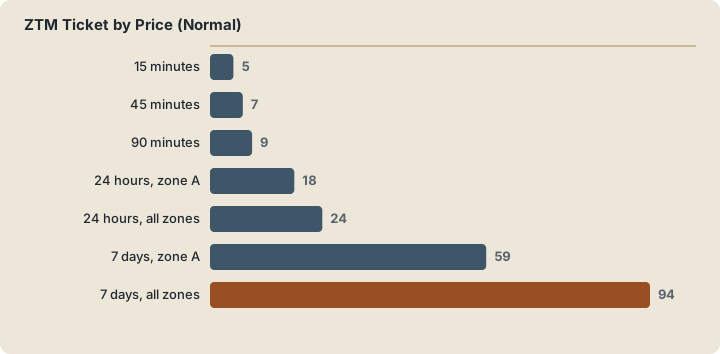
Start with the transport numbers, verified on the ZTM price list. Timed single tickets, valid in all zones with transfers: 5 zl for up to 15 minutes, 7 zl for up to 45 minutes, 9 zl for up to 90 minutes. A 24-hour ticket for zone A is 18 zl, all zones 24 zl. The fine for travelling without a valid ticket is 350 zl, or 175 zl if paid within 7 days, which concentrates the mind wonderfully on validating before boarding.
| ZTM Ticket | Price (Normal) | Validity |
|---|---|---|
| 15 minutes | 5 zl | All zones, transfers allowed |
| 45 minutes | 7 zl | All zones, transfers allowed |
| 90 minutes | 9 zl | All zones, transfers allowed |
| 24 hours, zone A | 18 zl | Zone A only |
| 24 hours, all zones | 24 zl | Zones A to D |
| 7 days, zone A | 59 zl | Zone A only |
| 7 days, all zones | 94 zl | Zones A to D |
Then the free and cheap entries, all verified on the venues' own pages. The National Museum's branches, including the Royal Castle and the Museum of Musical Instruments, are free on Tuesdays. The Independence Museum network's branches, among them the Museum of Armaments in Citadel Park, are free on Tuesdays too. The Gniezno Origins museum is the Sunday exception, free that day. The Old Zoo on ul. Zwierzyniecka is free every day, year round.
| Venue | Free Or Cheap Entry | Day |
|---|---|---|
| National Museum branches (Royal Castle, Musical Instruments) | Free admission | Tuesdays |
| Independence Museum branches (Museum of Armaments, Citadel Park) | Free admission | Tuesdays |
| Museum of the Origins of the Polish State, Gniezno | Free admission | Sundays |
| Old Zoo, ul. Zwierzyniecka 19 | Free entry, open daily | Every day |
| Fara church | Free entry, open daily 6:00-19:30, no visits during Mass | Every day |
| Poznan City Card, 24 h with transport | 65 zl | Paid pass, free entry to most museums |
The Poznan City Card deserves one honest caveat, because the "free entry everywhere" claim travels further than the facts. The card's own page promises free admission to most museums, but partners such as the Enigma Cipher Centre (21 zl with the card, against a 35 zl normal ticket) and Porta Posnania (21 zl with the card, against 35 zl) are discounted, not free. Each attraction can be used once. Whether the card beats single tickets depends on your museum appetite, not on marketing arithmetic. The full breakdown sits in this site's Poznan City Card guide.
A budget day can therefore run: morning at a free-Tuesday museum or the Citadel Park, a milk bar lunch within walking distance of it, an afternoon at the free Old Zoo or, in season, the New Zoo (45 zl weekdays from March to October, 20 zl for everyone from November to February), and an evening walk back through the Old Market Square. Rain changes the plan rather than the budget, and this site's rainy-day guide to Poznan lists the indoor options in full. For a deeper cut at the same theme, the Poznan on a budget guide and the free things to do in Poznan page carry the arithmetic further.

How Do Milk Bars Compare With Poznan's Other Budget Food?
Milk bars are the cheapest hot meal, but Poznan's budget ladder has more rungs: the market halls, the kebab and zapiekanka counters, the milk-bar-style cafeteria chains, and the Bib Gourmand restaurants that deliver restaurant cooking at controlled prices. The Michelin Guide Poland 2026 lists 25 restaurants from Poznan and surroundings, and several of them sit closer to the affordable end than visitors assume.
The comparison is worth making honestly. A milk bar wins on price and speed, and it loses on comfort, English and atmosphere. The middle rungs fill the gap. Market halls such as Jezyce's sell bread, cheese, cold cuts and fruit at retail prices, which turns a bench into a picnic. Street counters sell zapiekanka, the halved baguette with mushrooms and cheese, a late-night institution across Poland.
The top rung is closer than the price of a London starter. The Michelin Guide's 2026 Poznan selection gives Bib Gourmand awards, its marker of good food at moderate prices, to Fromazeria, POSTO, SPOT., TU. REStAURANT and to the Skorzewo newcomer Farmer & Sons, while Muga holds the city's one Michelin star. No menu price belongs on this page, because none is verified here, but the existence of a starred kitchen and five Bib awards tells you the raw material in this region is strong.
| Budget Option | What You Get | Where It Sits |
|---|---|---|
| Milk bar | Hot cooked Polish dishes, self-service, cheapest hot plate | City centre edges and residential districts |
| Market hall (e.g. Rynek Jezycki) | Bread, cheese, cold cuts, fruit at retail prices | Jezyce, Monday to Saturday 6:00-20:00 |
| Street counter | Zapiekanka and kebabs, late-evening standard | Around the Old Town and nightlife streets |
| Bib Gourmand restaurants | Restaurant cooking at moderate prices | Fromazeria, POSTO, SPOT., TU. REStAURANT, Farmer & Sons (Skorzewo) |
| Fine dining | Muga, one Michelin star in the 2026 guide | The top of the ladder |
The local thread running through all of it is Poznan's own food identity. Pyry z gzikiem belongs to the market and the milk bar; the St Martin's croissant, a Protected Geographical Indication registered by Commission Regulation (EC) No 1070/2008, belongs to November and the name-day celebrations on Sw. Marcin street. This site's Poznan food guide and the St Martin's Day in Poznan page carry those stories further. One warning travels with the season: the 2025 name-day edition had no parade, replaced by an all-day "Miasteczko Imieninowe", so never promise yourself a parade until the programme is published.

When Is The Best Time To Eat At A Poznan Milk Bar?
The best time is the late-morning lull, between the opening rush and the noon office crowd, roughly 10:30 to 11:30, when the kitchen is warm, the queue is short and the daily board is fully written. The worst is the 12:00 to 14:00 lunch peak, when every seat fills and the till queue runs deep. Late afternoon brings student traffic after lectures.
The rhythm is universal to the format, and it is the single most useful planning fact about eating in one. Arrive at the peak and you will queue twice, once to order and once to collect, in a room designed for throughput rather than lingering. Arrive early and you get the first batches, the empty tables and a kitchen with time to answer a pointed question.
The season matters less than the hour, but it still shapes the day around the meal. WMO's 1991-2020 climate normals for the Poznan station give the year a mean daily high of 13.8 C, with July the warmest month at 25.2 C on average and also the wettest at 84.4 mm of precipitation; April is the driest at 28.6 mm. January's mean low sits at -2.9 C with 19.7 frost days. In short: a milk bar is a cold-weather friend, and Poznan supplies the cold weather.
| Month | Mean Daily High | Mean Daily Low | Precipitation | Frost Days |
|---|---|---|---|---|
| January | 2.1 C | -2.9 C | 37.7 mm | 19.7 |
| April | 15.0 C | 4.0 C | 28.6 mm | 4.6 |
| July | 25.2 C | 14.1 C | 84.4 mm | 0.0 |
| October | 13.3 C | 5.4 C | 35.4 mm | 3.8 |
| December | 3.2 C | -1.4 C | 40.1 mm | 17.5 |
The full monthly breakdown, and what it means for packing, sits in this site's Poznan weather by month guide, with the best time to visit Poznan page covering the festivals that fill the calendar. Two seasonal notes belong here. First, the Christmas market, Betlejem Poznanskie, opens on 14 November 2026 and runs to 6 January 2027, with the MTP grounds from 14 November, Plac Wolnosci from 20 November and Stary Rynek from 21 November: a winter visit pairs a canteen lunch with an evening market, and the Poznan Christmas market guide has the details. Second, if a winter day runs long and the evening turns social, the pub crawl with bar and nightclub entry, free shots and games is the bookable option, and the desk's honest advice is to check the live listing rather than any summary.

A longer stay widens the frame. Poznan sits at the centre of a region of small historic towns, and the same self-service logic, cheap food near the main square, travels with you. Torun, the gingerbread city on the Vistula, is one of the standard day trips from Poznan Glowny, and a guided sightseeing tour there can be booked before you travel.
For anyone building the trip around food, the practical pages on this site do the rest of the work: where to stay in Poznan, including budget beds near the centre, and the Poznan airport to city centre guide for arrival day. An overnight bed booked in the hostel category keeps the whole trip on the same budget the milk bar set.
Compare hostel rates in Poznan

Common Questions About Poznan Milk Bars
What is a milk bar in Poznan?
A milk bar, bar mleczny, is a self-service canteen serving traditional Polish dishes at low prices. The menu hangs on the wall in Polish with prices in zloty, you order and pay at the till, collect your food when called, and return the tray yourself. There is no table service and no tipping expectation.
Are milk bars in Poznan cheap?
Yes, they are the cheapest hot cooked meal in the city. No verified price list for individual milk bars is published centrally, so this page prints no figures, but the format exists to keep the bill low: simple ingredients, fast turnover and self-service. The board on the wall carries the day's actual prices in zloty.
What should I order at a milk bar in Poznan?
Start with pierogi ruskie, dumplings filled with potato and cottage cheese, plus a soup of the day. Potato pancakes and the breaded pork cutlet are the heartier choices. In Poznan specifically, look for pyry z gzikiem, boiled potatoes with cold cottage cheese and scallion, the city's signature dish. A glass of kompot, sweet stewed-fruit drink, is the traditional companion.
Do milk bars in Poznan speak English?
Often not much, and the menu board is usually in Polish only. Pointing at the board works, and a few words cover most orders: zupa is soup, pierogi needs no translation, ziemniaki means potatoes. The staff deal with tourists and students daily, so the transaction is quick and forgiving.
Can children eat at a milk bar in Poznan?
Yes. Milk bars are family-friendly by design, with fast service, large portions and simple food children recognise, such as dumplings, pancakes and potato dishes. For a full plan of child-friendly stops around the city, including the free Old Zoo, see this site's Poznan with kids guide.
Where can I find a milk bar near Poznan's Old Market Square?
Milk bars sit on the streets just off the Old Market Square rather than on it, since the square itself holds visitor-facing restaurants. Walk one or two blocks towards Sw. Marcin street, the university quarter or the main station approaches, and the boards with zloty prices appear. The Jezyce district, with its market hall trading Monday to Saturday 6:00-20:00, is another reliable hunting ground.
The milk bar is the most honest meal in Poznan: a plate, a price on the wall, and a tradition that outlived the system that created it.