What To Eat In Poznan
Poznan, the capital of the Wielkopolskie voivodeship in western Poland, on the Warta river, eats differently from the rest of the country: croissants with a protected name, potato dishes older than the tourist maps and a restaurant scene that the Michelin Guide now takes seriously.

Short answer
Poznan is known for the St Martin's croissant (rogal swietomarcinski), a Protected Geographical Indication crescent roll filled with white poppy seed, and pyry z gzikiem, potatoes with cottage cheese. The Croissant Museum, the Srodka and Jezyce districts and a growing Michelin-listed restaurant scene round out the food picture.
Poznan, the capital of the Wielkopolskie voivodeship (Greater Poland) in western Poland, on the Warta river, has a food identity that is genuinely its own. The city of 534,239 residents is the home of a croissant with legal protection across the European Union, a potato-and-cottage-cheese plate that locals treat as a regional flag, and a restaurant scene that the Michelin Guide Poland 2026 now covers with 25 listings from the city and its surroundings. This guide is written from what the venues, the city portal and the official listings state, not from a single visitor's table, and it sticks to figures that those sources actually publish.
The plan of this page: first the dishes Poznan is actually known for, then the St Martin's croissant in detail, then the Croissant Museum where you can watch it being made, then the restaurant scene, the neighbourhoods to eat in, the seasonal calendar and the practical questions. If you want the short version, the quick answer above is it.
What Food Is Poznan Known For?
Poznan is known for two dishes above all: the St Martin's croissant (rogal swietomarcinski), a crescent-shaped yeast roll filled with a white poppy seed paste, and pyry z gzikiem, boiled potatoes served with a seasoned cottage cheese called gzik and often fried onion. The croissant is a Protected Geographical Indication under EU law, which means only bakers in the Poznan area following the registered recipe may use the name, and the potato plate is the everyday dish locals claim as their own.
Everything else on a Poznan menu orbits those two. The croissant appears in bakery windows across the city and has its own museum on the Old Market Square, which tells you how seriously the city takes it. Pyry z gzikiem is the homely counterweight: cheap, filling and tied to the agricultural plain that surrounds the city. Around them sit the broader Polish classics, pierogi, bigos, soups such as zur, and the local lager, Lech, which is brewed in the city and is covered in its own right elsewhere on Poznan Travel Guide.
A word on what this page will not do. It will not invent prices for dishes, because no official source in this guide's research carries them, and it will not rank Poznan as any kind of food capital, because no source says so either. What it will do is tell you what the protected, dated and published facts are, and where to check the rest yourself. The best restaurants in Poznan guide carries the dining side in more depth.

Why The St Martin's Croissant Is Poznan's Signature Dish
The rogal swietomarcinski is a crescent roll made from a yeasty, enriched dough rolled with a filling of ground white poppy seed, raisins, nuts and crumbs, and it is registered in the EU register as a Protected Geographical Indication (PGI) by Commission Regulation (EC) No 1070/2008 of 30 October 2008. That registration means the name is legally tied to Poznan and its surroundings: a baker outside the registered area following the same recipe still cannot call the result a rogal swietomarcinski.
The protected status is the single most useful fact for a visitor, and it is also the most commonly misstated one. Some guides call it a PDO, which it is not, and some give a protection date that does not match the regulation. The Polish agriculture ministry's own page on the croissant describes it as the sweetest symbol of Poznan, and the regulation date of 30 October 2008 is the one to rely on. In practice, the protection shows up on the street: the rolls are sold under that name in the city's bakeries around St Martin's Day on 11 November, when St Martin Street (Swiety Marcin) celebrates its name day.
| Fact | Detail | Status |
|---|---|---|
| Dish | Rogal swietomarcinski (St Martin's croissant) | Signature sweet of Poznan |
| Legal protection | Protected Geographical Indication (PGI), Polish ChOG | Registered |
| Registration | Commission Regulation (EC) No 1070/2008 | 30 October 2008 |
| Filling | Ground white poppy seed with raisins, nuts and crumbs | Per the registered recipe |
| Home area | Poznan and surroundings | Per the registration |
| Festival date | 11 November, St Martin Street name day | Annual, organised by CK Zamek |
The name day itself deserves care. What you should not expect is a parade: the 2025 edition had no parade, it was replaced by an all-day "Miasteczko Imieninowe" on police safety recommendations, and the 2026 programme had not been published when this page was researched. The street celebrates its name day, croissants are everywhere, and the CK Zamek programme is the place to check what form the day takes. The St Martin's Day in Poznan guide covers the whole festival.
The croissant is also the reason one of the city's odder museums exists, and that museum is the most reliable place in Poznan to taste the dish with some context.
Where To Watch Croissants Being Made: The Croissant Museum
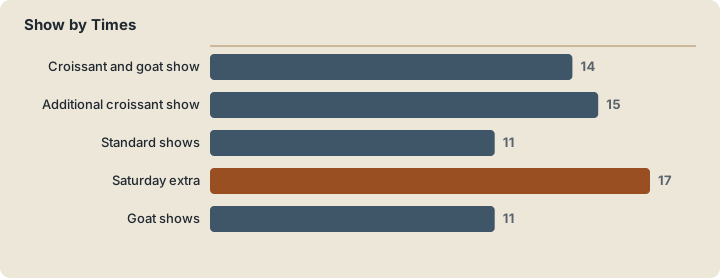
The Croissant Museum (Rogalowe Muzeum Poznania) sits at Stary Rynek 41/2, with the entrance from Klasztorna Street 23, and its centrepiece is a show in which the croissant is made in front of you, with a tasting included in the ticket. The English-language "Croissant and goat show" runs at 14:00, lasts about 65 minutes, and is held daily in July and August, on Saturdays and Sundays all year, and on other days as the booking calendar shows.
The show schedule is worth setting out plainly, because the museum's own page is the only reliable source for it and secondhand guides routinely get it wrong. Polish shows run at 11:00, 12:30, 14:00 and 15:30, plus 17:00 on Saturdays. The English show at 14:00 is the regular one, and a second English show at 15:30, about 60 minutes, opens only when the 14:00 show is fully booked. The "goat shows", which start at 11:00 or 14:00, end with a view of the Town Hall goats from the museum windows, which ties the croissant story back to the square outside. Visitors should arrive 10 minutes before the start. Ticket prices are not published outside the booking widget, so this page prints none.
| Show | Language | Times | Notes |
|---|---|---|---|
| Croissant and goat show | English | 14:00 | About 65 minutes |
| Additional croissant show | English | 15:30 | About 60 minutes, only when 14:00 is full |
| Standard shows | Polish | 11:00, 12:30, 14:00, 15:30 | Daily schedule |
| Saturday extra | Polish | 17:00 | Saturdays only |
| Goat shows | Polish | From 11:00 or 14:00 | End with a view of the Town Hall goats |
Printed opening hours on the museum's site are Sunday to Thursday 11:00-15:30 and Saturday 11:00-17:00. Friday hours are not listed there, so this guide will not state any. July and August are the easiest months for an English-speaking visitor: the 14:00 English show runs daily then, and the rest of the year the weekend slots are the safe bet. If your trip falls outside those windows, the booking calendar on the museum's own page is the authority.

A food-focused visit to Poznan pairs well with a guided table crawl, and the city's featured food tour is built exactly around the traditional dishes this page describes. Check availability on the operator's live listing if a guide-led route through the Old Town kitchens appeals.
To taste the croissant with a guide leading the way, book a private walking tour here.
What Is Pyry Z Gzikiem And Why Does Poznan Claim It?
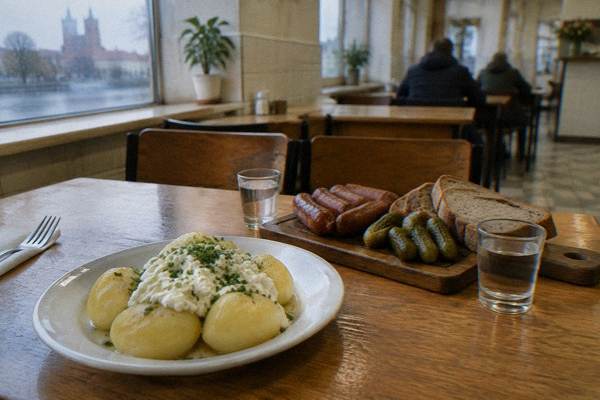
Pyry z gzikiem is the everyday regional plate of the Wielkopolska countryside around Poznan: boiled potatoes (pyry in the local dialect) served with gzik, a fresh cottage cheese mixed with cream, chives, radish or spring onion, and often accompanied by fried onion or a simple meat side. It is the dish locals name first when asked what separates their region's table from the rest of Poland, and it costs a fraction of anything on a tourist menu, though no official source publishes a price for it.
The honest way to describe gzik is as a farmer's plate that survived the city. The cheese is young and crumbly, the seasoning is raw allium and salt, and the potatoes are served in their skins or peeled depending on the kitchen. What matters for a visitor is that it appears on menus across the city under its dialect name, and that ordering it by that name marks you as someone who knows the region. The dish has its own full page in this site's pyry z gzikiem guide, which covers the variations and where to look for them.
| Element | What It Is | Where It Sits On The Plate |
|---|---|---|
| Pyry | Potatoes, in the local dialect | Boiled, the base of the dish |
| Gzik | Fresh cottage cheese with cream and seasoning | Spooned over or alongside |
| Seasoning | Chives, spring onion, radish | Mixed into the gzik |
| Common addition | Fried onion, sometimes a meat side | Optional |
| Region | Wielkopolska (Greater Poland) | The agricultural plain around Poznan |
The wider Polish repertoire sits alongside these two Poznan signatures. Pierogi, the filled dumplings known across the country, bigos, the long-cooked cabbage and meat stew, and zur, a sour rye soup, all appear on Poznan menus, and the what food is a must try in Poland answer page puts the national classics in order. What Poznan adds to that national table is the croissant, the gzik and a lager, Lech, brewed in the city. The brewery's visitor centre is a different question: its tour schedule could not be verified on any official page, so this guide gives no days, no prices and no recommendation for it.

Where Are The Best Restaurants In Poznan?
The Michelin Guide Poland 2026 lists 25 restaurants from Poznan and its surroundings, with Muga holding one Michelin star and Bib Gourmand awards going to Fromazeria, POSTO, SPOT., TU. REStAURANT and the newcomer Farmer & Sons in Skorzewo. That selection, published on the city portal and by the local tourism board, is the only restaurant ranking this page will state, because it is the only one with a named, dated, official source.
The Bib Gourmand is the award that matters most for a food traveller, since it flags good cooking at moderate prices, and Poznan now holds five of them counting the newcomer. Beyond the Michelin list, the honest position is that this desk has not eaten in any of these kitchens and will not pretend otherwise. The best restaurants in Poznan guide carries the full dining landscape, and the Michelin selection below is the verified core of it.
| Venue | Recognition | Notes |
|---|---|---|
| Muga | One Michelin star | The city's starred listing |
| Fromazeria | Bib Gourmand | Poznan |
| POSTO | Bib Gourmand | Poznan |
| SPOT. | Bib Gourmand | Poznan |
| TU. REStAURANT | Bib Gourmand | Poznan |
| Farmer & Sons | Bib Gourmand, newcomer | Skorzewo, outside the city |
The city portal's news item of 28 May 2026, which carried the selection, also named new entries to the guide: Arte, Maremma, Rytm Natury, Strona and Yes Butcher!. Those are listings in the guide rather than awards, but they show the direction of travel: the Poznan restaurant scene is being watched, and it is growing. For a visitor planning dinners, the practical advice is to book the starred and Bib venues ahead, especially around the trade-fair dates when the Poznan International Fair fills the city, and to treat the new entries as the second tier worth trying when the first is full.

Which Poznan Neighbourhoods Should You Eat In?
Srodka, the small district just across the Warta from Ostrow Tumski, is a food quarter worth starting with: a cluster of restaurants and cafes around ul. Srodka, anchored by the large mural "Opowiesc srodecka z trebaczem na dachu i kotem w tle" on the tenement at ul. Srodka 3, which the city marked as 10 years old in October 2025.
Jezyce, west of the centre, is the second stop: its Rynek Jezycki market hall trades Monday to Saturday 6:00-20:00, with only some florists opening on Sunday.
Srodka's appeal is concentration. You cross the river from the cathedral island and the district announces itself with the mural, painted in 2015 according to the city's own anniversary notice, and then delivers a compact set of tables within a few minutes' walk. It is the natural lunch stop on any route that takes in the cathedral and the Ostrow Tumski sights. The Srodka guide on this site covers the district in full.
Jezyce is the locals' version of the same instinct. The market hall at its heart keeps the hours the operator publishes: Monday to Saturday 6:00-20:00, Sunday largely closed apart from some florists. Around it sits a district of tenement streets and a growing set of cafes, covered in the Jezyce guide. The Old Town itself, around the Stary Rynek, holds the tourist-facing tables and the Croissant Museum, and Poznan Old Town maps it.
| District | Food Reason To Go | Verified Anchor |
|---|---|---|
| Srodka | Compact cluster of restaurants and cafes | Mural at ul. Srodka 3, from 2015 |
| Jezyce | Market hall and neighbourhood cafes | Rynek Jezycki, Mon-Sat 6:00-20:00 |
| Old Town | Croissant Museum and square-side tables | Stary Rynek 41/2 |
| Lazarz | Quieter streets, local tables | See the Lazarz guide |
The mural detail is worth a sentence more, because it is the kind of thing that dates a district. The city portal published its anniversary item on 2 October 2025 for the celebration on 4 October, marking ten years since the mural went up, which fixes its origin in 2015. It shows a Srodka trumpeter on a rooftop with a cat in the background, and it has become the district's postcard.
When Is The Best Time Of Year For Food In Poznan?
For a food-centred trip, early winter is the strongest window: St Martin's Day on 11 November puts the protected croissant at the centre of the city's calendar, and the Betlejem Poznanskie Christmas markets then run from 14 November 2026 to 6 January 2027, with the Stary Rynek site open from 21 November 2026 and Plac Wolnosci from 20 November 2026. The croissant season and the market season overlap by design, and the cold is what the food is built for.
The Christmas market dates deserve their own table, because three sites open on three different dates and the official Betlejem Poznanskie page is the only place that carries all of them. The MTP grounds site runs the shortest window, 14 November to 20 December 2026, while the two central sites run into the new year. The Poznan Christmas market guide covers the stalls, and Poznan in winter covers the rest of the season.
| Market Site | Opens | Closes |
|---|---|---|
| MTP grounds | 14 November 2026 | 20 December 2026 |
| Plac Wolnosci | 20 November 2026 | 6 January 2027 |
| Stary Rynek | 21 November 2026 | 6 January 2027 |
December adds the POZnan Ice Festival, whose 20th edition runs 11 to 13 December 2026 with a small sculpture contest, Speed Ice Carving, a main competition and children's workshops, all on the city portal's official page. None of that is food, strictly speaking, but it is the reason the city centre is full and the restaurants are busy on those weekends, so book tables for those dates.
The rest of the year has its own logic. WMO's 1991-2020 climate normals for the Poznan station put July as both the warmest month (a mean daily high of 25.2 C) and the wettest (84.4 mm of precipitation), with April the driest at 28.6 mm, so a summer terrace evening comes with a real chance of a shower, while spring is the drier bet. The Poznan weather by month and best time to visit Poznan guides carry the full picture.

Can You See Poznan's Food Sights On A Guided Tour?
Yes, and the food tour this site features is a private traditional Polish food tour of Poznan, which walks the classic dishes with a local guide; its price, rating and duration render on the operator's live listing, which is where to check them. Beyond it, the same operators run history walks and full-day trips to Gniezno and Biskupin, the archaeological sites east of the city, which pair the food story with the regional one.
The value of a guided food walk in Poznan is specific: the croissant and the gzik both come with stories, and the stories are better told by someone who can also point at the bakery. A private tour also handles the ordering, which is not a small thing when the signature dish of the region goes by a dialect name. The trio of tours below are the ones this site has verified listings for, and each has a full page of its own.
For travellers who would rather not pay up front, the city also has a free walking tour option: "The Best of Poznan (Small group)" by Mateusz, a GuruWalk PRO guide, is a free, tip-based walk covering the city's highlights. It is not a food tour, but it maps the ground the food sits on, and this site's Poznan free walking tour guide explains how the tip model works. You can See This Free Tour On GuruWalk on its own listing page.
How Do You Plan A Full Food Day In Poznan?
A realistic food day starts on the Stary Rynek: the Croissant Museum's 14:00 English show (about 65 minutes, tasting included) anchors the late morning and early afternoon, lunch follows in Srodka across the river, and the evening goes to a Michelin-listed restaurant booked in advance. The museum show needs a 10-minute-early arrival, the Srodka walk takes in the 2015 mural at ul. Srodka 3, and the starred and Bib venues fill up, so the reservation is the one non-negotiable of the day.
The shape of the day matters more than the exact hours, because the sources for this page carry the museum schedule and the restaurant names, not a minute-by-minute plan. What follows is a frame you can slide across any day of your trip.
| Time | Stop | Why |
|---|---|---|
| Morning | Stary Rynek and bakery windows | Croissants in their home square |
| 14:00 | Croissant Museum, English show | About 65 minutes, tasting included |
| Afternoon | Srodka, across the Warta | Lunch and the mural at ul. Srodka 3 |
| Evening | A Michelin-listed restaurant | Muga or a Bib Gourmand venue, booked ahead |
Two cautions keep the day honest. First, the English show at 14:00 is guaranteed daily only in July and August and on weekends the rest of the year: on other days it depends on the museum's booking calendar, so check it the day before. Second, if the 14:00 show is full, the museum opens a 15:30 English show, which pushes the Srodka lunch late; that is fine, but know it before you commit to a dinner reservation.
A rainy day changes the frame rather than the food. The Croissant Museum is indoors, the Poznan rainy day guide lists the city's indoor options, and the museum-heavy alternatives are covered by Poznan museums. Families get a dedicated angle too: the Poznan with kids guide treats the food day and the zoo question together.

What Should Food Travellers Know Before They Go?
Poznan prices are in zloty (PLN), not euro, and Poland is not in the euro area, so every menu and market stall quotes in zl. The city's trams and buses run on timed tickets covering all zones: 15 minutes for 5 zl, 45 for 7 zl, 90 for 9 zl, per the ZTM price list, and the fine for travelling without a valid ticket is 350 zl, or 175 zl if paid within 7 days.
Tap water is safe to drink, per the city utility Aquanet, and 112 is the emergency number.
Those are the practical facts a food trip actually touches. The transport figures come from ZTM's published price list, and they matter because a food day in Poznan crosses the river at least twice: the Stary Rynek to Srodka leg is walkable, but a day that adds Jezyce's market hall will want a tram. The Poznan public transport guide carries the full ticket logic, including the 24-hour and 7-day options and the weekend promotion.
Getting to Poznan for the food is its own question. The city is a rail hub: direct trains from Berlin take about 4 h 30 to 5 h 30 and from Warsaw about 2 h 20 to 3 h 20, though these are reported ranges, so check the PKP Intercity planner for the day. Poland has temporary internal border controls at its land borders with Germany and Lithuania from 2 October 2026 to 30 March 2027, so carry ID on the Berlin train. The Berlin to Poznan train and Warsaw to Poznan train guides carry the routes, and flights to Poznan covers the air side.

Common Questions About Poznan Food
What food is Poznan known for?
Poznan is known for the St Martin's croissant (rogal swietomarcinski), a Protected Geographical Indication crescent roll filled with white poppy seed paste, and for pyry z gzikiem, boiled potatoes with a seasoned cottage cheese called gzik. The croissant has been protected under Commission Regulation (EC) No 1070/2008 since 30 October 2008.
Where can I try a St Martin's croissant in Poznan?
Bakery windows across the city sell the croissant, especially around St Martin's Day on 11 November, and the Croissant Museum at Stary Rynek 41/2 (entrance from Klasztorna Street 23) runs shows in which the croissant is made in front of you, with a tasting included. The English show is at 14:00.
Does Poznan have any Michelin-starred restaurants?
Yes. The Michelin Guide Poland 2026 lists Muga with one Michelin star, plus Bib Gourmand awards for Fromazeria, POSTO, SPOT., TU. REStAURANT and the newcomer Farmer & Sons in Skorzewo, out of 25 restaurants listed from Poznan and surroundings.
What is pyry z gzikiem?
Pyry z gzikiem is the everyday regional dish of Wielkopolska: boiled potatoes (pyry in the local dialect) served with gzik, a fresh cottage cheese mixed with cream and chives, spring onion or radish, sometimes with fried onion or a meat side. It is the homely counterweight to the protected croissant.
When is the best time to visit Poznan for food?
Early winter. St Martin's Day on 11 November centres the city's food calendar on the protected croissant, and the Betlejem Poznanskie Christmas markets then run from 14 November 2026 to 6 January 2027 across three sites, with the Stary Rynek site open from 21 November 2026.
Is Poznan expensive for eating out?
No official source publishes restaurant price levels for Poznan, so this page prints no figure. The practical anchors are that Poland uses the zloty (PLN), that the Michelin Bib Gourmand awards in the 2026 guide flag good cooking at moderate prices, and that pyry z gzikiem is a farmer's plate rather than a tourist menu item. The Poznan on a budget guide covers the wider cost picture.
The short version of Poznan food: eat the croissant where it is protected, eat the potatoes where they are dialect, book the starred table weeks ahead, and time the trip to November if you can. Everything else on the city's table is built around those four moves, and the sources linked throughout this guide, from the museum's own schedule page to the Michelin selection on the city portal, are the places to confirm the details before you go.