Pyry Z Gzikiem: Poznan's Potato Dish
Pyry z gzikiem, boiled potatoes with a cool farmer cheese and chive mixture, is the dish most locals in Poznan, the capital of the Wielkopolskie voivodeship in western Poland, will name first when asked what their region eats. This guide explains what it is, where it came from, how it is served and how to build a food-focused visit around it.

Short answer
Pyry z gzikiem is the signature everyday dish of Poznan and Greater Poland: boiled potatoes (pyry in the local dialect) served with gzik, a fresh mixture of quark-style farmer cheese, cream, radish, spring onion and chives. It is cheap, seasonal and found in milk bars, modern restaurants and homes across the city.
Pyry z gzikiem is the everyday dish most closely tied to Poznan, the capital of the Wielkopolskie voivodeship (Greater Poland), in western Poland, on the Warta river. Ask people from this region what food says home to them and the answer, more often than not, is simple boiled potatoes with a cool, herby farmer cheese mixture spooned over the top. It is not a restaurant showpiece. It is the food of farm kitchens, school canteens, milk bars and, increasingly, modern restaurants in Poznan that put regional cooking back on the menu with pride. This guide covers what the dish is, where the name comes from, how gzik is put together, where in Poznan to look for it, and how the rest of a food-focused visit to the city fits around it.
What Is Pyry Z Gzikiem?
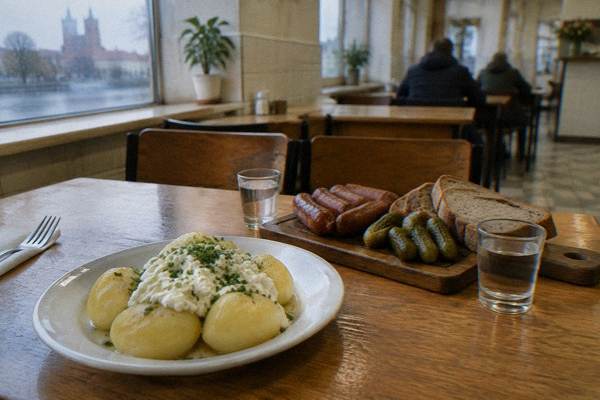
Pyry z gzikiem is the signature home-style dish of Poznan and the wider Wielkopolska region: whole boiled potatoes, called pyry in the local dialect, served hot with gzik, a cold, fresh mixture of farmer cheese (twarog or curd cheese), soured cream or yoghurt, chopped radish, spring onion, chives, salt and pepper, spooned generously over the top or served alongside in a bowl.
The contrast is the whole point. The potatoes arrive steaming, skins on or peeled depending on the household, and the gzik lands on them cold and bright. The cheese softens slightly where it touches the hot potato, the radish gives bite, the chives give colour, and the whole plate costs very little to make. In a region with a strong farming tradition, this was food built from what a smallholding had in abundance: potatoes from the field, cheese and cream from the cow, radish and onion from the garden.

Visitors sometimes confuse gzik with a dip or a salad, but in Poznan it is treated as a proper component of the meal, not a garnish. The dish is eaten as a light lunch, a supper or a side, and it belongs to the same family of humble regional cooking as pyry z okrasa, potatoes with cracklings, which appears on menus across Greater Poland. If you want one sentence of shorthand: pyry z gzikiem is to Poznan what a full breakfast plate is elsewhere, the thing everyone grew up on and no visitor should leave without trying. For readers wondering how it fits into the wider Polish table, our piece on what a typical Polish breakfast is covers the broader morning habits, where cheese and fresh vegetables also star.
Where Does The Name Pyry Z Gzikiem Come From?
The word pyry is the local Greater Polish and Poznan dialect word for potatoes, and gzik is the regional name for the farmer cheese mixture, so the dish's name is literally "potatoes with gzik" in the speech of the region; the vocabulary itself marks the dish as belonging to Wielkopolska rather than to Poland as a whole.
Standard Polish calls potatoes ziemniaki or kartofle, so hearing pyry immediately tells you that you are in the west of the country. Local food writing treats gzik as a word of the region too, tied to the farm dairy tradition of Wielkopolska rather than to any single town. That dialect stamp matters for visitors, because it explains why the dish appears under its dialect name on Poznan menus instead of a translated description: the name is part of the identity of the plate.

The dish sits inside a wider set of Poznan food traditions that the city celebrates loudly every November. St Martin's Day on 11 November, organised around St Martin Street, is the moment the whole city leans into its own culinary identity, most famously through the St Martin's croissant. That pastry, the rogal swietomarcinski, is registered in the EU register as a Protected Geographical Indication (PGI) under Commission Regulation (EC) No 1070/2008 of 30 October 2008, a status the Polish ministry itself summarises by calling it the sweetest symbol of Poznan. Our guides to St Martin's Day in Poznan and to the St Martin's croissant cover that side of the city's food calendar in detail. Note one honest caveat for November planning: the 2025 edition of the name-day celebration had no parade, replaced by an all-day street fair, so check the CK Zamek programme rather than expecting a parade.
How Is Gzik Made?
Gzik is a cold, no-cook mixture: farmer cheese (in Poland sold as twarog, a dense quark-style curd cheese) is mashed or grated and loosened with soured cream, thick yoghurt or kefir until spoonable, then folded with finely chopped radish, spring onion or chives, and seasoned with salt and plenty of black pepper; recipes vary by household but the cheese, cream and raw allium trio is constant.
Every Poznan family defends its own ratio of cheese to cream, and the texture is the tell: gzik should be thick enough to sit on a spoon, not pourable like a dressing. Some versions lean on radish alone, others on chives, others use both plus spring onion. The cheese matters most. Twarog is drier and tangier than the cream cheese sold in many countries, so cooks abroad often substitute a mix of farmer cheese and a little feta or quark to get the correct grain and acidity.

For the potato half, the tradition is firm: medium waxy potatoes boiled in salted water, served hot, often with a knob of butter on the side for those who want it. Nothing about the dish needs precision equipment, which is exactly why it survived as the region's comfort food. A practical note for travellers who fall for it and want to recreate it at home: the ingredient list is short enough that the dish travels well, provided you can find a dry curd cheese. And if you are planning a food-first trip and budgeting for it, our answer page on whether 2,000 zloty is enough for three days breaks down how far the currency stretches. Remember that Poland uses the zloty (PLN), not the euro, and exchange rates move daily, so never plan on a fixed conversion.
Where Can You Eat Pyry Z Gzikiem In Poznan?
Pyry z gzikiem appears across Poznan in three kinds of places: traditional milk bars (bar mleczny), the cheap state-inherited canteens where it costs very little; modern restaurants serving reworked Wielkopolska regional cuisine, several of which now carry Michelin Guide recognition; and seasonal food events and markets, including the Christmas fair on the Old Market Square, where regional dishes sit alongside the stalls.
The milk bar is the most reliable hunting ground. These canteens serve a short, rotating menu of Polish home cooking, and potatoes with farmer cheese are exactly the kind of plate they exist to serve. The Poznan Travel Guide site covers the milk bar scene and the restaurant scene in separate food guides, and both are worth reading before you commit your evenings, because Poznan's dining has quietly become one of the more decorated regional scenes in the country.

The Michelin Guide Poland 2026 lists 25 restaurants from Poznan and its surroundings, with Muga holding one Michelin star and Bib Gourmand awards going to Fromazeria, POSTO, SPOT., TU. REStAURANT and the Skorzewo newcomer Farmer & Sons. The city's own portal reported the selection, and the visitor board publishes a summary. None of that guarantees pyry z gzikiem on a tasting menu, but it tells you the regional larder is taken seriously here, and cream-and-curd dishes are part of that larder. For structure, pair your eating with walking: the Old Market Square, Ostrow Tumski cathedral island and the Srodka district across the bridge are all within an easy stroll of each other. Srodka, a small former island quarter with the 2015 mural "Opowiesc srodecka z trebaczem na dachu i kotem w tle" on the tenement at ul. Srodka 3, has become one of the city's most recognised food streets, and the city marked the mural's tenth anniversary in October 2025, a measure of how recently the district's dining reputation took off.
If you would rather have a local put the city in order before you eat your way through it, the highlights walk below is the natural fit.
How Does Pyry Z Gzikiem Fit The Rest Of Poznan's Food?
Poznan's table runs on a handful of regional items alongside pyry z gzikiem: the St Martin's croissant, a Protected Geographical Indication pastry tied to 11 November; pyry z okrasa, potatoes with cracklings; czernina, a sweet-sour duck blood soup that survives in traditional kitchens; and the local lager tradition, with Lech the best-known Poznan brand; together they form a distinctly Wielkopolska rather than generic Polish menu.
The croissant deserves a special note because it is the one Poznan food with an EU-level legal status. The rogal swietomarcinski is a crescent of puff pastry with a white poppyseed and almond filling, and by the terms of its PGI registration, what can be sold under that name is controlled. If you want the full story, including the museum dedicated to it, our St Martin's croissant guide goes deep. The Croissant Museum (Rogalowe Muzeum Poznania) at Stary Rynek 41/2, entrance from Klasztorna Street 23, runs participatory shows where the pastry is rolled in front of you and tasting is included; its own site lists the schedule below.
| Croissant Museum show | Days and times listed on the museum's own site |
|---|---|
| Polish-language shows | 11:00, 12:30, 14:00, 15:30 daily, plus 17:00 on Saturdays |
| English "Croissant and goat show" | 14:00 daily in July and August, Saturdays and Sundays all year, other days per the booking calendar |
| Extra English croissant show | 15:30, launched only when the 14:00 English show is fully booked |
| Arrival advice from the museum | Arrive 10 minutes before the start |

The one honest warning: never say the English shows run every hour, because they do not. Goat shows at the museum end with a view of the Town Hall's famous goats from the museum windows, but whether the goats perform on a given day during the current facade works is not officially confirmed, so treat that as a bonus rather than a promise. The goats are officially listed to appear every day at noon and, since recently, also at 3 pm.
For seasonal planning around food, note that the city's food calendar peaks twice. In June, festival season runs through early summer. In winter, the Betlejem Poznanskie Christmas market runs 14 November 2026 to 6 January 2027 across three sites, with the MTP grounds from 14 November to 20 December 2026, Plac Wolnosci from 20 November 2026 and the Old Market Square from 21 November 2026, both to 6 January 2027. The POZnan Ice Festival follows from 11 to 13 December 2026. Our guides to the Poznan Christmas market and to Poznan's events and festivals carry the full calendar.
How Do You Get Around Poznan To Eat Across The City?
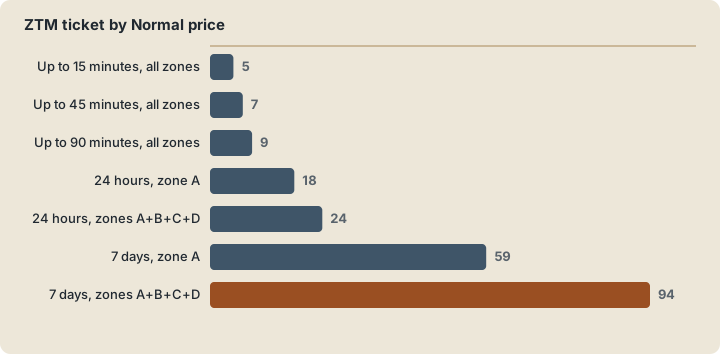
Poznan's ZTM network uses timed single tickets valid in all zones (A, B, C and D) with transfers allowed: 15 minutes for 5 zl, 45 minutes for 7 zl and 90 minutes for 9 zl, with 24-hour tickets at 18 zl for zone A and 24 zl for all zones, and the fine for travelling without a valid ticket is 350 zl, reduced to 175 zl if paid within 7 days.
The timed-ticket logic suits a food crawl better than a per-ride fare, because one 90-minute ticket can cover a tram to Jezyce, the market there and a ride back to the centre. Tickets are bought in machines, apps or onto a PEKA card; contactless bank-card payment directly on trams and buses is not available yet, with the modernisation expected to bring it in 2028. If you see advice telling you to tap your bank card on a tram, it is out of date.
| ZTM ticket | Normal price | Reduced price |
|---|---|---|
| Up to 15 minutes, all zones | 5 zl | 2.50 zl |
| Up to 45 minutes, all zones | 7 zl | 3.50 zl |
| Up to 90 minutes, all zones | 9 zl | 4.50 zl |
| 24 hours, zone A | 18 zl | 9 zl |
| 24 hours, zones A+B+C+D | 24 zl | 12 zl |
| 7 days, zone A | 59 zl | 29.50 zl |
| 7 days, zones A+B+C+D | 94 zl | 47 zl |

Two neighbourhoods reward the trip outside the Old Town. Srodka, mentioned above, sits just across from the cathedral island and is walkable. Jezyce, west of the centre around its own small market square, has a covered market (Rynek Jezycki) that trades Monday to Saturday from 6:00 to 20:00, with only some florists opening on Sunday, so time a visit for a weekday or Saturday morning if you want to see the stalls full. Our general transport guide at Poznan public transport covers routes and the PEKA card in more detail.
There is no city bike system to recommend: the Poznan City Bike ran from 2012 to 2022 and has not returned, so plan on foot, tram or the guided bike tour in the picks below.
When Is The Best Time To Visit Poznan For This Food?
For the dish itself, any season works, because pyry z gzikiem is a year-round home dish; for the food calendar around it, November and December are strongest, with St Martin's Day on 11 November, the Christmas market from 14 November 2026 to 6 January 2027 and the Ice Festival from 11 to 13 December 2026, while May and June offer the warmest comfortable eating weather before July, which is both the warmest and the wettest month.
WMO's 1991-2020 climate normals for the Poznan station put July's mean daily high at 25.2 C with 84.4 mm of rain, the wettest month of the year, while April is the driest at 28.6 mm. January has a mean low of -2.9 C with 19.7 frost days. What that means in practice: terrace eating is safest from May through September, Christmas market eating needs proper layers, and a rain plan matters most in high summer, oddly enough. Our month-by-month breakdown at Poznan weather by month and the best time to visit Poznan guide carry the full tables.
| Month | Mean daily high | Mean daily low | Precipitation |
|---|---|---|---|
| January | 2.1 C | -2.9 C | 37.7 mm |
| April | 15.0 C | 4.0 C | 28.6 mm |
| July | 25.2 C | 14.1 C | 84.4 mm |
| October | 13.3 C | 5.4 C | 35.4 mm |
| December | 3.2 C | -1.4 C | 40.1 mm |
Can You Build A Whole Trip Around Poznan's Food?
Yes, comfortably: a two- or three-day Poznan stay can move from a milk bar plate of pyry z gzikiem to a Michelin-listed dinner, a Croissant Museum show, the Srodka dining street, the Jezyce market and a December Christmas market, with the Old Market Square, the cathedral island and the Imperial Castle all inside the same walkable core, and day trips to Kornik or Rogalin for a rural Grande Poland lunch afterwards.
The classic base is the Old Town or the centre, from which everything in the previous sections is reachable on foot or a single tram ride. If you are still choosing where to sleep, our where to stay in Poznan guide compares the districts, and budget travellers can check current hostel prices through the hostel booking search. Visitors weighing the overall budget should also read up on the Poznan City Card, which bundles transport with free entry to most museums (a few partners such as the Enigma Cipher Centre and Porta Posnania give a discount instead of free entry, 21 zl and 17 zl, and 21 zl respectively, on the confirmed partner prices of 35/29 zl for Enigma and 35/29 zl for Porta Posnania).

For the countryside plate of the same cuisine, the combined Rogalin and Kornik day tour below leaves from Poznan and covers a palace, a castle and the ancient oaks of the region, giving you the landscape that produced the dairy-and-potato cooking in the first place.
One last pairing worth planning around: November. St Martin's Day on 11 November is the city's own food festival in all but name, the croissant season peaks, and the Christmas market opens at mid-month, so a mid-November visit can compress the entire sweet and savoury calendar of Poznan into four days, with a steaming plate of pyry z gzikiem as the honest, unsweet anchor of the trip.
Common Questions About Pyry Z Gzikiem
What is pyry z gzikiem?
It is the signature home dish of Poznan and Greater Poland: boiled potatoes (pyry in the local dialect) served hot with gzik, a cold mixture of farmer cheese, soured cream, radish, spring onion and chives, seasoned with salt and pepper.
What does pyry mean in the Poznan dialect?
Pyry is the Greater Polish dialect word for potatoes. Standard Polish uses ziemniaki or kartofle, so the word itself marks the dish and the speaker as belonging to the Wielkopolska region.
Is pyry z gzikiem served hot or cold?
Both at once, which is the point: the potatoes are served steaming hot and the gzik lands on them cold, so the cheese softens slightly at the contact point while the cream stays cool and fresh.
Where can I try pyry z gzikiem in Poznan?
Traditional milk bars are the most reliable places, modern restaurants serving regional Wielkopolska cuisine carry it or reworked versions of it, and seasonal events including the Christmas market on the Old Market Square offer regional dishes alongside the stalls.
Is gzik the same thing as cottage cheese dip?
Not quite. Gzik is built on twarog, a dense, dry quark-style farmer cheese, loosened with soured cream and folded with radish, spring onion or chives. It is thicker and tangier than most cottage cheese dips and is treated as a component of the meal rather than a snack dip.
When is the best time to eat it in Poznan?
Any time of year, since it is a year-round home dish. November is the richest food month in the city, with St Martin's Day on 11 November and the Christmas market opening on 14 November 2026 and running to 6 January 2027.