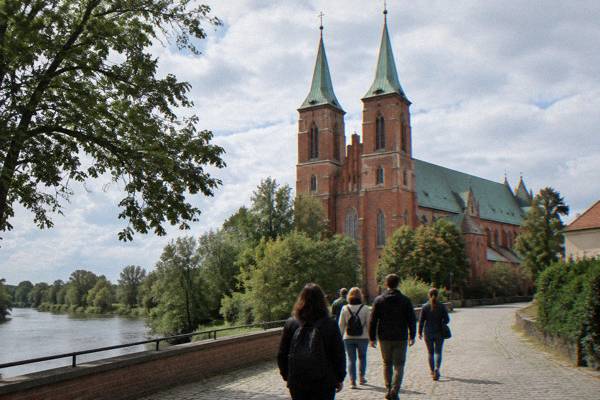
Morasko Meteorite Reserve
The Morasko Meteorite Reserve is a protected woodland in the north of Poznan, the capital of the Wielkopolskie voivodeship in western Poland, known for the group of impact craters scattered across the forested Morasko hill.
Short answer
The Morasko Meteorite Reserve is a forested nature reserve in northern Poznan,Protecting a field of meteorite impact craters. Public transport reaches the Morasko area with standard ZTM tickets, and no official visiting terms, opening hours or admission prices for the reserve appear in the verified sources used here, so treat any figure you read elsewhere with caution.
Poznan, the capital of the Wielkopolskie voivodeship (Greater Poland) in western Poland, on the Warta river, is a city of 534,239 residents according to the Statistical Office in Poznan, and among its quieter curiosities is one of the least expected landscapes in any European city: a woodland in the northern Morasko district where a group of meteorite impact craters lies scattered across a hill. The Morasko Meteorite Reserve protects that ground. It is not a ticketed attraction with turnstiles and a gift shop; it is a protected natural area, and this page explains what it is, how to reach it with the city's public transport, what the verified sources say, and, just as importantly, what they do not.
What Is The Morasko Meteorite Reserve In Poznan?
The Morasko Meteorite Reserve is a protected woodland area on the Morasko hill in the north of Poznan, Poland, set aside around a field of meteorite impact craters formed when iron meteorites struck the ground in prehistoric times; the reserve covers forested terrain, and, unlike a museum, it is experienced as a walk through the landscape itself rather than as a collection behind glass.
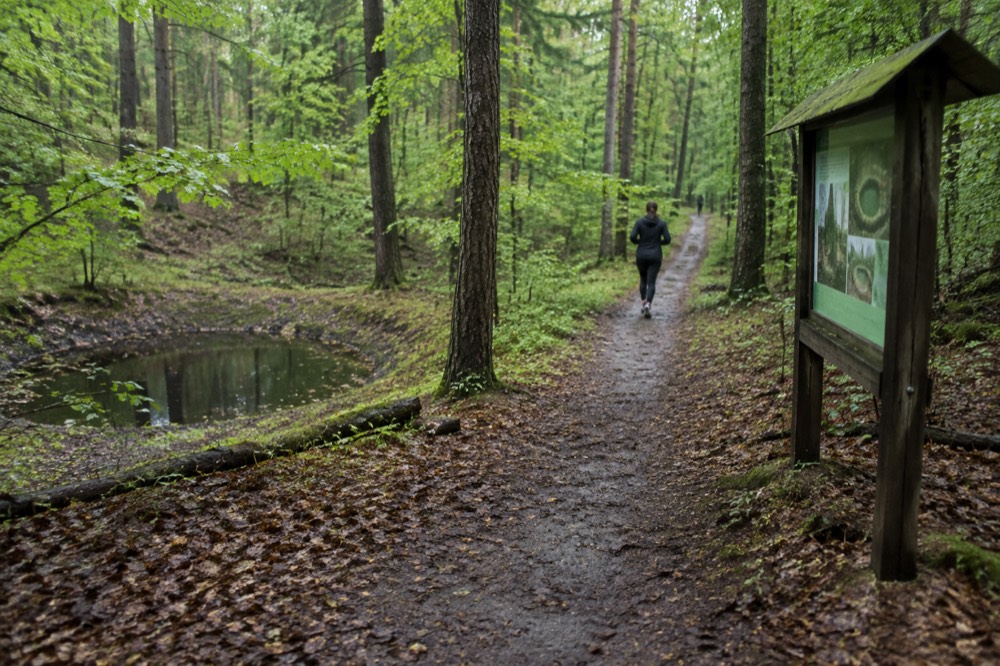
That framing matters, because most of what a visitor does at Morasko happens outdoors. The craters sit among trees on the hill, and the experience is closer to a nature walk than to a conventional sight: you follow paths, you look for the depressions in the ground, and you read whatever information is posted on site. The reserve sits in the Morasko district, a part of the city well off the usual tourist routes, well north of the Old Market Square and the cathedral island of Ostrow Tumski that anchor the usual itineraries. Visitors with an interest in archaeology and deep history often pair Morasko with the Archaeological Museum in Poznan or with the Genius Loci Archaeological Reserve near the cathedral, both of which display excavated material with published ticket prices, 20 zl normal and 15 zl reduced at Genius Loci according to the Archaeological Museum's own price list.
An honest word about sourcing, in the spirit of this site: the verified fact pack behind this page, drawn from official pages fetched and checked by this desk, carries no published visiting terms for the Morasko Meteorite Reserve itself. There is no verified opening-hour schedule, no admission price and no official guided-tour timetable in the sources. Competing guides print confident figures here. This one will not, which is exactly the approach the Poznan Travel Guide editorial desk takes across the whole site.
How Do You Get To The Morasko Meteorite Reserve?
The reserve lies in the Morasko district of northern Poznan, Poland, and the city's ZTM tram and bus network covers the whole city with timed tickets valid in every zone: 5 zl for up to 15 minutes, 7 zl for up to 45 minutes and 9 zl for up to 90 minutes, with transfers allowed, so a single 90-minute ticket comfortably covers a cross-city ride to Morasko from the centre.
Those fares come straight from ZTM's published price list, and they apply to trams and buses alike. A few practical points from the same source are worth knowing before you ride. Tickets are timed, not zoned for short rides: the 15, 45 and 90 minute tickets are valid in all zones, A through D, and transfers within the ticket's time are allowed. Real travel time counts, and tickets cannot be combined to extend their validity. The 24-hour options are 18 zl for zone A and 24 zl for all zones, and a 7-day all-zone ticket is 94 zl. A useful quirk: a 24-hour ticket validated between 20:00 on Friday and 24:00 on Saturday stays valid until 24:00 on Sunday under ZTM's weekend promotion.
| ZTM ticket | Normal price | Reduced price | Validity |
|---|---|---|---|
| Timed 15 minutes | 5 zl | 2.50 zl | All zones, transfers allowed |
| Timed 45 minutes | 7 zl | 3.50 zl | All zones, transfers allowed |
| Timed 90 minutes | 9 zl | 4.50 zl | All zones, transfers allowed |
| 24 hours, zone A | 18 zl | 9 zl | Until midnight next day |
| 24 hours, all zones | 24 zl | 12 zl | Until midnight next day |
| 7 days, zone A | 59 zl | 29.50 zl | Seven days |
| 7 days, all zones | 94 zl | 47 zl | Seven days |
Payment deserves a warning, because Poznan differs from many European cities right now. Contactless bank-card payment on trams and buses is not yet available: ZTM signed the PEKA system modernisation contract in 2026, with contactless bank-card and phone payment expected to follow, with effects in 2028. Today you buy timed tickets from machines, in apps, or on a PEKA card. The PEKA bearer card costs 27 zl, of which 12 zl is a refundable deposit and 15 zl is travel credit, and it is sold at ZTM customer points and selected sales points. Do not board without a valid ticket: the fine is 350 zl, reduced to 175 zl if paid within 7 days.
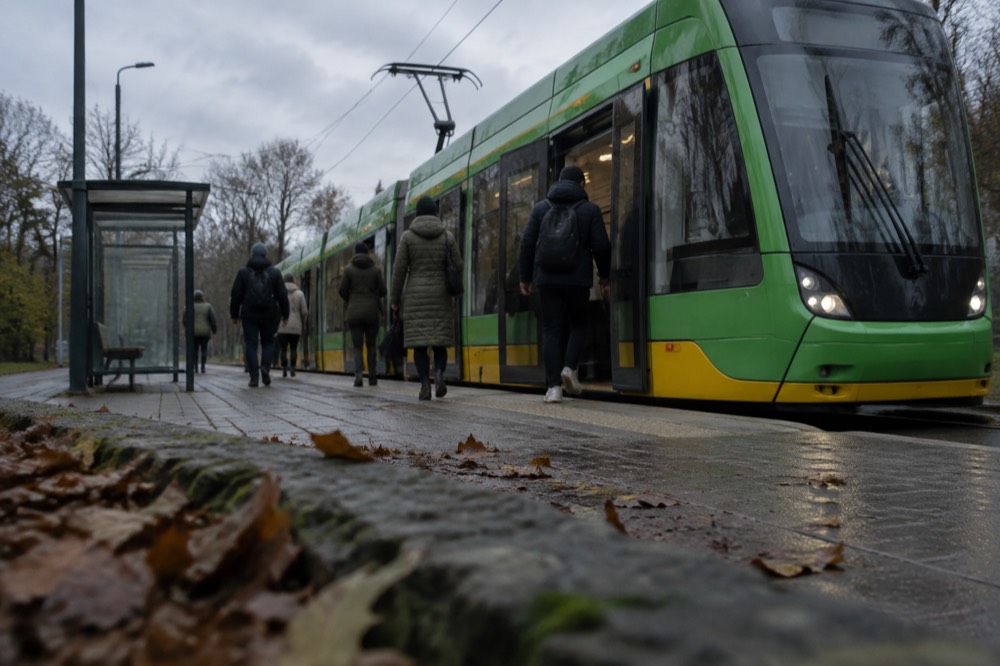
Once you are up in Morasko, the reserve is reached on foot through the district. For orientation, think of the trip as a contrast: in the morning you can stand among craters on a forested hill, and an hour later be back at the Old Market Square watching the famous Town Hall goats, which the National Museum's page says appear every day at noon, and since recently also at 3 pm. That is the scale of Poznan: a meteorite landscape and a Renaissance square in one afternoon.
What Can You Actually See At The Morasko Meteorite Reserve?
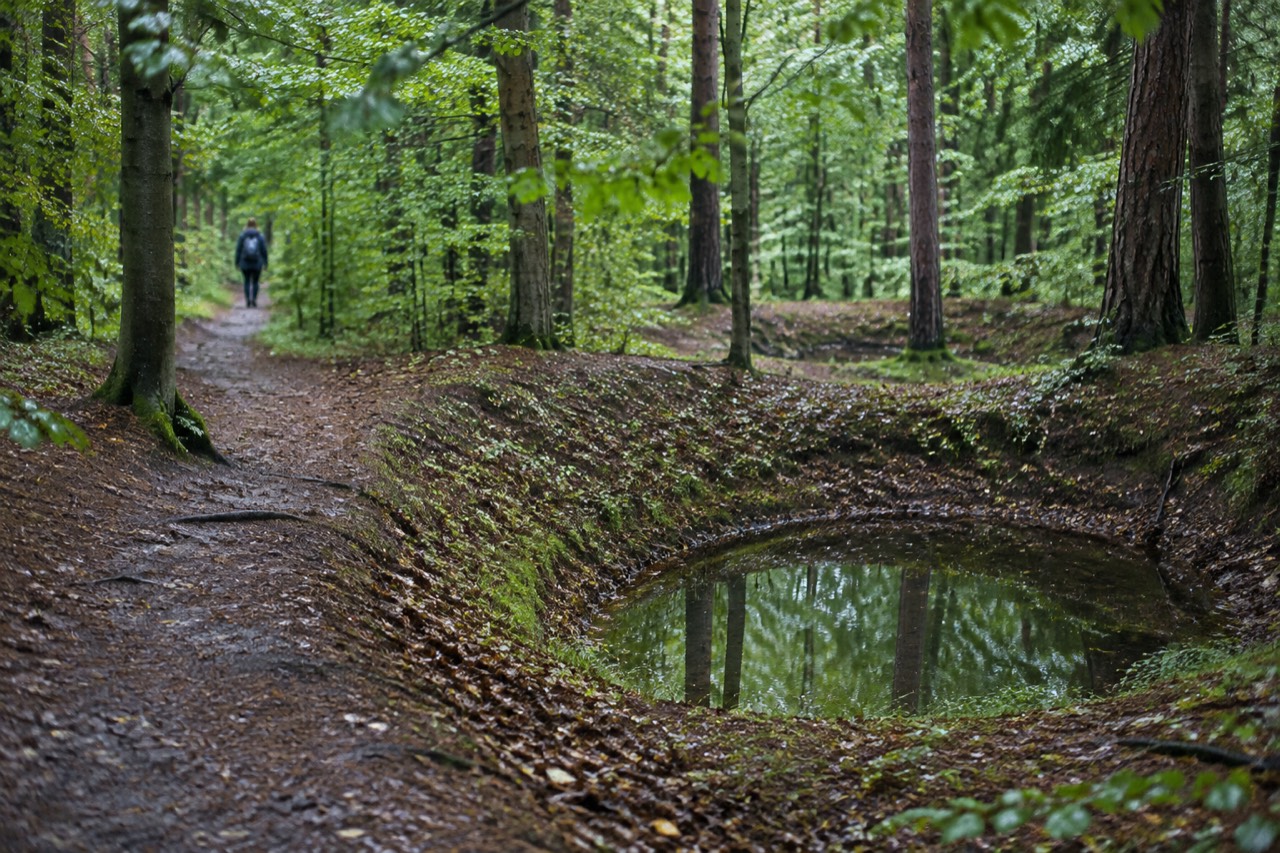
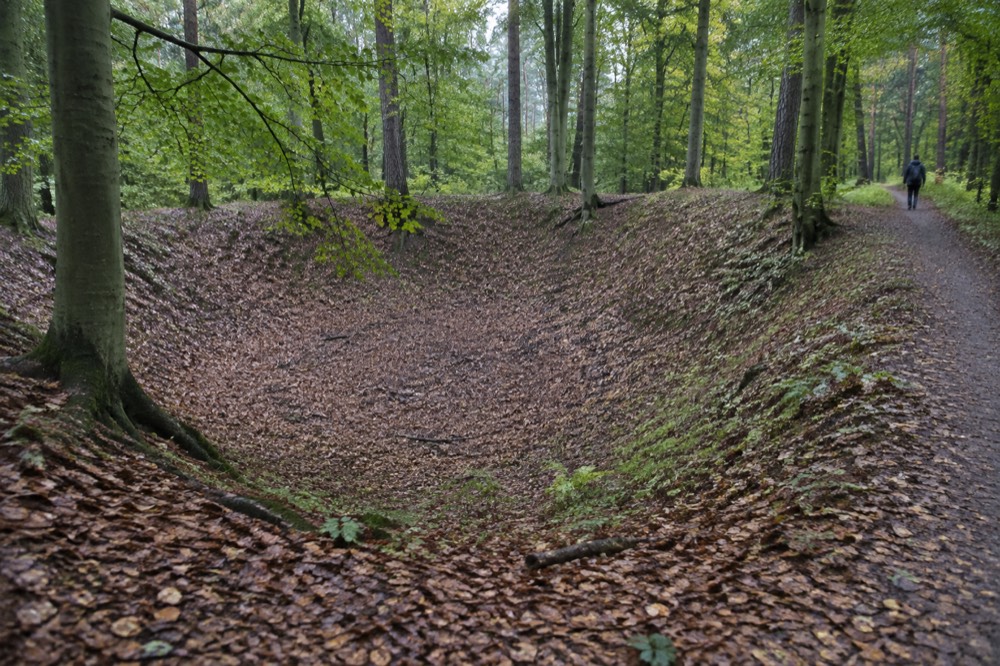
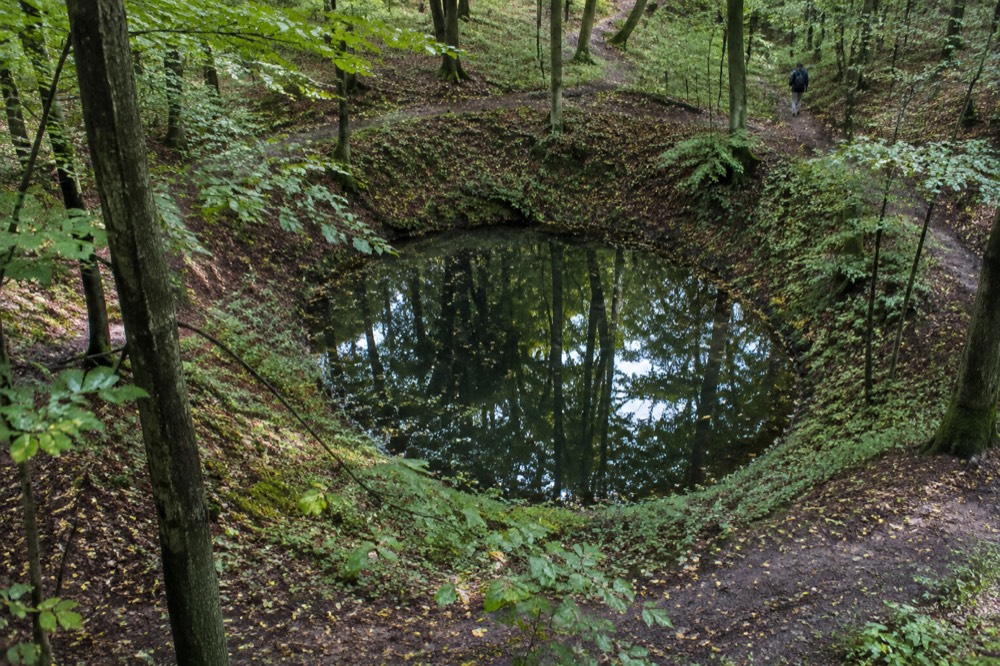
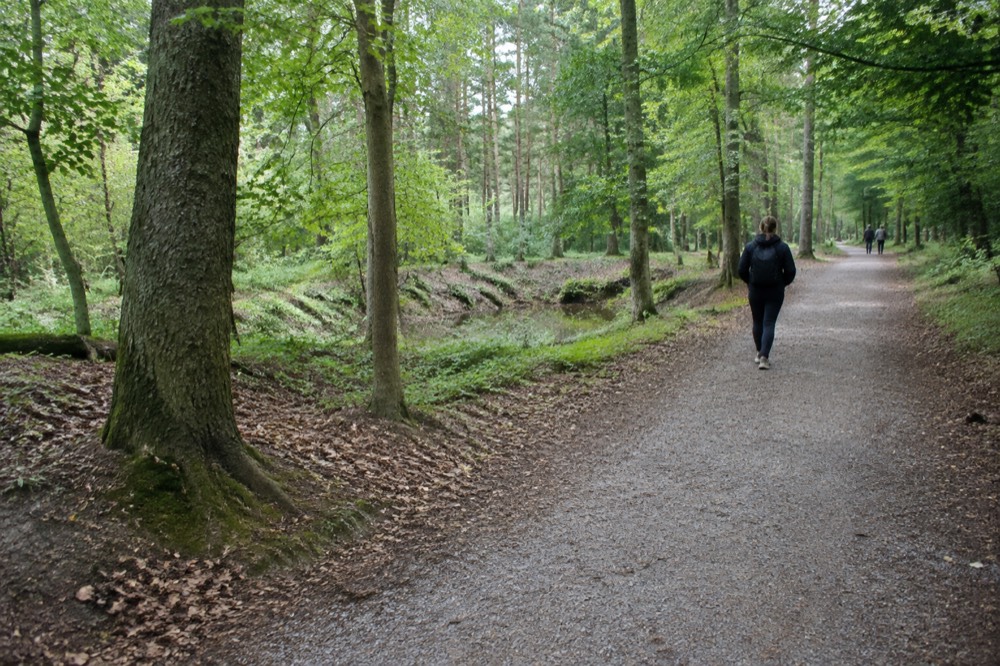
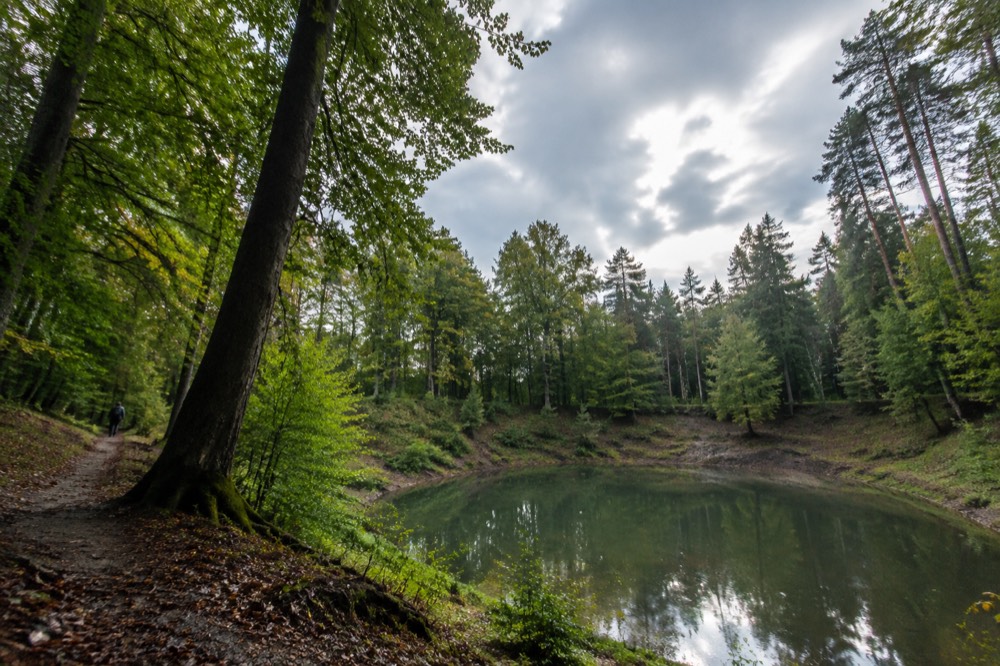
Visitors to the reserve walk a forested hill in northern Poznan where a group of meteorite impact craters appears as rounded, water-collecting depressions among the trees; the sight is subtle rather than spectacular, closer to reading a landscape than touring a monument, and the reserve's meaning comes from knowing that the hollows were formed by iron meteorites striking the ground rather than by water or human hands.
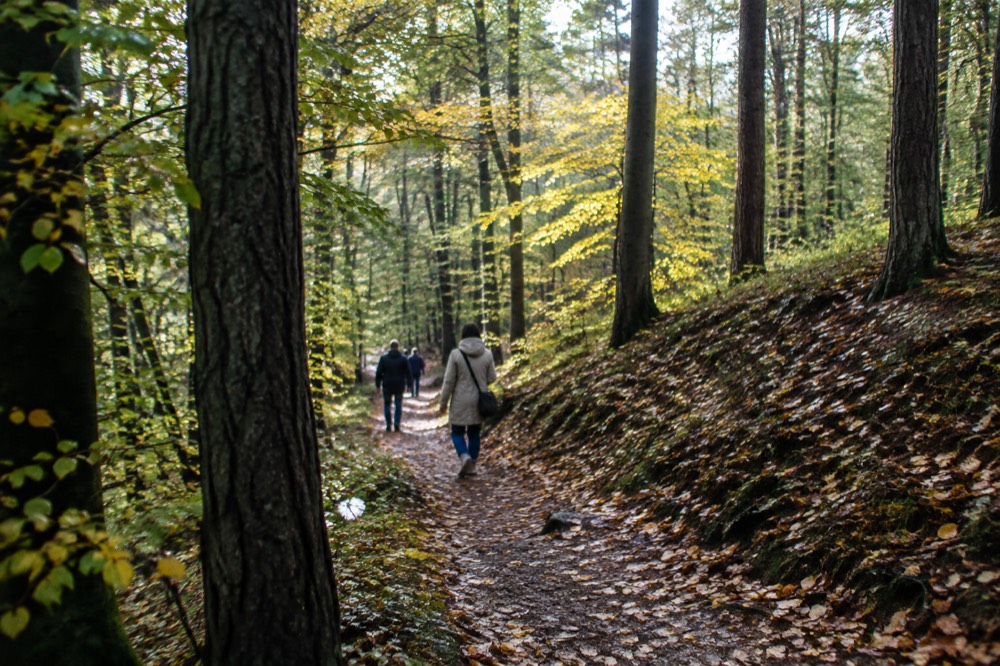
The craters themselves are the draw. They are depressions in the forest floor, several of them close together on the hill, and several famously hold water, which helps them stand out in the terrain. There are no barriers, no glass cases and no light show: the reserve presents the craters as they are, inside a protected woodland. Walkers should expect ordinary forest conditions, decent shoes after rain, and the kind of quiet that the city centre, with its 534,239 residents across 262 km2 according to the Statistical Office, can no longer offer. Morasko is also a district of student life, with campus areas nearby, so the ride out and back has its own everyday-Poznan character.
Because the reserve itself publishes no visitor programme in the sources used here, the practical half of a Morasko trip is usually one of the city's guided walks, which cover the centre's sights while you leave the hill to yourself. The featured tour on this page, a discover-Poznan walk that includes a tram ride and a traditional snack, is a natural pairing: it handles the Old Town, the square and the food, and the operator's live listing carries the current price, times and cancellation terms.
The tour's full description, current rating and departure details render on the operator's live listing, so check availability there rather than relying on any figure printed here, and pair it with the walk around Morasko for a day that spans both the scientific and the classic sides of Poznan.
Is The Morasko Meteorite Reserve Free To Visit, And When Is It Open?
No verified opening hours, admission prices or booking terms for the Morasko Meteorite Reserve appear in the official sources this desk checked, so the honest answer is that visiting terms are unconfirmed: treat the reserve as an open woodland you reach at your own responsibility, check locally on the day, and be sceptical of any guide that quotes confident hours or a ticket price for it.
This is a deliberate editorial position, not laziness. The fact pack behind this site verifies every figure against an official page before it is printed, and for Morasko no such page yielded visitor terms. Other Poznan institutions are better documented, and the contrast is instructive. The National Museum's branches, for example, publish full schedules, and several of them are free on Tuesdays: the National Museum branches and the Independence Museum branches, including the Museum of Armaments in Citadel Park, all list Tuesday as their free day, while in Gniezno the Museum of the Origins of the Polish State is free on Sundays instead. A blanket claim that "museums are free on Sundays" in Poznan would be wrong.
| Poznan sight | Monday | Published hours | Ticket, normal | Free day |
|---|---|---|---|---|
| Royal Castle (Museum of Applied Arts) | Closed | Tue-Wed 10:00-16:00, Thu to 18:00, Fri to 20:00, Sat-Sun to 17:00 | 20 zl | Tuesday |
| Enigma Cipher Centre | Closed | Tue-Fri 9:00-18:00, Sat-Sun 10:00-19:00 | 35 zl | None listed |
| Museum of Armaments, Citadel Park | Closed | Nov-Feb 10:00-16:00, Mar-Oct to 17:00 (Sun 16:00) | 15 zl | Tuesday |
| Porta Posnania | Closed | Tue-Fri 9:00-18:00, Sat-Sun 10:00-19:00 | 35 zl | None listed |
| Imperial Castle (CK Zamek) | Open | Daily 12:00-19:00 | 10 zl with map | None listed |
| Morasko Meteorite Reserve | Unverified | Not published in verified sources | Not published | Not published |
The Enigma Cipher Centre deserves its own mention for the scientifically minded visitor, since it sits at the other end of Poznan's scientific story. Its own visit page lists hours of 9:00 to 18:00 Tuesday to Friday and 10:00 to 19:00 weekends, closed Mondays, with tickets at 35 zl normal, 29 zl reduced and 75 zl family, and its exhibition and audio guides come in Polish, English, German, Russian and Ukrainian. The centre's timeline names the three Polish codebreakers Marian Rejewski, Jerzy Rozycki and Henryk Zygalski. Full details are in this site's guide to the Enigma Cipher Centre.
When Is The Best Time Of Year To Visit The Morasko Meteorite Reserve?
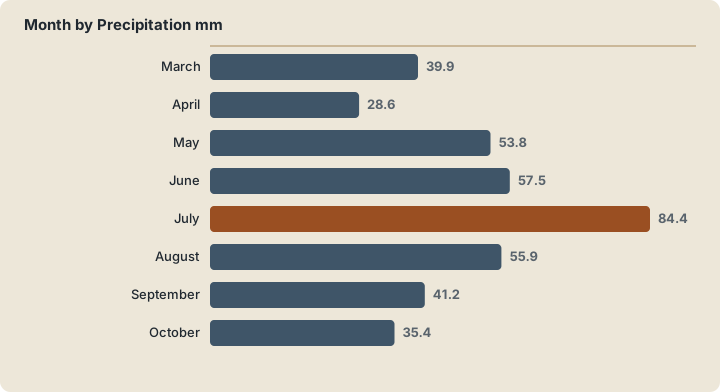
The warmest and most comfortable months for a forest walk in Poznan are June through August, when WMO's 1991-2020 climate normals for the Poznan station show mean daily highs of 23.1, 25.2 and 24.9 C respectively, though July is also the wettest month with 84.4 mm of rain, so late spring and early autumn often give the best balance of warmth, daylight and drier ground for walking the crater field.
Those normals, recorded at WMO station 12330 for Poznan by the IMGW-PIB observing service, are the most reliable climate picture available, and they carry a few surprises worth planning around. April, not summer, is the driest month, with only 28.6 mm of precipitation across the month. July combines the highest mean daily high, 25.2 C, with the heaviest rainfall, 84.4 mm. Winter is real winter: January averages a daily low of -2.9 C with 19.7 frost days in the month, and December carries 17.5. For a woodland walk where the ground underfoot matters, the shoulder months look best on paper.
| Month | Mean high C | Mean low C | Precipitation mm | Frost days |
|---|---|---|---|---|
| March | 8.1 | 0.0 | 39.9 | 14.1 |
| April | 15.0 | 4.0 | 28.6 | 4.6 |
| May | 19.8 | 8.4 | 53.8 | 0.4 |
| June | 23.1 | 11.9 | 57.5 | 0.0 |
| July | 25.2 | 14.1 | 84.4 | 0.0 |
| August | 24.9 | 13.7 | 55.9 | 0.0 |
| September | 19.5 | 9.6 | 41.2 | 0.1 |
| October | 13.3 | 5.4 | 35.4 | 3.8 |
About 50 days a year reach 25 C or more in Poznan according to the same normals, so hot walking days are common in midsummer but not relentless. What the data does not support is any claim about sunshine hours, which are unsourced for this station and therefore never printed on this site. If you visit in the colder half of the year, the frost-day counts above tell the story: the craters under a light snowfall are a striking sight, but the forest paths will be cold and, in the wet months, muddy. Layer accordingly, and check the day's forecast rather than trusting a fixed seasonal promise.
What Else Can You Combine With The Morasko Meteorite Reserve?
The natural pairings for a Morasko trip are Poznan's greener and more scientific sights: the free-entry Old Zoo on Zwierzyniecka street, the ticketed New Zoo near Lake Malta, Citadel Park described by the city portal as the largest park in Poznan, and the lakeshore complex at Lake Malta, all reachable with the same ZTM timed tickets and each documented with official hours and prices that the reserve itself does not publish.
Citadel Park is the easiest recommendation for a second outdoor stop. The city's own page describes it as the largest park in Poznan, a 15-minute walk from the Old Market Square, on the ground of a 19th-century fortress described as the largest artillery fort in Europe at the time. Its Museum of Armaments publishes winter hours of 10:00 to 16:00 Tuesday to Sunday and summer hours to 17:00, Monday closed, with tickets at 15 zl normal, 10 zl reduced, and free entry on Tuesdays; a visit takes 45 to 90 minutes by the museum's own estimate. The zoo pairing splits neatly: the Old Zoo on ul. Zwierzyniecka is free to enter, while the New Zoo is ticketed, 45 zl on weekdays in the March-to-October season and 55 zl on Saturdays and holidays, dropping to a flat 20 zl for everyone from November to the end of February.
| Outdoor Poznan sight | Entry | Seasonal note from official pages |
|---|---|---|
| Old Zoo, ul. Zwierzyniecka 19 | Free | Open daily, Nov-Feb 9:00-16:00, Apr-Sep 9:00-19:00 |
| New Zoo, ul. Krancowa 81 | 45-60 zl in season, 20 zl Nov-Feb | Ticket desks close one hour before the zoo |
| Citadel Park | Free grounds | 15-minute walk from the Old Market Square |
| Lake Malta lakeshore | Free to walk | Lake dimensions unsourced, keep figures out |
| Maltanka park railway | 18 zl single, 24 zl return | Seasonal; 2026 season ended 27 September |
| Morasko Meteorite Reserve | Unverified | No published visiting terms |
One seasonal trap to avoid: the Maltanka park railway, which runs between the Maltanka station and the New Zoo, is a summer-only operation, and MPK's notice confirms the 2026 season ended on Sunday 27 September, with no 2027 start date published. Never promise yourself a ride in winter. For the evening, after a day of craters and parkland, the city's cultural calendar is worth a look: this site carries a full guide to Poznan in winter, to the Christmas market and to the classical-music options around town.
Can You Take A Meteorite-Themed Day Trip From Poznan?
Yes, and the strongest pairing is with Poznan's prehistoric and archaeological day trips: Biskupin, the reconstructed Iron Age settlement about an hour from the city, publishes May-September hours of 9:00 to 18:00 with tickets at 28 zl normal and 19 zl reduced, while the Museum of the First Piasts at Lednica lists its museum seat at 30 zl normal and Ostrow Lednicki at 25 zl, making a two-site deep-history day entirely plannable from official pages.
Biskupin is the headline. Its own visiting page gives the full seasonal schedule: 9:00 to 18:00 from May to September, 9:00 to 17:00 in April and October, and 9:00 to 16:00 from November to March, closed only on 1 January, Easter Sunday, 1 November and 25 December. Tickets are 28 zl normal, 19 zl reduced, free for children up to 7, and 75 zl for a family of two adults and two children. The site's XXXI Archaeological Festival ran from 12 to 16 September 2026, a reminder that Biskupin hosts large events that can crowd a casual visit. Lednica, further east, publishes 2026 prices of 30 zl normal and 20 zl reduced for the museum seat, and 25 zl for Ostrow Lednicki, 35 zl with an audio guide, free parking, and free entry for children up to 7; the opening date of the new museum building and the ferry season are unsourced, so check before travelling.
| Deep-history site near Poznan | Hours (official) | Ticket, normal | Closures |
|---|---|---|---|
| Biskupin Archaeological Museum | May-Sep 9:00-18:00, Nov-Mar 9:00-16:00 | 28 zl | 1 Jan, Easter Sunday, 1 Nov, 25 Dec |
| Museum of the First Piasts, Lednica (seat) | Unverified hours | 30 zl | Under 7 free, parking free |
| Ostrow Lednicki | Unverified season | 25 zl, 35 zl with audio guide | Ferry season unsourced |
| Gniezno, Museum of the Origins | Oct-Apr 9:00-16:00 daily | Unverified | Sunday free admission |
| Morasko Meteorite Reserve | Unverified | Unverified | None published |
Train access to the wider region is straightforward, with one caveat this site repeats everywhere: journey times are reported ranges, never minute-exact figures, and fares are never quoted. Direct trains from Poznan Glowny take about 2 h 20 to 3 h 20 to Warsaw, about 4 h 30 to 5 h 30 to Berlin, about 2 h 20 to 3 h 30 to Wroclaw and about 4 to 6 hours to Krakow, and the PKP Intercity planner is the place to confirm the day's timetable. One more entry note if you are coming from Germany: Poland has temporary internal border controls at its land borders with Germany and Lithuania, in force from 2 October 2026 to 30 March 2027, so carry your passport or ID card on the Berlin train.
What Should You Know Before You Go To Morasko?
Bring sensible walking shoes, a transport ticket bought before you board, and no expectation of facilities: the reserve is a protected woodland without published visitor services, the nearest certainty of food and toilets is back in the city, your US or UK passport must meet Schengen rules with EES registration in operation since 10 April 2026, and the local currency is the Polish zloty, not the euro.
Start with the practical layer. Poland uses the zloty (PLN), it is in the European Union but not in the euro area, and every price on this page is in zl. Exchange rates move daily, so no fixed rate is ever printed on this site; check a live source on the day. Tap water in Poznan is safe to drink according to the city utility Aquanet, which answers the question directly on its own page, so a refillable bottle is a better plan than bottled water for the walk.
Entry formalities matter mostly to readers flying in. The EU Entry/Exit System has been fully operational at all external Schengen border crossing points since 10 April 2026, so visa-exempt visitors, including US and UK citizens, may have fingerprints and a photo registered at the border, at no cost for registration. UK visitors get 90 days in any 180 in the Schengen area, with a passport issued less than 10 years before arrival and valid at least 3 months past departure, per the UK government's own entry requirements page. The ETIAS travel authorisation is a separate future requirement whose start date and fee are unconfirmed in the sources used here: check the EU's official ETIAS site before you travel rather than trusting a date in a forum post.
Back on the hill, the final word on Morasko is temperance. The reserve is a genuinely unusual feature, a meteorite crater field inside a major European city's boundaries, and it rewards visitors who arrive knowing that its visitor terms are informal and its pleasures are quiet ones. Walk it after rain and you will remember the mud; walk it in late April, the driest month on the 1991-2020 normals, and you may have the craters almost to yourself.
Common Questions About The Morasko Meteorite Reserve
Is the Morasko Meteorite Reserve in Poznan free to visit?
No admission price, opening schedule or booking system for the reserve appears in the official sources, so treat any confident price or hours you read elsewhere as unconfirmed. The practical costs of a visit are your ZTM transport ticket, 5 to 9 zl for a timed single, and your time.
How do I get to the Morasko Meteorite Reserve by public transport?
Poznan's ZTM trams and buses cover the Morasko district in the north of the city with the standard timed tickets: 5 zl up to 15 minutes, 7 zl up to 45 minutes and 9 zl up to 90 minutes, valid in all zones with transfers. Buy from a machine, an app or a PEKA card, since contactless bank-card payment on board is not yet available.
What will I actually see at the Morasko craters?
A group of rounded, water-collecting depressions scattered across a forested hill, best appreciated as a landscape walk rather than a museum visit. Several craters hold water and stand out clearly among the trees; there are no barriers or displays, just the protected woodland and the ground itself.
When is the best time of year to walk the reserve?
By WMO's 1991-2020 normals for Poznan, June to August are warmest with mean highs of 23.1 to 25.2 C, but July is also the wettest month at 84.4 mm. Late April to May and September offer a drier, comfortable middle ground; January, with a mean low of -2.9 C and 19.7 frost days, suits only hardy walkers.
Can I combine Morasko with other Poznan sights in one day?
Yes. The same ZTM tickets reach Citadel Park, described by the city portal as the largest park in Poznan, the free Old Zoo, the ticketed New Zoo and the Lake Malta shore. In the evening, guided walks and concerts in the centre round out the day; check availability on each operator's live listing.
Do I need a visa or ETIAS to visit Poznan?
US and UK visitors stay visa-free under Schengen's 90-in-180 rule, and the EU Entry/Exit System, fully operational since 10 April 2026, may register fingerprints and a photo at the border at no cost. ETIAS has no confirmed start date or fee in the sources used here, so check the EU's official ETIAS site before you travel.
Is the reserve suitable for children?
The terrain is ordinary forest path rather than a curated attraction, and no published visitor facilities exist in the verified sources, so plan it as a nature walk with children old enough for a cross-city tram ride and a woodland loop. Pair it with the free Old Zoo for an easier family half-day.
Morasko will never compete with the Town Hall goats for crowds, and that is precisely its value: a meteorite field inside a city of 534,239 people, walked on a 9 zl ticket, is the kind of quiet oddity that makes Poznan worth a longer look.