Poznan Town Hall And The Billy Goats
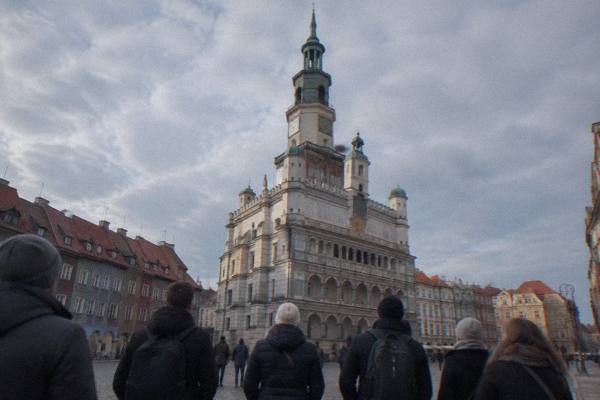
The Poznan Town Hall stands on Stary Rynek in the capital of the Wielkopolskie voivodeship in western Poland, and twice a day two metal goats lock horns above its clock to a cheering crowd.
Short answer
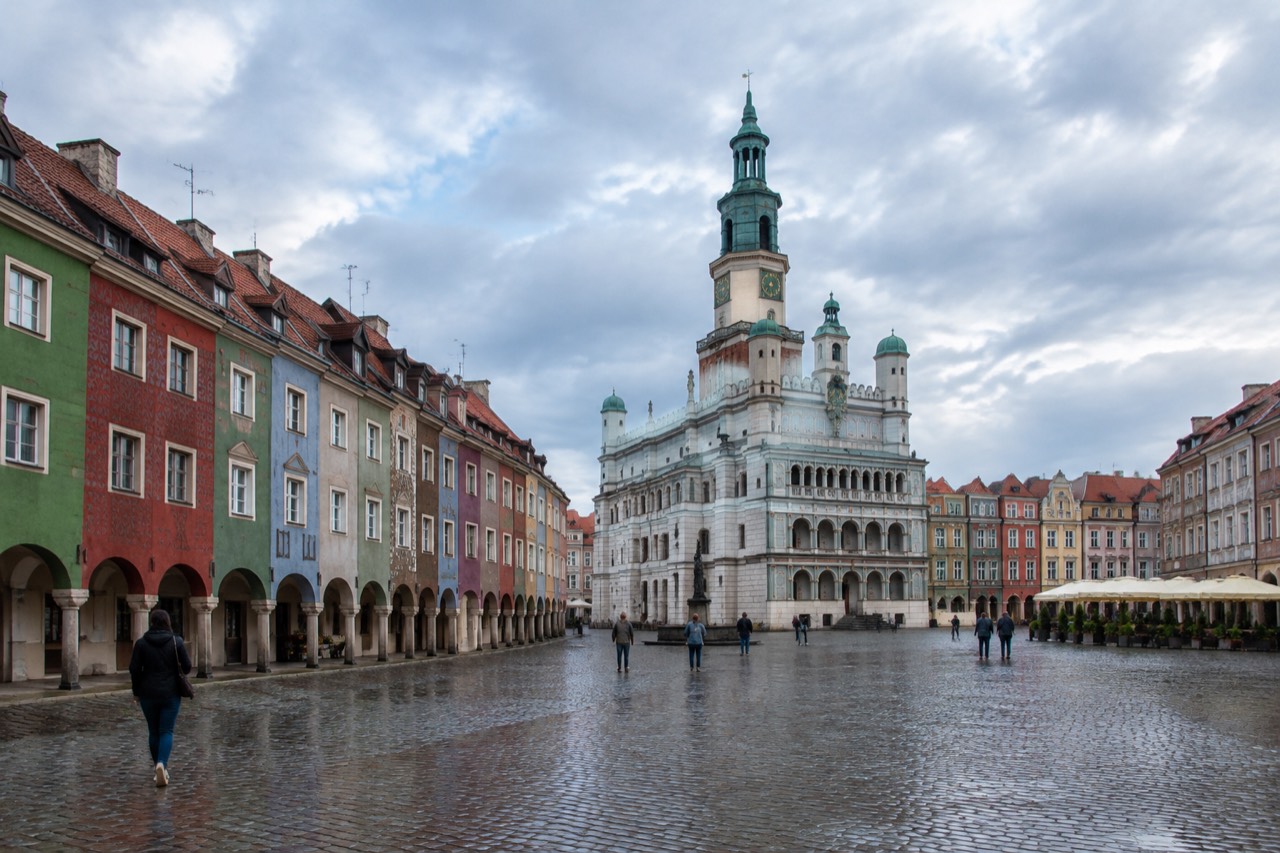
The goats appear every day at noon, and since recently also at 3 pm, on the Town Hall facade above the clock. The museum inside is closed for renovation with no published reopening date.
The Poznan Town Hall rises at the head of Stary Rynek, the old market square of Poznan, the capital of the Wielkopolskie voivodeship in western Poland, a city of 534,239 people on the Warta river. Visitors come for one reason: at noon each day, two metal billy goats emerge above the clock on the facade and lock horns while a trumpet call plays and the square fills with onlookers. The National Museum, whose branch has occupied the building since 1954, says the show now runs twice daily, and the second performance is the one most itineraries miss. This guide sets out what the official pages actually state about the building, the goats and the square around them, including the one thing many other guides get wrong: the museum interior is closed.
What Is The Poznan Town Hall?
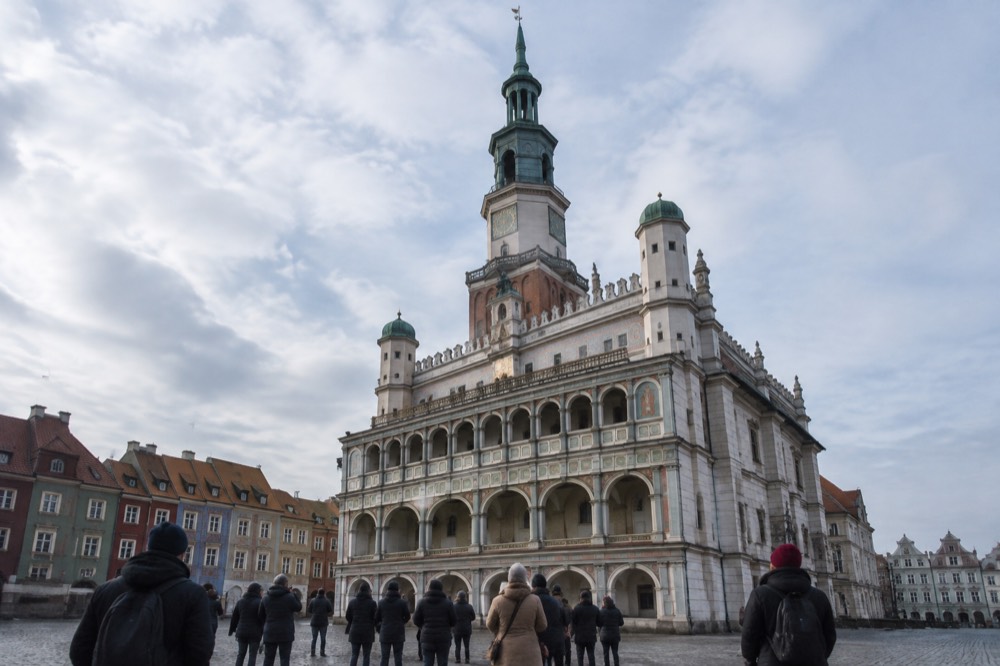
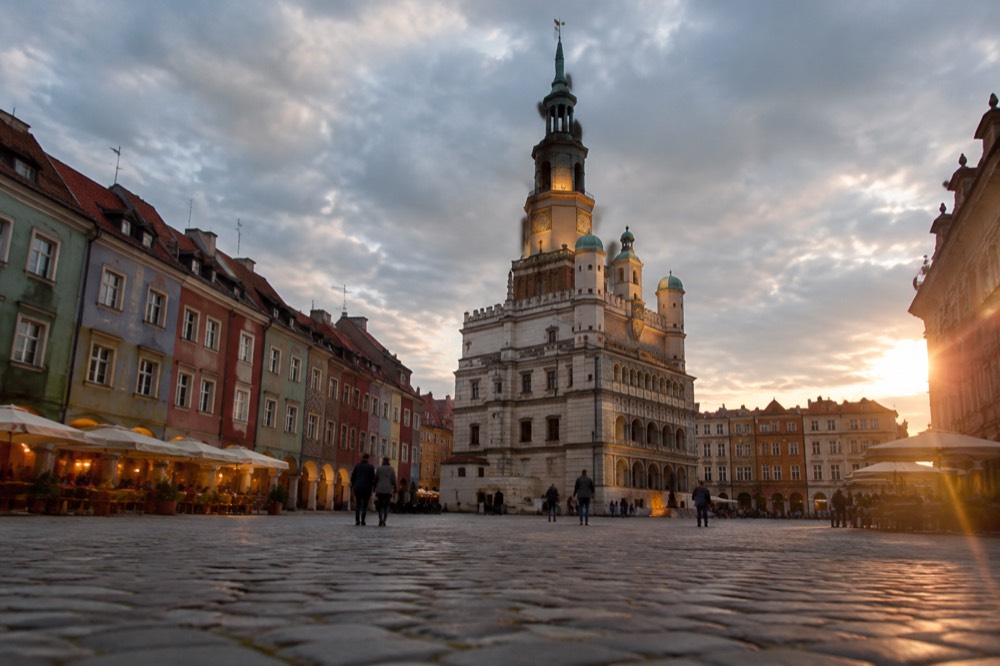
The Poznan Town Hall, or Ratusz, at Stary Rynek 1, is the historic city hall of Poznan, a building dated to the early 14th century that today houses the Museum of the History of the City of Poznan, a branch of the National Museum in Poznan, which has been based here since 1954. The building was conserved between 1910 and 1913, and its tower collapsed in 1945 near the end of the Second World War. Its Renaissance loggia, parapet and tower make it the visual anchor of the old market square, and its facade clock with the two goats has become the single most recognizable symbol of the city.
The National Museum's page on the building traces its role as the seat of city government and later as a museum. The address it lists is Stary Rynek 1, 61-772 Poznan. Nothing in the official material invites visitors inside at present, and the reason why is covered further down this page.
The square around it deserves its own attention. Poznan's Stary Rynek is lined with narrow merchant houses, once traded from cellars and ground floors, and today holding restaurants, museum branches and visitor services. The Old Market Square in Poznan is a fuller treatment of the square itself, while this page stays with the building at its head.
Like to hear the square's stories as you wander? Book a self-guided audio tour here.
A short historical table, drawn only from the dates the National Museum publishes:
| Date | What the official page records |
|---|---|
| Early 14th century | The Town Hall building is dated to this period |
| September 1551 | A clock with goats first installed, made by Bartel Wolff of Gubin |
| 1910 to 1913 | The building conserved |
| 1913 | A new clock installed |
| 25 August 1922 | The goats reappear after a repair |
| 1945 | The tower collapses |
| 1954 | The Museum of the History of the City of Poznan moves in |
What Time Do The Goats Come Out In Poznan?
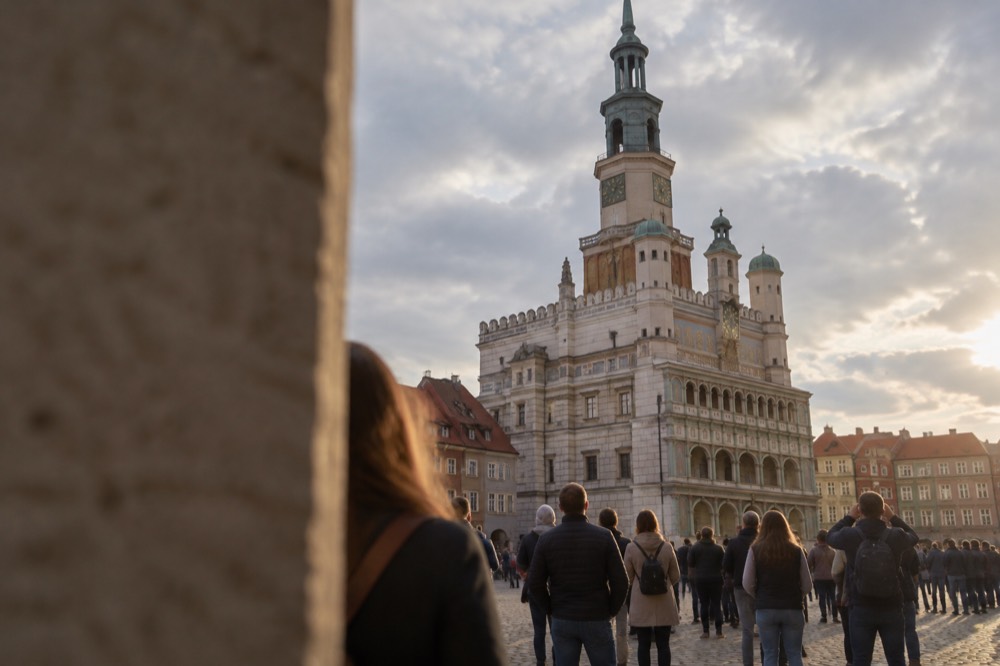
The goats appear every day at noon, and, in the National Museum's official wording, "since recently also at 3 pm", when two metal goats emerge from a small structure above the clock on the Town Hall facade and lock horns to a trumpet call. Visitors should arrive a few minutes early, because the show lasts only moments and the best viewing spots on the square fill quickly. Whether the goats perform during the current facade works is not stated on any official page, so check on the day rather than counting on the show as a guarantee.
The full question, with viewing tactics and seasonal notes, has its own answer page: what time the goats come out in Poznan. The short version for planners: build the noon show into the middle of your day, then use the 3 pm show as a backup. Crowds are thinner in the afternoon, and the light on the facade is often better for photographs.
The museum's goats page also carries the history, which is worth knowing before you watch. The clock with goats was first installed in September 1551 by the clockmaker Bartel Wolff of Gubin, the tradition was restored with a new clock in 1913, and the goats reappeared on 25 August 1922 after a repair. That is nearly five centuries of goats, interrupted and restarted, which is more history than most city-center clock spectacles can claim.
Why Do Two Goats Lock Horns Above The Clock?
The honest answer is that the National Museum publishes no legend as fact: it records the mechanics and the dates, a clock with goats first installed in September 1551 by Bartel Wolff of Gubin and a new clock in 1913, and leaves the stories told on the square to the storytellers. Popular local tales, repeated by guides and in popular retellings, involve a pair of roasted goats that sprang to life, or goats that escaped a banquet and butted each other above the clock to the amusement of diners. Those stories are folklore, not museum text, and a guide will usually present them as such.
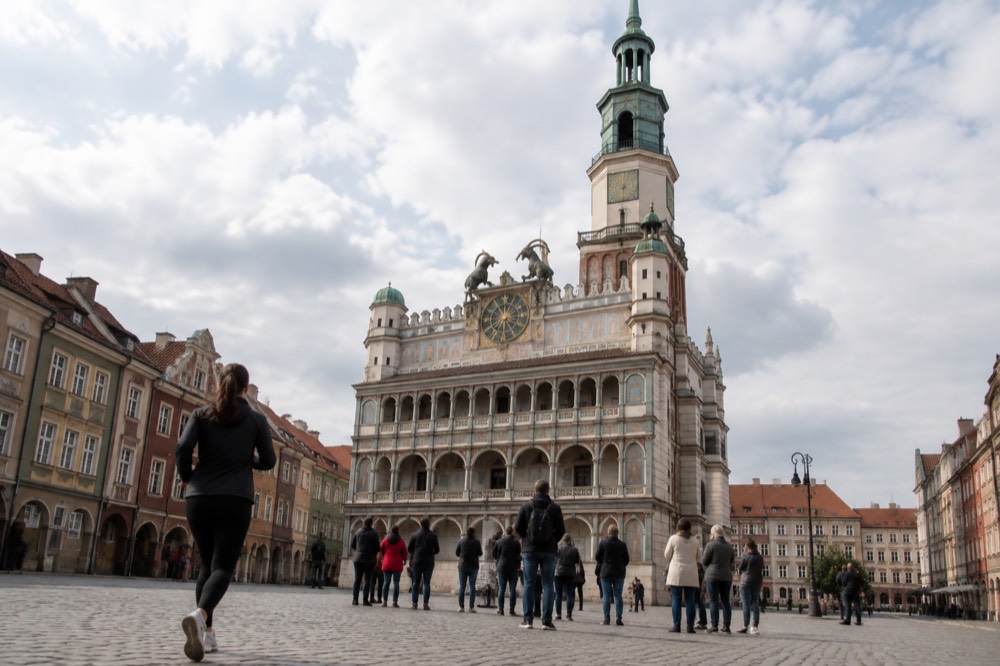
What the museum does state is precise and checkable. The show is daily at noon, and since recently also at 3 pm. The goats are metal figures. The mechanism sits above the clock on the facade, facing the square, so the performance is visible from anywhere on Stary Rynek with a clear line of sight to the tower.
One reliable way to combine the folklore with a guaranteed good view is the Croissant Museum, whose goat shows are timed to end with a view of the Town Hall goats from the museum windows. That detail, and the show schedule, comes from the museum's own English page and is set out in a later section of this guide.
Can You Visit The Town Hall Museum Interior?
No: the National Museum's visit page for the Town Hall, home of the Museum of the History of the City of Poznan, lists every weekday as closed, no reopening date has been published, and the museum's own guidance amounts to checking its site before planning a visit. The facade, the clock and the goats are separate from the museum interior, and the square itself is fully open, so the closure removes the interior exhibits but not the reason most people come. Ticket prices that circulate online, including the listed normal 20 zl and reduced 13 zl rates, apply to the museum when open, and Tuesday is its free day, but none of that can be used today.
This is the single most common error in published guides to Poznan. Articles still describe touring the museum halls and climbing for views. The National Museum's page says otherwise, and a local news portal's suggestion of a reopening around the turn of 2027/2028 is not an official statement, so this guide does not repeat it as a date. Treat any reopening year you read elsewhere as unconfirmed.
What remains fully available is the outside. The loggia, the parapet, the clock and the goats are all on the facade, and the square gives you every angle. Practical viewing options, all confirmed on official pages:
| Way to see the goats | What the official page states |
|---|---|
| From Stary Rynek itself | Free, no ticket, show at noon and 3 pm daily |
| From the Croissant Museum windows | Goat shows timed to end with the Town Hall goats in view |
| On a guided walking tour | Old Town walks include the square and the show as a staple stop |
| With an audio tour | Self-paced commentary covering the square and the building's history, available online |
What Else Can You See On Stary Rynek?
Stary Rynek carries three other museum branches in addition to the closed Town Hall museum: the Greater Poland Military Museum at number 9, the Museum of Musical Instruments at number 45, and the Museum of the Wielkopolska Uprising 1918-1919 in the Odwach at number 3, all open Tuesday to Sunday and all free on Tuesdays. Each charges 15 zl normal and 10 zl reduced on other days, which makes a Tuesday museum crawl on the square one of the better value moves in the city, confirmed on the National Museum's and the Independence Museum network's own pages.
The Military Museum at Stary Rynek 9 keeps hours of 10:00 to 17:00 Tuesday to Sunday. The Museum of Musical Instruments at Stary Rynek 45 stretches to 18:00 on Thursdays and 20:00 on Fridays, and its collection of instruments is a genuinely unusual city-centre visit. The Odwach, the small guardhouse facing the Town Hall, holds the Wielkopolska Uprising 1918-1919 museum and, in the winter months of November to February, opens 10:00 to 16:00. The full index of guides sits on Poznan Travel Guide.
| Museum on Stary Rynek | Address | Hours | Tickets |
|---|---|---|---|
| Greater Poland Military Museum | Stary Rynek 9 | Tue-Sun 10:00-17:00, Mon closed | 15 / 10 zl, Tuesday free |
| Museum of Musical Instruments | Stary Rynek 45 | Tue-Wed 10:00-16:00, Thu to 18:00, Fri to 20:00, Sat-Sun 10:00-17:00, Mon closed | 15 / 10 zl, Tuesday free |
| Museum of the Wielkopolska Uprising 1918-1919 | Stary Rynek 3 (Odwach) | Nov-Feb Tue-Sun 10:00-16:00, Mon closed | 15 / 10 zl, Tuesday free |
| Museum of the History of the City of Poznan (Town Hall) | Stary Rynek 1 | Interior closed, no reopening date published | 20 / 13 zl listed for when it reopens, Tuesday free |
Beyond the museums, the square is a place to slow down. The merchant houses around it hold cafes and restaurants, the Croissant Museum runs its shows from a tenement on the square's eastern side, and in late November the Christmas market moves in, with the Stary Rynek site of Betlejem Poznanskie running from 21 November 2026 to 6 January 2027 according to the event's official page.
How Does The Croissant Museum Show Connect To The Goats?
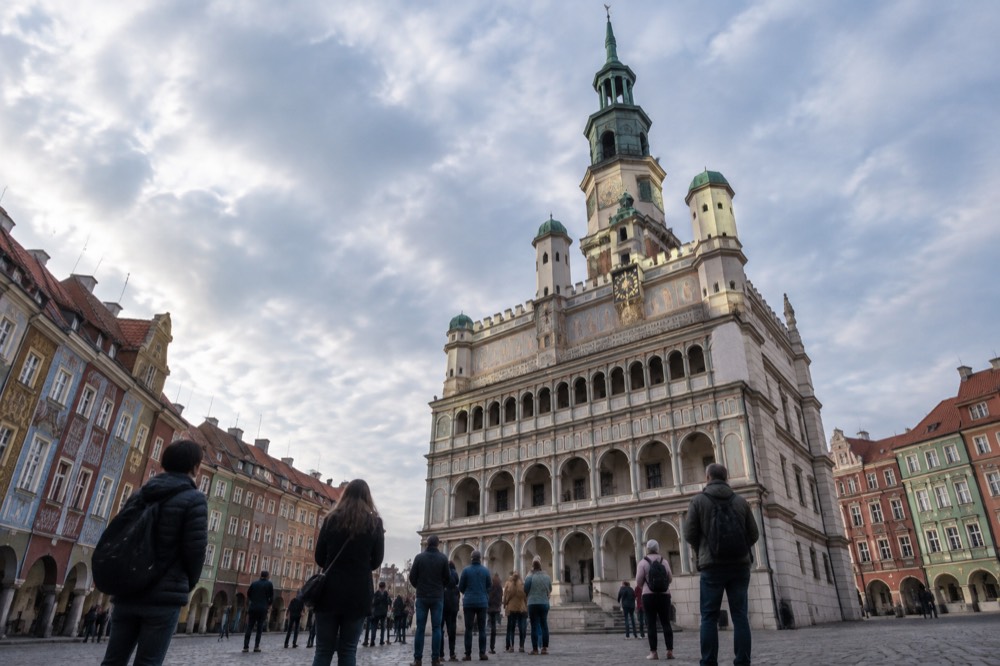
The Croissant Museum, at Stary Rynek 41/2 with its entrance from Klasztorna Street 23, runs shows that end with a view of the Town Hall goats from the museum's windows, so a goat show timed before noon or 3 pm delivers both the performance and the city's famous pastry in one sitting. The museum's English page lists Polish shows at 11:00, 12:30, 14:00 and 15:30, plus 17:00 on Saturdays, and an English "Croissant and goat show" at 14:00, about 65 minutes long, running daily in July and August, on Saturdays and Sundays all year, and on other days as shown in the booking calendar.
Two details from the museum's page are worth repeating because generic guides get them wrong. First, a 15:30 English show, about 60 minutes, opens only when the 14:00 show is fully booked, so English visitors should not assume an hourly schedule. Second, tasting is included in the price, and the page asks visitors to arrive 10 minutes before the start. Ticket prices are shown only in the booking widget, so this guide prints none.
| Show | Language | Times listed on the museum page |
|---|---|---|
| Croissant show | Polish | 11:00, 12:30, 14:00, 15:30 |
| Croissant show | Polish, Saturday extra | 17:00 |
| Croissant and goat show | English | 14:00 (about 65 min), daily Jul-Aug, weekends all year, other days per calendar |
| Croissant show | English, overflow | 15:30 (about 60 min), only when 14:00 is full |
The pastry itself has legal standing. The rogal swietomarcinski, the St Martin's croissant, is entered in the EU register as a Protected Geographical Indication under Commission Regulation (EC) No 1070/2008 of 30 October 2008, which is why genuine croissants carry a certification mark. It is PGI status, not the stricter PDO, a distinction the Polish agriculture ministry's own page makes plain. The croissant's home street, Swiety Marcin, celebrates its name day on 11 November in an event organized by CK Zamek, though the 2025 edition had no parade, replaced by an all-day fairground, so check the programme rather than expecting a procession.
How Do You Get To The Poznan Town Hall?
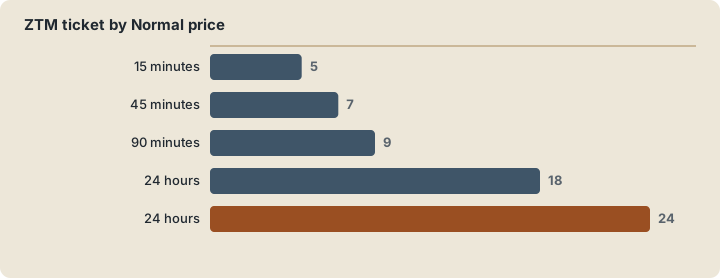
Stary Rynek sits in the heart of the Poznan old town and is served by the ZTM tram and bus network, where timed tickets valid in all zones cost 5 zl for up to 15 minutes, 7 zl for up to 45 minutes and 9 zl for up to 90 minutes, with transfers allowed within the ticket's time. Tickets come from machines, apps or a PEKA card, because contactless bank-card payment on vehicles is not available yet; ZTM has signed the PEKA modernisation contract with effects expected in 2028, so tapping a bank card on a tram today will not work.
For a full transport treatment, including the airport buses, see the city's transport coverage on this site. The essentials for the square: validate before you ride, because the fine for travelling without a valid ticket is 350 zl, or 175 zl if paid within 7 days. Real travel time counts on timed tickets, and tickets cannot be combined to extend time.
| ZTM ticket | Coverage | Normal price | Reduced |
|---|---|---|---|
| 15 minutes | All zones, transfers | 5 zl | 2.50 zl |
| 45 minutes | All zones, transfers | 7 zl | 3.50 zl |
| 90 minutes | All zones, transfers | 9 zl | 4.50 zl |
| 24 hours | Zone A | 18 zl | 9 zl |
| 24 hours | All zones A+B+C+D | 24 zl | 12 zl |
One more planning note from the price list: a 24-hour ticket validated between 20:00 on Friday and 24:00 on Saturday stays valid until 24:00 on Sunday, which suits a weekend visit built around the noon goats. And there is no city bike system to fall back on; the Poznan City Bike ran from 2012 to 2022 and has not returned, so walking and trams are the practical choices.
Is The Town Hall Better With A Guided Tour?
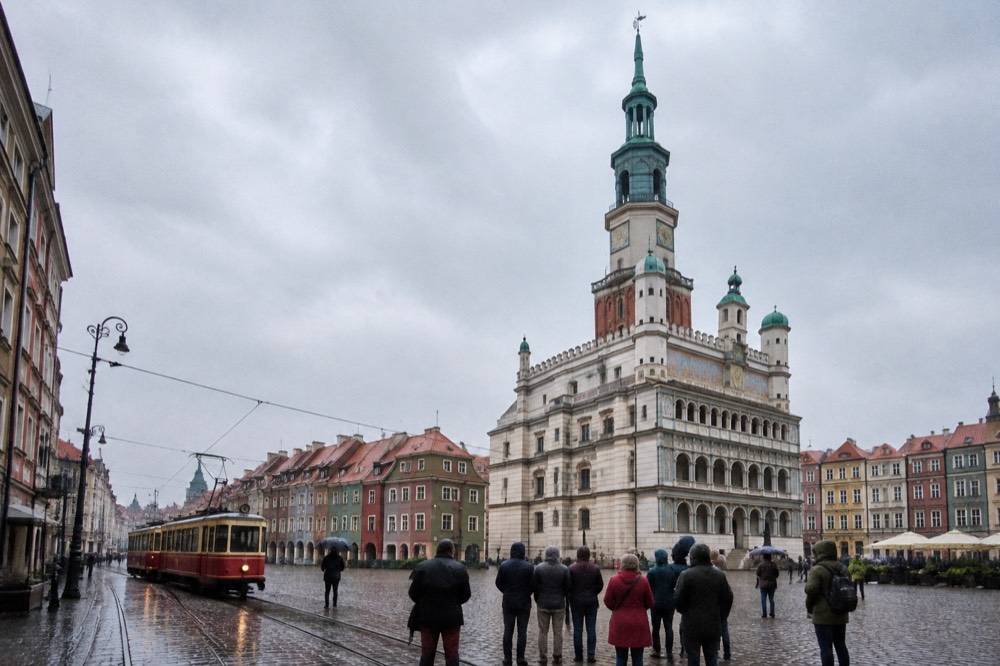
A guided walk is the most reliable way to get the goats, the square's museums and the surrounding old town in one coherent visit, and an English-language Old Town walking tour is a standard product in the city, with the leading option on this site a two-hour guided walk that covers the square and its stories. Independent visitors see the show perfectly well from the square, but a guide supplies what the closed museum interior no longer can: the interior narrative of the building and the city, delivered on the spot. This desk has not taken any of these walks, so the detail above is what the operators' own listings state, and prices, ratings and durations render on the live listings rather than on this page.
For visitors who prefer self pacing, an audio tour of the old town covers the same ground with commentary on demand. For those who want the square at its most atmospheric, the 3 pm goat show followed by an early dinner in a square-side tenement is a rhythm that fits the official show times without any crowding at noon.
Beyond the square, the same visit can stretch naturally. Poznan Cathedral and Porta Posnania sit across the Warta on Ostrow Tumski, a short tram or a longer walk away, and the Imperial Castle on Swiety Marcin is on the street that leads from the square toward the station. Each has its own page on this site with verified hours and prices.
What Is Nearby Once You Have Seen The Goats?
Within a fifteen-minute walk of Stary Rynek you can reach the Citadel Park, described on the city portal as the largest park in Poznan and a relic of a 19th-century fortress, plus the Enigma Cipher Centre on Swienty Marcin 78, open Tuesday to Sunday with tickets at 35 zl normal and 29 zl reduced. The Enigma centre tells the story of the three Polish codebreakers, Marian Rejewski, Jerzy Rozycki and Henryk Zygalski, whose work on the Enigma cipher began in Poznan, and its exhibition and audio guides run in Polish, English, German, Russian and Ukrainian.
Staying central, the Stary Browar gallery on Polwiejska, a former brewery turned shopping and arts complex, opens Monday to Saturday 9:00 to 21:00 and Sunday 10:00 to 20:00 on trading Sundays, and sits a few blocks south of the square. The Fara, the collegiate basilica at Golebia 1, opens daily 6:00 to 19:30 with no ticket listed for individual visits, though sightseeing pauses during Mass.
| Sight near the square | Distance character | Key official detail |
|---|---|---|
| Enigma Cipher Centre, Sw. Marcin 78 | Short walk down Sw. Marcin | Tue-Fri 9:00-18:00, Sat-Sun 10:00-19:00, 35 / 29 zl |
| Royal Castle museum, Gora Przemysla | Short walk uphill from the square | Tue-Sun, closed Monday, 20 / 13 zl, Tuesday free |
| Stary Browar, Polwiejska 42 | A few blocks south | Mon-Sat 9:00-21:00, Sun 10:00-20:00 |
| Fara basilica, Golebia 1 | Edge of the old town | Daily 6:00-19:30, no ticket listed |
| Citadel Park | Fifteen-minute walk per the city portal | Largest park in Poznan, free |
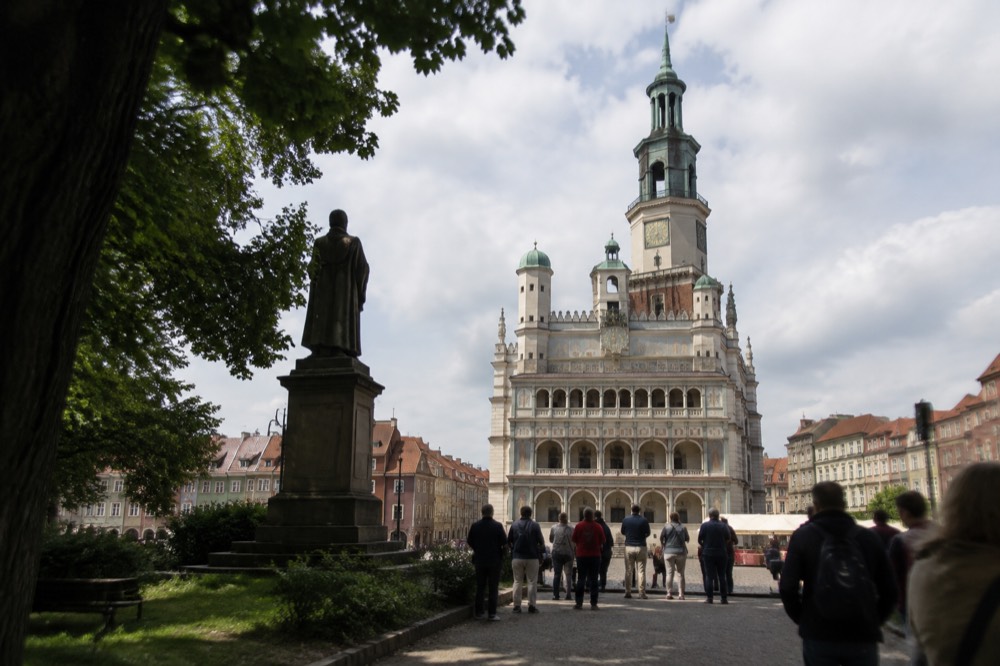
Visitors with more time can build the Town Hall into a wider first day, and this site's itineraries cover exactly that, from a single day to a full week in the region. The square rewards an unhurried loop: the Odwach, the instrument museum, a croissant show, the noon goats, then out along Swiety Marcin toward the castle and the Enigma centre.
Should You Plan Your Day Around The Goats?
Yes, with a caveat: the noon and 3 pm goat shows are the fixed points of any Poznan day, and the official show times let you anchor museums, meals and walks around them, but whether the goats run during the current facade works is not stated on any official page, so hold the plan loosely and check on the day. A Tuesday visit stacks the free-admission day at the square's museums against the show times for the cheapest full day out. A weekend visit adds the Saturday 17:00 croissant show and, from late November, the Christmas market on the square.
The Poznan Travel Guide desk frames all of this from official pages rather than personal visits, and the facts above trace to the National Museum's Town Hall, goats and branch pages, the Croissant Museum's English page, ZTM's price list and the event organizers' own sites. Where a figure is not published, such as the museum's reopening date or the goats' performance during facade works, this page says so instead of guessing. That is the difference between a plan that works and an itinerary copied from a guide that was written before the museum closed.
Common Questions About The Poznan Town Hall
What time do the goats come out in Poznan?
Every day at noon, and, in the National Museum's official wording, since recently also at 3 pm. The show is brief, so arrive a few minutes early. Whether the goats perform during the current facade works is not stated officially, so check on the day.
Can you go inside the Poznan Town Hall?
No. The National Museum's visit page lists the Museum of the History of the City of Poznan inside the Town Hall as closed, and no reopening date has been published. The facade, the clock and the square remain fully accessible.
How old is the Poznan Town Hall?
The National Museum dates the building to the early 14th century. It was conserved between 1910 and 1913, its tower collapsed in 1945, and the museum branch moved in in 1954.
How old are the goats on the Town Hall clock?
A clock with goats was first installed in September 1551 by the clockmaker Bartel Wolff of Gubin. The current tradition was restored with a new clock in 1913, and the goats reappeared on 25 August 1922 after a repair.
Are the museums on Stary Rynek free?
The Greater Poland Military Museum, the Museum of Musical Instruments and the Museum of the Wielkopolska Uprising 1918-1919 are free on Tuesdays and charge 15 zl normal, 10 zl reduced on other days. They are closed on Mondays. The Town Hall museum interior is closed entirely.
Where is the best place to watch the goats?
Anywhere on Stary Rynek with a clear view of the clock tower works, and the Croissant Museum's goat shows are timed to end with a view of the goats from the museum's windows, which adds shelter and a tasting.