St Martin Croissant: Poznan's Protected Pastry
The St Martin's croissant is the sweet symbol of Poznan, a crescent of laminated dough filled with white poppy seed, protected across the European Union under a 2008 regulation that ties the name to this city in western Poland.

Short answer
A St Martin's croissant (rogal swietomarcinski) is a Poznan pastry of yeast-laminated dough filled with a white poppy seed mixture, shaped into a crescent and glazed. Only bakers in and around Poznan who follow the registered recipe may sell it under the name, a protection the EU registered by Commission Regulation (EC) No 1070/2008 of 30 October 2008.
Every year on 11 November, the main street of Poznan, the capital of the Wielkopolskie voivodeship in western Poland, fills with the smell of baking while bakers push out hundreds of thousands of crescent pastries. The rogal swietomarcinski, the St Martin's croissant, is not a marketing invention: it is a registered European product, and the regulation that protects it names the city directly. This page explains what the pastry is, what the protection actually covers, where to eat one, and how the city's St Martin Street Name Day works in a year when the old parade no longer exists.
What Is A St. Martin's Croissant?
A St Martin's croissant, in Polish rogal swietomarcinski, is a crescent-shaped pastry of laminated yeast dough filled with a white poppy seed mass, baked and glazed in and around Poznan in western Poland. The name is protected across the European Union as a Protected Geographical Indication, registered by Commission Regulation (EC) No 1070/2008 of 30 October 2008, which means only bakers in the registered area working to the registered specification may sell it under that name.
The Polish Ministry of Agriculture's page on the product calls it the sweetest symbol of Poznan, and that is a fair description of how the city treats it. The filling is the defining feature: white poppy seed, not the blue poppy seed more common in central European baking, worked with sugar, eggs, raisins or candied peel and almonds or walnuts into a dense, almost marzipan-like mass. The dough is folded with fat in layers, though the result is softer and more bready than a French croissant. After baking, each rogale is finished with a sugar or icing glaze and often chopped nuts.
The recipe is not folklore preserved only in memory. It is written into the registered specification that the 2008 regulation attaches to the name, and that is the whole point of a Protected Geographical Indication: the product's qualities are tied to a place and to a documented method, and the name travels only with both. A bakery in another city can bake a similar crescent, but selling it as a rogal swietomarcinski would infringe the registration.
The date matters as much as the dough. The pastry is named after St Martin, whose feast day falls on 11 November, the same day Poland marks Independence Day. In Poznan the two anniversaries share one street, Swiety Marcin, and the croissant is the edible link between them. Production peaks in the days around the feast, though registered bakeries in the city bake rogale through the whole autumn and winter season.

For visitors, the practical summary is simple. If you are in Poznan between late October and the New Year, the pastry is everywhere, from the Old Market Square bakeries to hotel breakfast tables. If you want to understand it rather than just eat it, the city runs a museum dedicated to it, and a tasting tour pairs it with the best view in the city.
If tasting it above the rooftops sounds appealing, book a croissant tasting tour here.
Why Can Only Poznan Bakers Call It A Rogal Swietomarcinski?
Because the name is a Protected Geographical Indication, or PGI, registered at EU level by Commission Regulation (EC) No 1070/2008 of 30 October 2008, published in the Official Journal as OJ L 290 on 31 October 2008. The registration ties the name to a defined geographical area around Poznan and to a specification covering the dough, the white poppy seed filling and the finishing, so a baker outside that area following a different recipe cannot use it.
The distinction between the two EU protection schemes confuses many visitors, and even some printed guides get it wrong. A PGI protects a name whose quality or reputation is linked to a place, where at least one stage of production happens in that place. The stricter scheme, a Protected Designation of Origin, requires every stage in the defined area. The St Martin's croissant is a PGI, sometimes shown in Polish as ChOG, from the Polish name of the scheme. Calling it a PDO, or claiming it was protected in 2013, are the two most common errors, and neither matches the register.
| Question | Answer | Source basis |
|---|---|---|
| Protection type | Protected Geographical Indication (PGI), Polish ChOG | Registration record |
| Registering act | Commission Regulation (EC) No 1070/2008 | Official Journal |
| Date of the act | 30 October 2008 | Official Journal |
| Journal reference | OJ L 290, 31.10.2008 | Official Journal |
| Product | Rogal swietomarcinski, a glazed crescent with white poppy seed filling | Specification |
| Protected area | The registered area in and around Poznan, Poland | Specification |
What the protection does in practice is draw a circle around Poznan's bakers. Inside it, producers who follow the specification, and whose product passes the checks, use the name and often stamp the EU PGI logo next to it. Outside it, a shop may sell a "croissant with poppy seed filling" but not a rogal swietomarcinski. The ministry's own page on the product celebrates it in exactly those terms, as the sweetest symbol of the city.
The legend behind the pastry is told in Poznan with some pride. In the local telling, a parish priest of St Martin's church, moved by the sight of the poor at the gates, is said to have turned his horse into dough and filling, and the crescent is said to echo a horseshoe. It is a story, not a document, and the verifiable record is thinner than the legend implies: croissants in some form were baked in the city for the feast long before the modern era, and the protected product grew out of the local bakers' tradition. The registered specification, not the legend, is what carries legal weight.
Where Can You See One Being Made In Poznan?
The Croissant Museum, Rogalowe Muzeum Poznania at Stary Rynek 41/2 with its entrance from Klasztorna Street 23, runs live shows where the pastry is made in front of the audience and tasted at the end. Polish shows run at 11:00, 12:30, 14:00 and 15:30, with an extra 17:00 show on Saturdays, and the English "Croissant and goat show" at 14:00 lasts about 65 minutes, running daily in July and August and on weekends all year.
The museum's own site is the source for all of that, and it is worth reading carefully because several details surprise people. The English show is not hourly: there is one at 14:00, and a second English slot at 15:30, about 60 minutes long, is opened only when the 14:00 show fills up. Polish-language shows fill the rest of the day, with other days shown in the booking calendar. Visitors are asked to arrive ten minutes before the start, and tasting is included in the ticket.
| Show | Language | Times | Notes |
|---|---|---|---|
| Croissant and goat show | English | 14:00 | About 65 minutes, daily July and August, weekends all year, other days per calendar |
| Extra croissant show | English | 15:30 | About 60 minutes, opened only when 14:00 is fully booked |
| Rogal show | Polish | 11:00, 12:30, 14:00, 15:30 | Daily programme |
| Extra Saturday show | Polish | 17:00 | Saturdays only |
The "goat" in the show's name is the town hall's famous pair of mechanical goats, which appear on the facade at noon and, since recently, also at 3 pm, according to the National Museum's page about them. Shows that start at 11:00 or 14:00 end with a view of the goats from the museum's windows, which is why timing your visit to the show also times your goat viewing. The museum's printed hours are 11:00 to 15:30 Sunday to Thursday and 11:00 to 17:00 on Saturday; Friday hours are not listed, so check the booking calendar before planning a Friday visit. Ticket prices are sold through the booking widget, so the listing is the place to look.

The museum sits right on the Old Market Square, a few doors from the Town Hall itself. The Town Hall's museum interior is closed for renovation, with every weekday listed as closed on the National Museum's visit page and no reopening date published, but the square, the facade and the goat clock are separate from that closure and the square works as a destination on its own. If you are planning a fuller route around the centre, the Old Market Square walking guide and the page on the Town Hall and its goats cover the rest of the square.
If you would rather eat the pastry above the city than learn to make it at street level, there is a tasting experience that pairs the croissant with a panorama from the 18th floor, and it can be booked before you travel:
Prefer to taste it in the evening after a day of sightseeing? You can cancel free of charge if your plans change.
How Is A St Martin's Croissant Different From A French Croissant?
The two pastries share a crescent shape and almost nothing else: the St Martin's croissant uses a sweet laminated yeast dough rather than the French viennoiserie dough, its filling is a cooked white poppy seed mass with nuts and candied fruit rather than a plain butter layer, it is glazed and decorated after baking, and its name is legally reserved to producers around Poznan, while "croissant" is a generic word anyone may use.
Start with the dough. A French croissant is a laminated dough in which butter is folded in to create thin, shattering layers, and the result is unsweetened and hollow. The Poznan rogale are made from a yeast dough enriched with fat and sugar, rolled and folded, but the crumb stays soft, bread-like and slightly chewy. It is closer to a filled Danish or a Polish sweet roll than to anything from a Parisian boulangerie.
The filling is the real signature. White poppy seed, ground and cooked with sugar, egg, raisins or candied peel and nuts, becomes a dense paste that makes up a large share of each pastry's weight. The colour is paler and the flavour nuttier and less flowery than blue poppy seed fillings. The glaze, usually a sugar or icing finish with chopped nuts, seals the pastry and keeps the filling moist.
| Feature | Rogal swietomarcinski | French croissant |
|---|---|---|
| Dough | Sweet laminated yeast dough | Butter-laminated viennoiserie dough |
| Filling | White poppy seed mass with nuts and candied fruit | None, or added after baking |
| Finish | Sugar or icing glaze, often with nuts | Egg wash only |
| Name status | EU Protected Geographical Indication since 2008 | Generic term |
| Where it belongs | Poznan and its registered area, Poland | No protected origin |
| Season | Peaks around 11 November, baked through autumn and winter | Year round |
The legal difference is the one that matters when you shop. In Poznan a genuine rogale carries the protected name and the EU logo; imitations sold elsewhere in Poland under other names copy the look but not the registration. If you want to bring some home, buy from bakeries inside the registered area and ask for the protected product by name.

What Happens On St Martin's Day In Poznan?
On 11 November, Swiety Marcin street celebrates its name day, the St Martin Street Name Day organised by CK Zamek, on the same day as Poland's Independence Day, and the city eats its way through vast quantities of the croissant; what you should not expect is a parade, because the 2025 edition replaced it with an all-day "Miasteczko Imieninowe" on police safety recommendations, and no parade is promised for 2026.
That last point is worth spelling out because almost every older guide, in several languages, still tells readers to watch the parade. The 2025 programme dropped it. The event continues, organised by the Imperial Castle cultural centre as part of its city-space programme, and the street fills with stages, stalls and, above all, croissant sales, but the format is the organiser's to announce each year, and the CK Zamek programme page is where the current edition is published. The wider set of guides lives on Poznan Travel Guide.

The date also makes practical demands on visitors. Independence Day is a public holiday across Poland, so shops close under the Sunday-trading style rules, while the street event and food stalls run regardless. The St Martin's Day guide covers the day in detail, and the broader events and festivals calendar places it among the city's year.
The croissant season then runs straight into the Christmas market season, and the dates are published. Betlejem Poznanskie opens on the MTP grounds on 14 November 2026, at Plac Wolnosci from 20 November 2026 and on the Old Market Square from 21 November 2026, with all locations ending on 6 January 2027 and the MTP grounds closing earlier, on 20 December 2026. Anyone visiting between mid-November and Christmas gets both the pastry and the markets.
| Event | Dates | Location |
|---|---|---|
| St Martin Street Name Day | 11 November, annually | Swiety Marcin street |
| Betlejem Poznanskie, first location | 14.11 to 20.12.2026 | MTP grounds |
| Betlejem Poznanskie, second location | 20.11.2026 to 6.01.2027 | Plac Wolnosci |
| Betlejem Poznanskie, third location | 21.11.2026 to 6.01.2027 | Stary Rynek |
| POZnan Ice Festival, 20th edition | 11 to 13 December 2026 | City venues |
The Christmas market guide and the winter in Poznan guide pick up the season from there.
Where Should You Buy And Eat One?
Buy from bakeries on and around the Old Market Square and along Swiety Marcin, at the Croissant Museum shows where tasting is included in the ticket, or on a tasting experience with a city view; prices for the pastry itself are set by each bakery and change year to year, so treat any printed figure as outdated and check the counter, while show and tour prices render from the live listings linked on this page.
The honest position on prices is that this desk does not print them for the pastry or the shows, because the museum sells tickets through a booking widget and bakery prices move. What can be said with confidence is where the product is genuine: any bakery in Poznan selling under the protected name is inside the registered scheme, so in this city the choice is between bakeries, not between authentic and fake.

For pairing, Poznan's food identity goes beyond the croissant. The city's everyday dish is pyry z gzikiem, potatoes with cottage cheese, covered in a guide of its own, and the two together make a decent eating day: savoury at lunch, protected pastry in the afternoon. The Croissant Museum is covered in more depth on the attractions page for the museum.
Two broader tips. First, November in Poznan is cool and damp: WMO's 1991-2020 normals for the Poznan station show a November mean of 4.4 C, a mean daily high of 7.1 C, a mean low of 1.8 C and 33.6 mm of precipitation over about 7.3 days with a millimetre or more, so a warm layer and a bakery stop are complementary plans. Second, if you are timing a whole trip around food and festivals, the best time to visit guide and the month-by-month weather guide carry the numbers.
| Month | Mean high C | Mean low C | Precipitation mm | Days with 1 mm+ |
|---|---|---|---|---|
| October | 13.3 | 5.4 | 35.4 | 7.8 |
| November | 7.1 | 1.8 | 33.6 | 7.3 |
| December | 3.2 | -1.4 | 40.1 | 9.1 |
Can You Try One Outside 11 November?
Yes: registered bakeries in Poznan bake the croissant through the autumn and winter season and many sell it all year, the Croissant Museum runs its shows in every month, with English shows guaranteed on weekends all year and daily in July and August, and the Christmas market season from mid-November to early January keeps demand, and supply, at their peak.
Summer visitors are not excluded either, which surprises people. The museum's English show runs daily in July and August precisely because summer tourism keeps the queue going, and a croissant in July is a perfectly normal purchase in the city's bakeries. What changes around 11 November is scale, not availability.

If the pastry has hooked you on Poznan's food generally, there is more to build a trip around. A walking tour of the Old Town pairs the eating with the architecture, and the torun sightseeing day trip from Poznan leads to another protected Polish gingerbread tradition, both bookable below.
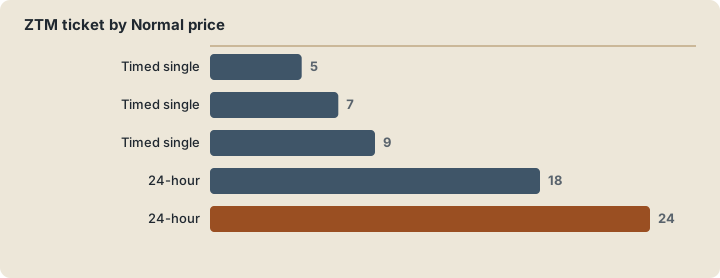
Getting around for all of this is cheap and simple. ZTM timed tickets, valid in all zones with transfers, cost 7 zl for 45 minutes and 9 zl for 90 minutes, and a 24-hour zone A ticket is 18 zl, with the full detail in the public transport guide. One warning the fare page makes itself: travelling without a valid ticket costs 350 zl, or 175 zl if paid within 7 days, so validate before you ride to the bakery.
| ZTM ticket | Validity | Normal price | Reduced price |
|---|---|---|---|
| Timed single | Up to 15 minutes, all zones | 5 zl | 2.50 zl |
| Timed single | Up to 45 minutes, all zones | 7 zl | 3.50 zl |
| Timed single | Up to 90 minutes, all zones | 9 zl | 4.50 zl |
| 24-hour | Zone A | 18 zl | 9 zl |
| 24-hour | Zones A+B+C+D | 24 zl | 12 zl |
What Else Should You Know Before You Go?
Bring zloty, not euros: Poland keeps its own currency, the PLN, and every price in this article is in zl; carry a passport or national ID even on the Berlin train because Poland runs temporary controls at its land borders with Germany until 30 March 2027, and expect EES fingerprint and photo registration at the external Schengen border if you arrive by air from outside the Schengen area.
The EES, the EU's Entry/Exit System, has been fully operational at all external Schengen border crossing points since 10 April 2026, so non-EU arrivals should expect biometrics to be taken, at no cost for registration. ETIAS, the travel authorisation for visa-exempt visitors, is a different scheme, and its start date and fee are not settled in official material this desk can verify, so check the EU's official ETIAS site before you travel rather than trusting a date printed anywhere, including here.
Getting to Poznan for the croissant season has never had more options. The airport's own news pages report an airBaltic route to Las Palmas from 26 October 2026 and four new Ryanair routes, to Barcelona, Porto, Shannon and Tirana, from a fifth based aircraft in winter 2026/27. The airport guide and the page on getting from the airport to the centre handle the arrival, and train travellers can use the Berlin and Warsaw rail guides, remembering to carry ID for the German border.

Where to sleep is covered in the where to stay guide, and the Poznan City Card may matter if museums are on the list alongside the bakeries: the card gives free entry to most of the city's museums, though partners such as Enigma and Porta Posnania are discounted rather than free, at 21 and 17 zl and 21 zl respectively per their own price pages.
Common Questions About The St Martin Croissant
What Is A St. Martin's Croissant?
A crescent-shaped pastry of sweet laminated yeast dough filled with a white poppy seed mass, glazed and baked in and around Poznan in western Poland. The name is protected across the EU as a Protected Geographical Indication by Commission Regulation (EC) No 1070/2008 of 30 October 2008.
Is A St Martin's Croissant A Normal Croissant?
No. The dough is a sweet yeast dough, not French viennoiserie, and the white poppy seed filling with nuts and candied fruit makes up much of the pastry's weight. It is closer to a filled festive roll than to a plain butter croissant.
When Do Poznan Bakers Sell St Martin's Croissants?
All year in many bakeries, with production peaking around 11 November, the feast of St Martin and Poland's Independence Day, and staying high through the Christmas market season, which in 2026/27 runs on the Old Market Square from 21 November 2026 to 6 January 2027.
Where Can I See The Croissant Being Made?
At the Croissant Museum at Stary Rynek 41/2, entrance from Klasztorna Street 23. Polish shows run at 11:00, 12:30, 14:00 and 15:30 with an extra 17:00 show on Saturdays; the English show at 14:00, about 65 minutes, runs daily in July and August and on weekends all year, with a 15:30 English show opened when 14:00 is full.
Is There A Parade On St Martin's Day In Poznan?
Not in the recent format: the 2025 edition replaced the parade with an all-day "Miasteczko Imieninowe" on police safety recommendations, and the 2026 programme had not been published when this page was prepared. The street celebrates its name day with an event organised by CK Zamek, whose programme page carries the current details.
Can I Bring St Martin's Croissants Home?
Yes, they travel well for a day or two in a paper bag and freeze for longer. Buy from bakeries selling under the protected name in Poznan, since the name guarantees the registered recipe and area.
The croissant is the one Poznan tradition you can put in a paper bag, and the protection that guards its name is the reason the bag is worth carrying home.