Gniezno Day Trip From Poznan
Gniezno sits a short train ride east of Poznan, in the Wielkopolskie voivodeship of western Poland, and its cathedral hill, bronze doors and museums make it one of the easiest day trips from the city.

Short answer
Gniezno is a small city in western Poland, east of Poznan, reachable by train in about 25 to 45 minutes. Its cathedral hill is open Monday to Saturday from 9:00 to 17:00 in the summer season, but on Sundays the cathedral and museum close to tourists and only the viewing terrace opens.
Gniezno is a small city in western Poland, in the same Wielkopolskie voivodeship as Poznan, and it makes one of the simplest day trips you can build from the regional capital. The city's own name is plain on every sign, its hill is walkable, and the train connection from Poznan Glowny is short enough that you can leave after breakfast and still put in a full day. This guide lays out what the official pages actually say: the cathedral hill's hours and ticket prices, the one day of the week when the cathedral closes to tourists, the train journey as the operator's timetable reports it, and how Gniezno fits alongside Biskupin, Kornik and Lednica in a wider Wielkopolska itinerary.
Where Is Gniezno?
Gniezno is a city in western Poland, in the Wielkopolskie voivodeship, east of Poznan across the flat farmland of Greater Poland. The two cities are close enough that Koleje Wielkopolskie timetables report the train journey between them at about 25 to 45 minutes, which puts Gniezno firmly inside Poznan's day-trip range. The city is small, compact around a hill, and everything a visitor needs sits within walking distance of the station area.
Poznan, for anyone arriving from further afield, is the capital of the Wielkopolskie voivodeship (Greater Poland) and stands on the Warta river in western Poland; the Statistical Office in Poznan puts its population at 534,239. Gniezno shares that region and, in practical terms, its transport system: the same regional railway line, the same flat landscape of fields and lakes, and the same weather station region, since the climate figures used on this site come from the WMO 1991-2020 normals for the Poznan station.
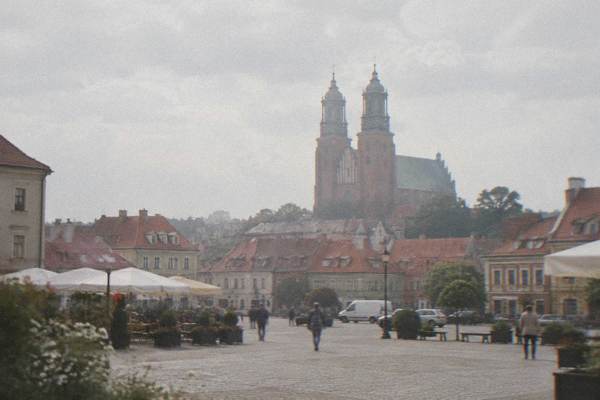
The city's layout is simple. The centre clusters around a hill, known in Polish as Wzgorze Lecha, where the cathedral stands, and the streets around it hold the Museum of the Origins of the Polish State, the old market square and a cluster of cafes. Nothing in the visitor core requires a bus or a taxi; the distances are short and the terrain, apart from the hill itself, is flat.

| What | The fact |
|---|---|
| Region | Wielkopolskie voivodeship (Greater Poland), western Poland |
| Direction from Poznan | East |
| Train journey from Poznan | About 25 to 45 minutes (Koleje Wielkopolskie timetables, check the operator for the day) |
| Visitor core | Cathedral hill (Wzgorze Lecha), Museum of the Origins of the Polish State, old market square |
| Currency | Polish zloty (PLN, "zl") |
| Best day to avoid | Sunday, when the cathedral and hill museum close to tourists |
One warning before anything else, because it is the single most common planning mistake on this route: Sunday is not the best day to visit Gniezno. The Museum of the Origins of the Polish State is free on Sundays, which sounds appealing, but on Sundays the cathedral and the hill museum close to tourists entirely and only the viewing terrace opens, in two windows, 13:00-15:00 and 16:00-17:30. A Monday-to-Saturday visit gives you everything.
How Do You Get From Poznan To Gniezno?
The train is the practical answer. Koleje Wielkopolskie's line timetables report the Poznan to Gniezno journey at about 25 to 45 minutes, and the operator's own timetable page is the place to confirm times for your travel day. There is no sourced figure for a bus journey time or a taxi fare on this route, so this guide prints none. Drivers can hire a car in Poznan and take the same corridor east.
The train figures above are reported ranges from the operator's timetable documents, not minute-exact promises. Polish regional trains vary by departure, and the only way to know what your specific train does is the Koleje Wielkopolskie timetable for the day. What is safe to say is that the route is short enough that a day trip does not consume itself in transit.
For travellers coming from beyond Poznan, the same logic applies in reverse. Trains from Warsaw to Poznan take about 2 h 20 to 3 h 20 and from Berlin about 4 h 30 to 5 h 30, again as reported ranges, so Gniezno works as an add-on to a Poznan base rather than a destination you reach directly from far away. Anyone planning wider rail travel can check current Poznan connections through rail options toward Warsaw or rail options toward Berlin.
Drivers have a second option. Car hire in Poznan covers the whole region, and a car is what turns Gniezno from a single-hill visit into a loop that can take in Biskupin, Kornik or Lednica in one day, since the distances between these places are short even though this site prints no kilometre figures for them. If a loop is the plan, compare car hire in Poznan before committing to trains, because the return legs from the smaller places are less frequent.

| Way of getting there | What is known | What to check |
|---|---|---|
| Train from Poznan Glowny | About 25 to 45 minutes, reported range | Koleje Wielkopolskie timetable for the day |
| Car from Poznan | Short drive east; no sourced distance or time printed | Road conditions and parking at the destination |
| Guided day trip | Covers Gniezno with Biskupin and Wenecja in one booking | The operator's live listing for dates and inclusions |
| Bus or taxi | No sourced journey time or fare on this route | Nothing to print; use the train |
What Can You See On Gniezno's Cathedral Hill?
The hill, Wzgorze Lecha, holds the cathedral, a museum and a viewing terrace, and its own price list page gives the hours plainly: from 1 May to 31 October the cathedral, museum and terrace are open Monday to Saturday from 9:00 to 17:00, while on Sundays the cathedral and museum close to tourists and only the terrace opens, 13:00-15:00 and 16:00-17:30. From 1 November to 30 April the museum runs Monday to Saturday, 9:00 to 16:00.
That Sunday rule deserves its own sentence in your notes. It is unusual: most Polish attractions close on Monday and run normally on Sunday, but Gniezno's hill inverts the pattern because the cathedral is a working place of worship. Sunday visitors get the terrace, in two afternoon windows, and nothing else on the hill itself.
The terrace is the hill's viewpoint, and the individual ticket prices on the hill's price list are as follows. The Gniezno Doors, the famous bronze doors of the cathedral, are ticketed at 16 zl normal and 14 zl reduced. The cathedral vaults cost 14 zl normal and 12 zl reduced. The viewing terrace (the tower) is 12 zl normal and 10 zl reduced. The Museum of the Archdiocese is 18 zl normal and 16 zl reduced. An all-inclusive pass with an audio guide runs 48 zl normal and 42 zl reduced, and a guide for individuals costs 4 zl per person.
| Hill attraction | Normal (zl) | Reduced (zl) |
|---|---|---|
| Gniezno Doors | 16 | 14 |
| Cathedral vaults | 14 | 12 |
| Viewing terrace (tower) | 12 | 10 |
| Museum of the Archdiocese | 18 | 16 |
| All-inclusive pass with audio guide | 48 | 42 |
| Guide for individuals | 4 per person | 4 per person |
The all-inclusive pass is the obvious pick for a first visit, since it bundles everything on the hill for less than the sum of the parts. The audio guide that comes with it is also the practical way around the fact that guided commentary in English is not guaranteed at the door; for travellers who prefer audio commentary everywhere they go, audio tour options cover several Polish cities.

Downhill from the cathedral, the Museum of the Origins of the Polish State at ul. Kostrzewskiego 1 runs on its own schedule, and its own page states it plainly: daily, May to September 9:00-18:00, October to April 9:00-16:00, with Sunday as the free-admission day and a free car park opposite. Ticket prices for the museum's exhibitions are not published in a form this site can verify, so the honest advice is to check the museum's own page before you go. The museum is the place where the story of the early Polish state is told in artefacts, and it pairs naturally with the hill above it.
When Is The Best Time To Visit Gniezno?
The best months for a Gniezno day trip are May through September, when the hill runs its full 9:00-17:00 schedule every day except Sunday, the Museum of the Origins is open until 18:00, and the WMO 1991-2020 normals for the Poznan station show mean daily highs from 19.8 C in May to 25.2 C in July. Winter visits work too, but the hill's museum shortens to 9:00-16:00 and the days are cold.
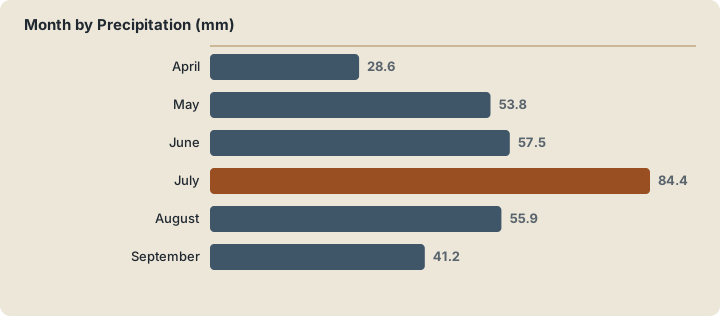
The climate figures on this site come from the World Meteorological Organization's 1991-2020 climate normals for the Poznan station (WMO 12330), observed by IMGW-PIB. They describe the region Gniezno shares with Poznan, and they carry two planning warnings. July is both the warmest and the wettest month, with 84.4 mm of precipitation on average, so the peak of summer is also the peak of rain. April is the driest month at 28.6 mm, and May sits at 53.8 mm with a mean high of 19.8 C, which makes late spring a strong compromise.
| Month | Mean daily high (C) | Mean daily low (C) | Precipitation (mm) | Days with 1 mm+ |
|---|---|---|---|---|
| April | 15.0 | 4.0 | 28.6 | 6.1 |
| May | 19.8 | 8.4 | 53.8 | 8.3 |
| June | 23.1 | 11.9 | 57.5 | 8.4 |
| July | 25.2 | 14.1 | 84.4 | 9.5 |
| August | 24.9 | 13.7 | 55.9 | 8.4 |
| September | 19.5 | 9.6 | 41.2 | 7.4 |
Frost is a winter consideration: January averages 19.7 frost days and December 17.5, while June through August record none. A winter trip is perfectly possible, and the museum's 9:00-16:00 winter hours leave room for a full afternoon, but pack for a mean January low of -2.9 C. Anyone sensitive to planning around weather can dig deeper with the site's month-by-month breakdown in Poznan Weather By Month and the wider timing discussion in When To Visit Poznan.
Can You Combine Gniezno With Biskupin In One Day?
Yes, and a guided option exists that does exactly this: the full-day trip from Poznan covers Gniezno, Biskupin and Wenecja in one booking, which matters because the public transport connections between these small places are thin and the day is otherwise spent watching timetables. Independent travellers can do it too, but Biskupin's seasonal hours and the return legs need checking on the operator's pages first.
Biskupin's own page gives the hours: May to September 9:00-18:00, April and October 9:00-17:00, November to March 9:00-16:00, closed on 1 January, Easter Sunday, 1 November and 25 December. Tickets are 28 zl normal, 19 zl reduced, free for children up to 7, and a family 2+2 ticket is 75 zl. The site is an archaeological reserve, a reconstructed early settlement, and it is the kind of place children remember, which is why the combined itinerary is a favourite with families. The wider set of guides lives on Poznan Travel Guide.
| Stop | Hours (own page) | Tickets (zl) | Closed |
|---|---|---|---|
| Gniezno cathedral hill (May-Oct) | Mon-Sat 9:00-17:00 | See hill table above | Sunday (terrace only) |
| Museum of the Origins, Gniezno | May-Sep 9:00-18:00; Oct-Apr 9:00-16:00 | Check the museum page | Open daily; Sunday free |
| Biskupin | May-Sep 9:00-18:00; Apr, Oct 9:00-17:00; Nov-Mar 9:00-16:00 | 28 / 19; family 2+2 75 | 1 Jan, Easter Sunday, 1 Nov, 25 Dec |
The guided version removes the connection risk entirely. The operator's live listing carries the current price, dates and inclusions, and the trip is the one this site features for this route.
For readers building the day independently, the honest version of the advice is this: start early, do Gniezno's hill in the morning while everything is open, and give Biskupin the afternoon, checking the last entry rules on its page before you commit. Wenecja, the third stop on the guided itinerary, holds its own small railway attraction; its details sit on the same regional pages and should be checked on the day.

What Other Day Trips Sit Near Gniezno?
The same eastern and southern corridor from Poznan holds Kornik Castle, Lednica and Rogalin, and each has a verified page of its own: Kornik Castle is closed Mondays with 40 zl normal entry, the Rogalin Palace Museum is closed Mondays at 20 zl normal, and the Lednica museum site lists Ostrow Lednicki at 25 zl normal. Distances and bus routes between them are not sourced on operator pages, so this guide prints none.
Kornik Castle, run by the PAN Kornik Library, is open Tuesday to Sunday and closed Mondays. Its low season, 14 February to 30 April and 1 October to 30 November, runs 10:00-15:15 with last entry at 14:30; high season, 1 May to 30 September, runs 10:00-17:00 with last entry at 16:15. The 2026 tourist season closes on 14 December. Tickets are 40 zl normal and 20 zl reduced, a Polish-language guide is 150 zl, an English or German guide 200 zl, and audio guide rental is 15 zl. The Kornik Arboretum next door is open every day, November to March 10:00-16:00, at 10 zl adult, 7 zl reduced, family 25 zl.
Rogalin Palace Museum, a branch of the National Museum in Poznan, keeps Monday closed and Tuesday to Sunday 9:00-16:00 in its standard schedule, with the park open 9:00-16:30 from November to February. Normal entry is 20 zl, reduced 13 zl, and Tuesday is free. It is closed on 1 November, 24 to 26 December, 31 December and 1 January.
| Day trip from Poznan | Open | Closed | Normal ticket (zl) |
|---|---|---|---|
| Kornik Castle | Tue-Sun; low season 10:00-15:15, high 10:00-17:00 | Monday | 40 |
| Kornik Arboretum | Daily; Nov-Mar 10:00-16:00 | Never | 10 |
| Rogalin Palace Museum | Tue-Sun 9:00-16:00 (standard schedule) | Monday; 1 Nov, 24-26 Dec, 31 Dec, 1 Jan | 20 |
| Lednica: Ostrow Lednicki | Check the museum page | Check the museum page | 25 (35 with audio guide) |
The Lednica site's 2026 price list gives the museum seat at 30 zl normal and 20 zl reduced, Ostrow Lednicki at 25 zl normal (35 zl with audio guide) and 17 zl reduced (20 zl with audio guide), free for children up to 7, with free parking. The opening date of its new museum building is not confirmed on the official site, so this guide states none. The site's fuller write-ups live at Kornik Castle, Rogalin Palace and Lake Lednica And Ostrow Lednicki.

How Does Gniezno Compare With Poznan's Own Sights?
Gniezno's hill and Poznan's Ostrow Tumski are natural companions, and the pairing is honest about what each does best: Poznan's cathedral crypts hold the tombs of Mieszko I and Boleslaw Chrobry and open 1 March to 15 November, while Gniezno's hill gives the fuller museum-and-terrace visit with its all-inclusive pass at 48 zl. Both close parts of themselves to tourists on particular days, so the sequencing matters.
Poznan's own cathedral, on Ostrow Tumski, opens its crypts and tower to tourists from 1 March to 15 November, weekdays 9:00-16:00 and Sundays 14:00-18:00. Crypts are 10 zl normal, 8 zl reduced, family 25 zl; the tower is 14 zl normal, 12 zl reduced, family 40 zl. The page states the tower has been open since 1 June 2026. Nearby, Porta Posnania at ul. Gdanska 2 is closed Mondays, runs Tue-Fri 9:00-18:00 and Sat-Sun 10:00-19:00, and charges 35 zl normal and 29 zl reduced, or 21 zl with the Poznan City Card.
The comparison is worth making because many travellers treat Gniezno and Poznan as an either-or. They are not. Poznan is the base with the hotels, the Old Market Square and the goat clock on the Town Hall facade (the goats appear every day at noon and, since recently, at 3 pm, though whether they run during the current facade works is not confirmed, so never promise the show on a given day). Gniezno is the excursion. The site's own pages cover Poznan Cathedral, Porta Posnania and the Old Market Square in full.

What Should You Check Before You Go?
Three things decide whether a Gniezno day works: the day of the week, the season and the train times. Avoid Sunday if you want the cathedral and hill museum, avoid Monday-adjacent planning errors on the combined trips (Kornik and Rogalin close Mondays), and confirm your trains on the Koleje Wielkopolskie timetable rather than trusting a remembered time. Everything else on this route is forgiving.
The checklist below is short because the route is short. The one genuinely non-negotiable item is the Sunday rule on the hill. The second is the realisation that the free Sunday admission at the Museum of the Origins is a trap for the unwary: it tempts you onto a day when the hill above it is shut to tourists.
| Check | Why it matters | Where to check |
|---|---|---|
| Day of the week | Sunday closes the cathedral and hill museum to tourists | The hill's own price and hours page |
| Season | Hill hours change between 31 Oct and 1 May | The hill's own page |
| Train times | Journey is about 25 to 45 minutes, varies by departure | Koleje Wielkopolskie timetable |
| Museum of the Origins tickets | Prices not published in verifiable form | The museum's own page |
| Combined-trip closures | Kornik and Rogalin close Mondays; Biskupin has seasonal hours | Each operator's own page |
Money is simple: Poland uses the zloty (PLN), not the euro, and every figure in this guide is a zl figure from an official page. Exchange rates move daily, so no fixed rate is printed here. Budget planning for the wider trip is covered in How Much Money Do I Need Per Day In Poland, and a rainy alternative day is sketched in Poznan Rainy Day ideas.
Is A Guided Tour Or An Independent Trip Better For Gniezno?
Independent travel suits confident visitors who want the hill at their own pace, since the train is short and the town is compact, but the guided full-day trip wins on the combined itinerary because it strings Gniezno, Biskupin and Wenecja together without thin rural connections. The operator's live listing carries the current price and dates, and this site never prints a product figure that does not come from the listing itself.
The trade-off is really about the second half of the day. Gniezno alone is an easy independent trip: one train, one hill, one museum, done. Biskupin and Wenecja are the part where a guided day earns its keep, because the connections between small places in this corner of Wielkopolska are not dense, and a misjudged return leg can strand an afternoon. Families with children usually come out ahead on the guided option for exactly this reason.
For the evening back in Poznan, the city's own offerings are covered elsewhere on this site, from the Poznan food guide to the nightlife options below.
Beer lovers have a second evening option that pairs well with a day of early-state history.

Common Questions About A Gniezno Day Trip
Where Is Gniezno?
Gniezno is a small city in western Poland, in the Wielkopolskie voivodeship, east of Poznan. Koleje Wielkopolskie timetables report the train journey from Poznan at about 25 to 45 minutes, which makes it one of the shortest day trips from the regional capital.
Is Gniezno open on Sundays?
Partly. The Museum of the Origins of the Polish State is open daily and free on Sundays, but on Sundays the cathedral and the hill museum are closed to tourists and only the viewing terrace opens, from 13:00 to 15:00 and from 16:00 to 17:30. Monday to Saturday is the better choice for a full visit.
How much do Gniezno Cathedral Hill tickets cost?
The hill's own price list gives the Gniezno Doors at 16 zl normal and 14 zl reduced, the cathedral vaults at 14 and 12 zl, the viewing terrace at 12 and 10 zl, the Museum of the Archdiocese at 18 and 16 zl, and an all-inclusive pass with audio guide at 48 zl normal and 42 zl reduced.
How long is the train from Poznan to Gniezno?
Koleje Wielkopolskie timetables report the journey at about 25 to 45 minutes, depending on the departure. Check the operator's timetable for your specific train, since this site prints reported ranges rather than minute-exact times.
Can you visit Gniezno and Biskupin in one day?
Yes. A guided full-day trip from Poznan covers Gniezno, Biskupin and Wenecja in a single booking, which sidesteps the thin public transport connections between them. Independent visitors should do Gniezno's hill in the morning and Biskupin in the afternoon, checking Biskupin's seasonal hours first.
What is the best time of year to visit Gniezno?
May to September, when the hill runs its full 9:00-17:00 schedule Monday to Saturday and the Museum of the Origins stays open until 18:00. WMO's 1991-2020 normals for the Poznan station show mean daily highs from 19.8 C in May to 25.2 C in July, with July also the wettest month at 84.4 mm, so late spring is a strong pick.
A Gniezno day trip is, in the end, a low-effort plan with one high-stakes detail: go Monday to Saturday, and the hill, the doors, the vaults and the terrace are all yours for the price of a short train ride and a 48 zl all-inclusive pass.