Biskupin Day Trip From Poznan
Biskupin, the reconstructed fortified settlement reached on a day trip from Poznan, is one of the most-visited archaeological reservations in Poland. Here is what the museum's own pages say about hours, prices and how to fit it into a Wielkopolska itinerary.

Short answer
Biskupin is open daily by season (May-September 9:00-18:00, April and October 9:00-17:00, November-March 9:00-16:00), tickets cost 28 zl normal and 19 zl reduced, and the site sits on a lake peninsula north-east of Poznan, most often combined with Gniezno.
Biskupin, in the Znin district north-east of Poznan, Poland, is one of the country's best-known archaeological reservations: a reconstructed timber settlement behind timber ramparts, standing on a peninsula jutting into a lake. Poznan, the capital of the Wielkopolskie voivodeship (Greater Poland) on the Warta river, is the natural base for visiting it, and the reservation sits alongside Gniezno, Lednica and other Wielkopolska sites in a compact day-trip arc. This guide sets out what the museum's own pages state about opening hours, admission prices and seasonal closures, what a visit involves, and how the desk at Poznan Travel Guide would combine Biskupin with the neighbouring sites.
What Is Biskupin And Why Do Day Trippers Go?
Biskupin is a full-scale reconstruction of a fortified lakeside settlement, presented today as the Biskupin Archaeological Museum, with timber ramparts, a breakwater, streets of thatched longhouses and ongoing archaeological work, and it ranks among the most-visited archaeological attractions in Poland. The reservation rebuilds a defensive settlement whose timber remains were preserved in the wet ground of the peninsula, and the museum uses the reconstruction to show everyday life behind the ramparts: houses furnished with hearths and tools, craft demonstrations, and seasonal events. The reservation also hosts an annual Archaeological Festival; the XXXI edition ran from 12 to 16 September 2026. For visitors based in Poznan the appeal is simple: it is a walkable, family-friendly open-air museum that pairs naturally with Gniezno, whose cathedral hill holds the tombs of Mieszko I and Boleslaw Chrobry, and with the Museum of the First Piasts at Lednica.

The site is managed as a branch museum with a seasonal calendar, so the experience changes with the year. In high summer the longhouses are open, demonstrations run through the day and the festival fills the calendar. In winter the museum keeps shorter hours and the lakeside walks are quieter. The desk's advice is to read the two tables below before choosing a date, because the difference between a 9:00-18:00 summer day and a 9:00-16:00 November one is the difference between a full day and a tight half.
A note on expectations: the fort is a reconstruction, not an untouched ruin, and the museum presents it that way, with the excavated material shown in the exhibition block rather than left in situ. That is precisely why it works so well for families and for visitors new to the period, since you walk through furnished streets rather than read labels over postholes. Visitors who want the below-ground half of the story can pair the day with the Genius Loci archaeological reserve back in Poznan, where the remains themselves are the exhibit.
How Do You Get From Poznan To Biskupin?
There is no verified public-transport figure for the Poznan to Biskupin journey in this desk's sources, so the honest answer is that many visitors arrive either by car or on an organised day tour, with the train to Gniezno (about 25 to 45 minutes, as reported from the Koleje Wielkopolskie timetable) covering the first leg of a combined Gniezno and Biskupin route. The distances and bus lines to Biskupin are not published on an operator page this desk could verify, so no kilometre count or minute count is printed here. What can be said with confidence: Biskupin lies in the Znin lake district, Gniezno is the rail hub on that side of the region, and a car gives the most control over a loop that takes in Gniezno, Biskupin and the Wenecja narrow-gauge railway in one day.
For drivers, compare car hire options for Poznan before committing to a rail-only plan. For everyone else, the organised option removes the transfer question entirely: the full-day tour from Poznan covers Gniezno, Biskupin and Wenecja in a single loop, and Check availability on the operator's live listing for your date. A sensible rail-and-road plan is described in the Gniezno day trip guide, which also covers the Sunday closure of the cathedral hill.
If you would rather build the trip around the city first, a Poznan self-guided walking tour or an itinerary such as one day in Poznan lets you judge how much city time to trade for a Biskupin day. Visitors on longer routes, including the Berlin to Poznan day trip, sometimes extend into Wielkopolska exactly for this arc of early-Polish sites; note that Poland has temporary internal border controls at its land border with Germany, so carry ID on the Berlin train.

What Does Biskupin Cost And When Is It Open?
The Biskupin Archaeological Museum lists three seasonal schedules, May to September 9:00-18:00, April and October 9:00-17:00, and November to March 9:00-16:00, with the museum closed on 1 January, Easter Sunday, 1 November and 25 December, and tickets at 28 zl normal, 19 zl reduced, free for children up to 7, and 75 zl for a family of two adults and two children. Those figures come from the museum's own visiting page, and they are the numbers to plan around. Note the closure list carefully: it is 1 November and 25 December, not the 24 to 26 December block some outlets print.
| Season | Opening hours | Notes |
|---|---|---|
| May to September | 9:00-18:00 | High season, longest days on site |
| April and October | 9:00-17:00 | Shoulder season |
| November to March | 9:00-16:00 | Winter schedule |
| Ticket type | Price |
|---|---|
| Normal | 28 zl |
| Reduced | 19 zl |
| Family (2 adults + 2 children) | 75 zl |
| Children up to 7 | Free |
The reduced rate applies to the usual concession groups; confirm your category on the museum's page when buying. Prices are in zloty, Poland's currency, and Poland is not in the euro area, so do not expect euro prices at the ticket window. The desk's planning note: the Archaeological Festival in mid-September is the single busiest period, so if you want the demonstrations without the biggest crowds, aim for June or early September instead. For a rainy-day alternative closer to the city, see the Poznan rainy day guide.

What Can You See Inside The Biskupin Reservation?
The core of a Biskupin visit is the reconstructed fort itself: a timber rampart ring with a gatehouse, internal streets of thatched longhouses, a lakeside breakwater, and an archaeological exhibition block that presents the excavated finds and the history of the dig. The longhouses are furnished to show daily life, with hearths, bedding platforms, tools and grain stores, and in season the museum fills them with craft demonstrations. Around the fort, the peninsula carries walking routes along the lake shore, and the wider reserve includes later-period reconstructions and experimental-archaeology areas that change from year to year, so the museum's current programme is worth reading before a repeat visit.
Plan on the better part of a day in high season and at least two hours even in winter. The surfaces are earth and timber, so footwear matters after rain, and the site is flat and largely step-free along the main routes. Families get a lot from it: children up to 7 enter free, the family ticket is 75 zl for two adults and two children, and the festival edition that ran 12 to 16 September 2026 added children's programming to the usual demonstrations. If the visit leaves you hungry for the period's wider story, the natural follow-ups are Poznan Cathedral, where the crypts hold the tombs of Mieszko I and Boleslaw Chrobry, and Porta Posnania on Ostrow Tumski, which interprets the same early-Polish story in multimedia form.
Photography needs no special arrangement in the open-air area, and the lakeside light in the late afternoon, when the summer schedule is still open until 18:00, is the moment most worth staying for. Do budget for the walk back along the breakwater at least once; the view of the ramparts across the water is the shot many visitors come away with.
Can You Combine Biskupin With Gniezno Or Lednica In One Day?
Yes, and that combination is the classic Wielkopolska day trip: Gniezno's cathedral hill and Museum of the Origins of the Polish State pair with Biskupin in one loop, with the Museum of the First Piasts at Lednica as a quieter third stop, and the main scheduling trap is that on Sundays the Gniezno cathedral and its museum are closed to tourists and only the viewing terrace opens, from 13:00-15:00 and 16:00-17:30 in the May to October season. The Gniezno origins museum itself is open daily, 9:00-18:00 May to September and 9:00-16:00 October to April, and Sunday is its free-admission day, which makes Sunday a bargain for the museum and a disappointment for the cathedral. Do the hill on a weekday if you can.
| Stop | Opening rhythm | Admission | Monday |
|---|---|---|---|
| Biskupin | Daily by season (see table above) | 28 / 19 zl, family 75 zl | Open |
| Gniezno, Museum of the Origins of the Polish State | Daily, 9:00-18:00 May-Sep, 9:00-16:00 Oct-Apr | Sunday free | Open |
| Gniezno, cathedral hill and museum | Mon-Sat 9:00-17:00 (May-Oct) | Terrace 12 / 10 zl; all-inclusive pass 48 / 42 zl | Closed Sundays to tourists |
| Museum of the First Piasts at Lednica | Hours unsourced, check the museum | Museum seat 30 / 20 zl | Check before travel |
At Lednica, the 2026 price list on the museum's own page gives the museum seat at 30 zl normal and 20 zl reduced, Ostrow Lednicki at 25 zl normal (35 zl with audio guide) and 17 zl reduced (20 zl with audio guide), children up to 7 free and parking free. The opening date of the new museum building and the ferry season to the island are unsourced, so check the museum's page before promising yourself the island. The Lednica and Ostrow Lednicki guide carries the fuller picture, and the seven days in Poland via Poznan itinerary shows how these stops chain together.

For a different flavour, Kornik Castle and Rogalin Palace sit south of Poznan rather than north-east, and both are closed on Mondays, which matters if you are chaining days. Greater Poland National Park is another southern option, though its entry fees and museum terms are unsourced here, so describe it as a landscape stop, not a priced one. Further afield, Torun and the Wolsztyn steam trains round out the regional list for a second or third day out of the city.
When Is The Best Time Of Year To Visit Biskupin?
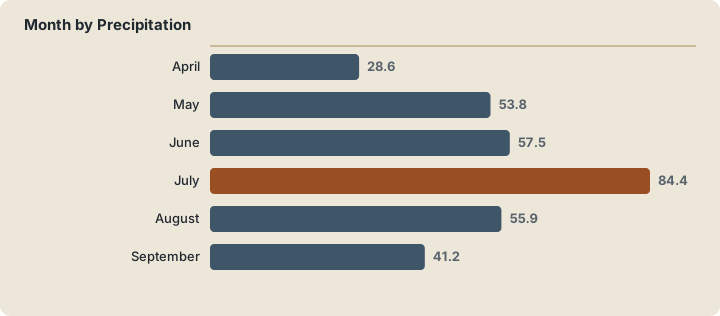
The desk's read of the WMO 1991-2020 climate normals for the Poznan station is that May to September, Biskupin's 9:00-18:00 season, is also the comfortable window, with July the warmest month (mean daily high 25.2 C) but also the wettest (84.4 mm of precipitation), April the driest (28.6 mm), and the frost season running from roughly November through March, with January's mean daily low at -2.9 C. Those normals are measured at the Poznan station, and Biskupin sits a similar continental climate away, so treat them as regional planning figures, not a forecast for the lake shore.
| Month | Mean daily high | Mean daily low | Precipitation |
|---|---|---|---|
| April | 15.0 C | 4.0 C | 28.6 mm |
| May | 19.8 C | 8.4 C | 53.8 mm |
| June | 23.1 C | 11.9 C | 57.5 mm |
| July | 25.2 C | 14.1 C | 84.4 mm |
| August | 24.9 C | 13.7 C | 55.9 mm |
| September | 19.5 C | 9.6 C | 41.2 mm |
The sweet spot, in the desk's planning view, is late May to June or early September: full opening hours, moderate rainfall, and in September the possibility of catching the Archaeological Festival's demonstrations. Winter visits are possible, 9:00-16:00 from November to March, and the low light on the lake has its own appeal, but the demonstration programme thins out and you should dress for means around freezing. The best time to visit Poznan guide carries the month-by-month detail, and the Poznan weather by month page the full table.

What Should You Know Before You Go?
Five practical points from the verified sources: Biskupin takes zloty, not euro; it is one of the few Wielkopolska day-trip sites open on Mondays, unlike Kornik Castle and Rogalin Palace; children up to 7 enter free and the family ticket is 75 zl; the site is open-air, so weather shapes the day more than at a city museum; and if you are arriving via Berlin, Poland's temporary border controls at the German land border run to 30 March 2027, so carry ID on the train. None of these is obvious from a first page of search results, and each one changes a plan.
| Practical point | What the sources say |
|---|---|
| Currency | Zloty (PLN); Poland is not in the euro area |
| Monday openings | Biskupin open; Kornik Castle and Rogalin Palace closed |
| Family pricing | 75 zl for 2 adults + 2 children; under 7s free |
| Site character | Open-air reconstruction; earth and timber surfaces |
| Border note | Temporary German land-border controls to 30 March 2027; carry ID |
Beyond the essentials, two comfort additions help. An audio tour on your own phone suits visitors who like context at their own pace: browse audio tour options and load one before you leave the city, as coverage at the lake can be patchy. And if your trip is anchored to the city rather than the region, the walking options in Poznan Old Town or the Old Market Square show you what you are trading a Biskupin day for: the Town Hall goats, which the National Museum's page says appear at noon and, since recently, also at 3 pm.
What to pack follows from the site's character rather than any dress code: solid shoes for timber walkways, a layer for the lake breeze even in July, water in summer, and nothing you would mourn if it picks up reed dust. The reserve's own programme page is the place to check whether a demonstration day or a quieter walk suits you better.
Is A Guided Tour Better Than Visiting Biskupin Independently?
A guided full-day tour is the better choice when the transfer logistics matter more than solo flexibility, because the verified sources carry no public-transport figures for the Poznan to Biskupin leg, while an independent visit rewards travellers who want to set their own pace at the fort and linger at the festival demonstrations or the lakeside walks. The tour route covers Gniezno, Biskupin and Wenecja in one loop, which is a hard day to replicate with regional buses and an early train. Independently, you control the clock: the 9:00-18:00 summer schedule is generous, and the family ticket pricing makes an unhurried family afternoon entirely reasonable.
The desk's split is simple. Solo visitors and families with a car: go independently, using the hours and prices above. Visitors without a car, or anyone fitting Biskupin into a single fixed day between city plans: take the tour, and read the listing for that day's inclusions. Whichever you choose, book the Gniezno cathedral hill for a weekday and keep Sunday for the free origins museum, and the loop falls into place.

Common Questions About Biskupin
Is Biskupin open on Mondays?
Yes. Unlike Kornik Castle and Rogalin Palace, both closed on Mondays, the Biskupin Archaeological Museum is open daily within its seasonal hours: 9:00-18:00 May to September, 9:00-17:00 April and October, and 9:00-16:00 November to March.
How much do Biskupin tickets cost?
The museum's visiting page lists 28 zl normal, 19 zl reduced, free entry for children up to 7, and a family ticket at 75 zl for two adults and two children. Prices are in zloty.
What days is Biskupin closed?
The museum closes on 1 January, Easter Sunday, 1 November and 25 December. It is not the 24 to 26 December block that some listings print; the museum's own page is the source to trust.
Can you visit Biskupin and Gniezno in one day?
Yes, and it is the classic combination. The train from Poznan to Gniezno takes about 25 to 45 minutes as reported from the Koleje Wielkopolskie timetable, and Biskupin lies beyond Gniezno in the Znin lake district. Avoid Sunday for the cathedral hill, which closes to tourists that day, with only the viewing terrace opening in the afternoon.
Is Biskupin good for children?
Yes. The reservation is an open-air site with furnished longhouses, craft demonstrations in season and children's programming during the September Archaeological Festival, and children up to 7 enter free with a 75 zl family ticket covering two adults and two children.
Is Biskupin open in winter?
Yes, on the winter schedule: 9:00-16:00 from November to March, closed only on 1 January, 1 November and 25 December in that period. Expect fewer demonstrations and dress for means around freezing, with January's mean daily low at -2.9 C in the regional normals.

Biskupin rewards a small amount of planning: pick a weekday outside the festival crush, check the seasonal hours table, carry zloty for the 28 zl ticket, and pair the fort with Gniezno's cathedral hill while keeping Sunday for the free origins museum.