What's A Typical Polish Breakfast?
What a typical Polish breakfast is, from open sandwiches and eggs to the St Martin's croissant and pyry z gzikiem, and where to eat it in Poznan.
Bread is the centre of a typical Polish breakfast, and in Poznan, the capital of the Wielkopolskie voivodeship in western Poland, that bread arrives with a distinctly regional twist. The classic morning table across the country holds fresh rolls or sliced loaf, butter, cold cuts such as ham or sausage, hard cheese, tomato and cucumber, often eggs boiled or scrambled, and strong black tea with lemon, a habit inherited from colder decades when coffee was a luxury. What separates the Poznan table from the Warsaw or Krakow one is the company it keeps: pyry z gzikiem, the Greater Poland pairing of potatoes with a fresh curd cheese mix, and, around 11 November, the St Martin's croissant, the city's protected pastry.

What's A Typical Polish Breakfast?
A typical Polish breakfast is an open-sandwich meal called kanapki: fresh bread rolls or sliced loaf topped with butter, ham or other cold cuts, yellow cheese, tomato and cucumber, served with tea, sometimes coffee, and often eggs boiled, fried or scrambled on the side. Sweet versions appear too, with jam, honey or twarog, the pressed curd cheese Poles treat as a breakfast staple rather than a dessert. It is assembled rather than cooked, fast to lay out, and it scales from a single roll with butter to a full family spread on a Sunday.
The word kanapki covers those open-faced slices, and it is the honest answer to what most Polish households eat before work or school. Nothing about the meal is fussy. The bread matters more than the topping, which is why Poles will walk to a bakery in the morning rather than eat yesterday's roll. In Poznan that bakery walk is a small institution of its own, and the city's guide to what Poznan is famous for starts, for many residents, with food.
Eggs are the other pillar. Jajecznica, soft scrambled eggs, often with sausage or chives, is the weekend version, while a hard-boiled egg sliced onto a kanapka is the weekday one. Tea with lemon, herbata z cytryna, remains more common than coffee at the traditional table, though café culture has shifted that in every large city, Poznan included.
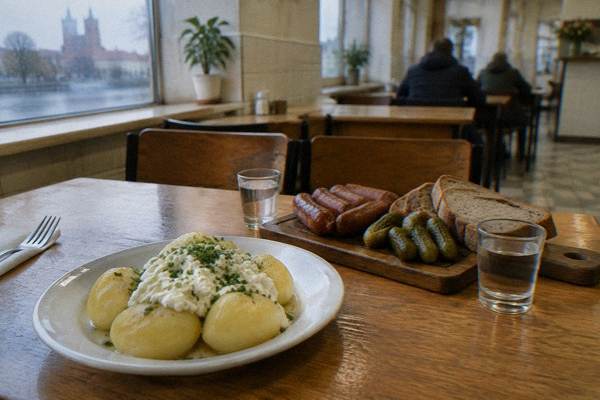
The regional layer is where a national answer stops being enough. Greater Poland, the region around Poznan, is potato country, and its signature breakfast dish is pyry z gzikiem: boiled potatoes served with gzik, a mix of twarog, radish, chives and cream or kefir. The site's dedicated guide to pyry z gzikiem covers the dish in full, but the short version is this: if a menu in Poznan lists it, you are eating the region's own breakfast, not a generic Polish one.
| Element | Weekday version | Weekend or regional version |
|---|---|---|
| Bread | Wheat roll (kajzerka) or sliced loaf | Fresh country loaf, sometimes toasted |
| Savoury topping | Ham, sausage, hard cheese, tomato, cucumber | Egg paste (pasta jajeczna), tartare-style spreads, smoked fish |
| Hot dish | Boiled egg | Scrambled eggs with sausage, pyry z gzikiem |
| Sweet option | Jam or honey on bread | Twarog with cream and sugar |
| Drink | Tea with lemon | Coffee, tea, cocoa for children |
Where Should You Eat Breakfast In Poznan?
Poznan's best breakfast streets sit in and around the Old Town and the Srodka district, the former island between the Old Town and Ostrow Tumski, where bakeries, milk bars and café-bakeries serve kanapki, fresh rolls and pyry z gzikiem. Srodka 3, which the city marked as ten years old in October 2025. Srodka rewards a morning visit precisely because it is compact.
You can cross it on foot between the cathedral island and the Old Market Square, stopping for coffee and pastry, and be in the heart of the Old Town in minutes. That geography is why a guided walk of the district pairs so naturally with breakfast, and the Srodka District And Cathedral Island Private Walking Tour is the listing this site features for exactly that route:
The Old Market Square itself is the other morning anchor. Around it run the streets of the Old Town, whose layout the site's Poznan old town guide walks in detail, and whose café terraces fill from mid-morning. One caution for planners: the Town Hall museum, the historic interior inside the square's landmark building, is closed while renovation work continues, with no reopening date published, so build your morning around the square, the bakeries and the facades rather than an interior visit. A practical note on timing. Polish breakfast habits start early and end early: a traditional milk bar or bakery counter is at its best before mid-morning, while café-brunch culture in Poznan, as in the rest of Poland, runs later into the weekend. If the goats on the Town Hall facade are on your list, the museum's own page has them appearing every day at noon and, since recently, also at 3 pm, which lands neatly after a late breakfast on the square. Whether they run during the current facade works is not stated anywhere official, so treat the show as a bonus rather than a promise.
What Is The Poznan Breakfast Pastry?
The croissant's protected status means only producers in the Poznan area following the registered recipe may sell it under the name. It is not a year-round breakfast item, and that seasonality is part of the point: the croissant arrives with the name-day celebrations in November and disappears when they end. The site's full guide to the St Martin's croissant and the wider St Martin's Day in Poznan page cover the tradition, the recipe rules and where the fresh batches are sold.
One thing a planner should not do is expect a parade. The 2025 edition of the name-day celebrations had no parade at all; it was replaced by an all-day "Miasteczko Imieninowe" on police safety recommendations, and the shape of each year's programme is announced by CK Zamek. The street celebrates its name day, the croissants are baked, and the programme is worth checking rather than assuming. Everything else covered here is indexed on Poznan Travel Guide.

For visitors who want the story with the pastry, the Croissant Museum on the square runs its English "Croissant and goat show" at 14:00, daily in July and August and on Saturdays and Sundays all year, with other days shown in the booking calendar and a 15:30 English show opening only when the 14:00 one fills. The show includes a tasting, the museum's page says, and visitors should arrive ten minutes early. Ticket prices are not published outside the booking widget, so treat the show's cost as something the listing gives.
Can You Learn To Make It, Or Only To Eat It?
You can do both in Poznan, though the city's food experiences lean towards eating rather than cooking: the Croissant Museum's show is the closest thing to a breakfast-making class, since visitors see how the protected croissant is formed and taste one at the end, while bakeries and milk bars do the rest. For a kitchen-level lesson in pyry z gzikiem, the honest answer is that no verified class appears in this site's tour roster, so the reliable route is a good table and a good guide, not a course.
That said, a morning spent walking Srodka and Ostrow Tumski with a guide who knows the bakeries does the same cultural work a class would. The featured private tour of the district and Cathedral Island covers the ground:
The wider point is that breakfast in Poznan is a street-level experience, not a single venue. The croissant show teaches one pastry, the market at Rynek Jezycki, trading Monday to Saturday from 6:00 to 20:00 with only some florists opening on Sunday, shows where the bread and cheese come from, and the cafés of Srodka and the Old Town show how the city eats them now.
Is Breakfast In Poznan Expensive?
Breakfast is one of the cheaper meals of the day in Poznan, because the core of it, a roll with butter and a topping, is bakery-priced rather than restaurant-priced, and Poland's currency is the zloty, not the euro, so a card bill in PLN usually reads lower than visitors expect. The site's detailed answer on whether Poznan is expensive covers the whole budget picture, but breakfast stands out even within it: the cheapest genuine local breakfast is rarely more than the price of a coffee in a Western European capital.
No printed price range belongs here, because a food-price band would be invented; what the constraints of this site do verify is the shape of the market. Milk bars, the state-era canteens that survive across Poland, sell assembled breakfasts at canteen prices. Café-brunch spots around the Old Market Square and Stary Browar, the gallery on ul. Polwiejska open Monday to Saturday 9:00-21:00 and Sunday 10:00-20:00, sit at the other end. And the seasonal croissant, sold only by authorised bakers in November, is priced by each bakery.
Two practical notes on paying and drinking. Contactless bank-card payment on trams and buses is not yet available in Poznan, the PEKA modernisation that will bring it is expected to show effects in 2028, so plan transit tickets through the app, machines or a PEKA card, and carry a little cash for bakery counters. And the tap water is safe to drink, the city utility Aquanet states, so a carafe with breakfast is normal, not a request worth apologising for.
Common Questions About Polish Breakfast In Poznan
What's a typical Polish breakfast?
Open sandwiches on fresh bread or rolls with butter, cold cuts, cheese, tomato and cucumber, plus tea and often eggs. In Poznan add pyry z gzikiem, boiled potatoes with a twarog, radish and chive mix, the Greater Poland signature.
What is pyry z gzikiem?
Pyry z gzikiem is the Greater Poland breakfast of boiled potatoes (pyry in the local dialect) served with gzik, a fresh mix of twarog curd cheese, radish, chives and cream or kefir. It is the dish that most clearly marks a Poznan menu as regional rather than generically Polish.
Do Poles eat sweet or savoury breakfast?
Mostly savoury. The standard table is bread with ham and cheese, with eggs on the side. Sweet options, jam, honey, or twarog with cream, exist but usually sit beside the savoury kanapki rather than replacing them.
What drink goes with a Polish breakfast?
Tea with lemon is the traditional answer and still common. Coffee has taken over in city cafés, and cocoa remains the children's default. Tap water is safe to drink in Poznan, the city utility states.
When can you eat a St Martin's croissant in Poznan?
Around St Martin's Day on 11 November, when the croissant is baked by authorised producers under its Protected Geographical Indication. It is a seasonal pastry tied to the street's name-day celebrations, not a year-round bakery item.
Is breakfast in Poznan cheap for visitors?
Relative to Western Europe, yes: the zloty is the local currency and bakery-based breakfasts are among the cheapest real meals in the city. The site's guide to whether Poznan is expensive gives the fuller budget picture.
For anyone who wants the morning story told on foot, the guided walks below cover the districts where Poznan eats:
A typical Polish breakfast, then, is bread with everything, and a typical Poznan breakfast is the same table with potatoes, curd cheese and, once a year, a protected croissant, best eaten within walking distance of the Old Market Square or across the bridge in Srodka.