Poznan Weather By Month
Poznan sits on the Warta river in western Poland, the capital of the Wielkopolskie voivodeship, and its weather is classic Central European: warm summers, cold winters and no dry season. Here is what WMO's 1991-2020 climate normals for the Poznan station say about every month of the year.

Short answer
July is Poznan's warmest month (mean daily high 25.2 C) and also its wettest (84.4 mm of rain); January is the coldest (mean daily low -2.9 C). April is the driest month, and about 50 days a year reach 25 C or more.
Poznan, the capital of the Wielkopolskie voivodeship (Greater Poland) in western Poland, lies on the Warta river and lives under a fully four-season climate. WMO's Climate Normals for 1991-2020, recorded at the Poznan station (WMO 12330, observing service IMGW-PIB), give the city a July mean daily high of 25.2 C and a January mean daily low of -2.9 C, with precipitation in every single month of the year. There is no dry season here. July is both the warmest and the wettest month, April the driest, and roughly 50 days a year reach 25 C or more. This page from the Poznan Travel Guide editorial team walks through the numbers month by month and translates them into practical planning: when to come, what to pack, and how the calendar of events lines up with the weather.
How Cold Does It Get In Poznan?
WMO's 1991-2020 normals for the Poznan station put January's mean daily low at -2.9 C and its mean daily high at just 2.1 C, with 19.7 frost days in the month; February is nearly as cold at -2.4 C overnight, and December averages -1.4 C at night with 17.5 frost days, so a properly cold stretch of roughly three months is the norm rather than the exception in this part of western Poland.
Cold in Poznan is steady rather than extreme. The normals show three winter months, December through February, with mean monthly temperatures below 1 C, and the coldest air usually arrives with clear, still high-pressure days rather than storms. Frost is not confined to deep winter either: the normals record 14.1 frost days in March, 4.6 in April and even 0.4 in May, so a late frost is a real possibility for anyone visiting in spring. Autumn cools quickly once October ends, with 9.2 frost days in November. What the table below makes clear is that the cold is measured and predictable: if you pack for a mean low of about -3 C in January, you are packed for the average worst month, not an outlier.

| Winter month | Mean daily low C | Mean daily high C | Mean C | Frost days |
|---|---|---|---|---|
| December | -1.4 | 3.2 | 0.9 | 17.5 |
| January | -2.9 | 2.1 | -0.4 | 19.7 |
| February | -2.4 | 3.7 | 0.5 | 17.9 |
For travellers who enjoy the cold-season atmosphere, the winter months are also when the city's calendar fills up: the Christmas market runs into early January and the POZnan Ice Festival lands in mid-December. The cold is part of the draw, and Poznan in winter is built almost entirely around it.
What Is The Weather Like In Poznan Month By Month?
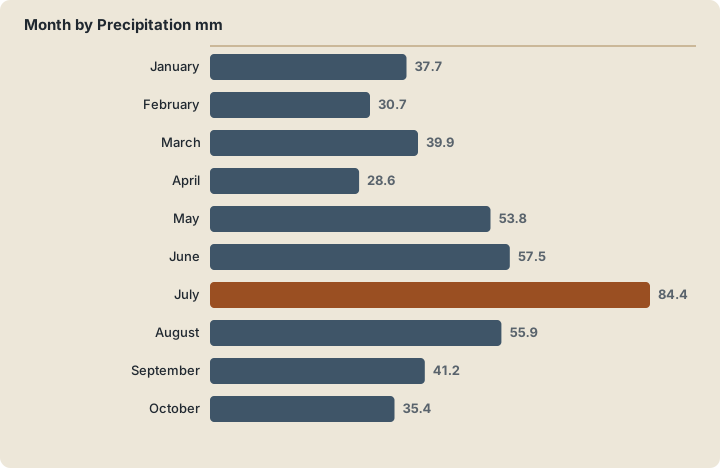
The full WMO 1991-2020 table for the Poznan station shows a smooth climb from a January mean of -0.4 C to a July mean of 19.5 C and back down again, with precipitation every month, from a low of 28.6 mm in April to a high of 84.4 mm in July, and with frost days falling from 19.7 in January to zero in June, July and August before rising again into late autumn.
The numbers are the backbone of every recommendation on this page, so here they are in full. Read the mean daily high as the temperature of a typical afternoon and the mean daily low as a typical pre-dawn and late-evening temperature. The "days with 1 mm+" column counts days with at least one millimetre of precipitation, and it never drops below 6.1 in any month, which is the statistical way of saying Poznan has no dry season: bring a layer for rain whenever you come.
| Month | Mean daily high C | Mean daily low C | Mean C | Precipitation mm | Days with 1 mm+ | Frost days |
|---|---|---|---|---|---|---|
| January | 2.1 | -2.9 | -0.4 | 37.7 | 9.1 | 19.7 |
| February | 3.7 | -2.4 | 0.5 | 30.7 | 7.6 | 17.9 |
| March | 8.1 | 0.0 | 3.8 | 39.9 | 8.6 | 14.1 |
| April | 15.0 | 4.0 | 9.5 | 28.6 | 6.1 | 4.6 |
| May | 19.8 | 8.4 | 14.1 | 53.8 | 8.3 | 0.4 |
| June | 23.1 | 11.9 | 17.5 | 57.5 | 8.4 | 0.0 |
| July | 25.2 | 14.1 | 19.5 | 84.4 | 9.5 | 0.0 |
| August | 24.9 | 13.7 | 19.1 | 55.9 | 8.4 | 0.0 |
| September | 19.5 | 9.6 | 14.3 | 41.2 | 7.4 | 0.1 |
| October | 13.3 | 5.4 | 9.1 | 35.4 | 7.8 | 3.8 |
| November | 7.1 | 1.8 | 4.4 | 33.6 | 7.3 | 9.2 |
| December | 3.2 | -1.4 | 0.9 | 40.1 | 9.1 | 17.5 |
| Year | 13.8 | 5.2 | 9.4 | 538.8 | 97.6 | 87.3 |
A few patterns deserve a second look. April is the driest month by a wide margin (28.6 mm against 53.8 mm in May), which makes it a quiet favourite for city breaks built around walking. July's 84.4 mm makes it the wettest month even though it is also the warmest, so summer visitors get heat and showers in the same package; June and August sit between the two extremes. September is the stealth pick of the table: a 19.5 C mean daily high, only 7.4 wet days and essentially zero frost risk.

Weather shapes a walking itinerary more than many visitors expect. The compact Old Town and the cathedral island of Ostrow Tumski are best in the dry shoulder months, while free things to do in Poznan include plenty of outdoor squares and parks that reward a dry forecast. A private guided walk is the most weather-flexible way to see the centre, because the route can shift indoors when the sky turns; the operator's live listing carries current prices and availability.
If the forecast looks wet, our Poznan rainy day guide collects the museums and covered spaces that keep a day moving, and the Poznan museums guide maps out which collections need the most time.
When Is The Best Time To Visit Poznan?
For weather alone, the WMO normals point to May, June and September as the sweet spots: mean daily highs of 23.1 C in June, 19.8 C in May and 19.5 C in September, with 7 to 8 wet days each and no frost, while July and August are warmer but wetter and the December to February window averages below 1 C, so the choice is really between comfortable shoulder months and a deliberate winter trip for the Christmas market.
May and September bracket the summer with similar numbers: mean lows of 8.4 C and 9.6 C respectively, mean highs near or just under 20 C, and a modest rain load. June is warmer still and frost-free. July trades comfort for heat: the warmest month on the table is also the wettest, so a summer visit should be planned with indoor afternoons in reserve. October is underrated for travellers who like cool-air walking: a 13.3 C mean high and only 3.8 frost days, with the autumn colour in the city's parks.

The calendar matters as much as the thermometer. The winter market season opens in mid-November and runs to early January, and the Ice Festival arrives in December, so the coldest months carry the biggest programme. Our fuller month-weighted comparison, including event load and prices, sits in the best time to visit Poznan. If May is your month, the dedicated answer page what the weather is like in Poznan in May goes deeper on that single month.
| Season | Months | Mean daily high range C | Rain mm per month | Best for |
|---|---|---|---|---|
| Winter | Dec to Feb | 2.1 to 3.7 | 30.7 to 40.1 | Christmas market, Ice Festival, frost-clear walks |
| Spring | Mar to May | 8.1 to 19.8 | 28.6 to 53.8 | Dry April days, parks, walking the centre |
| Summer | Jun to Aug | 23.1 to 25.2 | 55.9 to 84.4 | Long warm days, lakeside afternoons, terrace season |
| Autumn | Sep to Nov | 7.1 to 19.5 | 33.6 to 41.2 | Mild September, autumn colour, fewer crowds |
Does It Snow In Poznan In Winter?
Snow in Poznan is best understood through the frost columns of the WMO normals rather than a snowfall total, which the 1991-2020 station sheet does not carry: the city averages 19.7 frost days in January, 17.9 in February and 17.5 in December, with mean daily highs of only 2.1 to 3.7 C across those months, so nights well below freezing are routine and whatever falls often holds on the ground.
What the normals do say, plainly, is that deep winter in Poznan is a freeze-first season. With January afternoons averaging just above 2 C and nearly 20 frost days a month, thaw-and-refreeze cycles are the normal winter rhythm. Precipitation keeps falling through the cold months (37.7 mm in January, 40.1 mm in December), and with mean lows below -2 C in the two coldest months, a share of it arrives as snow. The honest framing for a visitor: plan for hard frost and possible snow, and treat a white Old Market Square as a bonus rather than a guarantee.

Winter is also Poznan's most atmospheric season, market first among equals. The Betlejem Poznanskie Christmas market runs 14 November 2026 to 6 January 2027 across three sites: the MTP grounds from 14 November to 20 December 2026, Plac Wolnosci from 20 November 2026 and the Old Market Square from 21 November 2026, both to 6 January 2027. The POZnan Ice Festival follows on 11 to 13 December 2026 with its sculpture contests and children's workshops, and the Cavaliada horse event is reported at the MTP grounds for 10 to 13 December 2026. Full planning detail is in the Poznan Christmas market guide.
How Much Rain Does Poznan Get, And When?
The Poznan station's 1991-2020 normals record 538.8 mm of precipitation across 97.6 days with 1 mm or more in an average year, with July the wettest month at 84.4 mm and 9.5 wet days, April the driest at 28.6 mm and 6.1 wet days, and every single month of the year carrying measurable rain, so there is no month a visitor can safely skip the rain layer.
The distribution matters more than the annual total. Winter and spring months cluster between 28 and 40 mm, then the numbers climb through the warm half of the year: 53.8 mm in May, 57.5 mm in June and the July peak of 84.4 mm, before easing to 55.9 mm in August. Summer rain in this climate tends to arrive heavily rather than constantly, which is why July can be both the warmest and the wettest month without being a washout. Autumn stays moderate, from 41.2 mm in September down to 33.6 mm in November.
| Ranking | Month | Precipitation mm | Days with 1 mm+ |
|---|---|---|---|
| Wettest | July | 84.4 | 9.5 |
| 2nd | June | 57.5 | 8.4 |
| 3rd | August | 55.9 | 8.4 |
| 4th | May | 53.8 | 8.3 |
| Driest | April | 28.6 | 6.1 |
A practical note for anyone touring with children: wet-day planning pays off in every season, and the Poznan with kids guide includes indoor stops that work whatever the sky is doing.
How Should You Pack For Poznan Weather?
Pack for the month's mean low, not its mean high: the WMO normals span from a -2.9 C January night to a 25.2 C July afternoon, with rain possible in every month (6.1 to 9.5 days of 1 mm or more), so the universal kit is layers plus a waterproof, and the seasonal kit swings from a proper winter coat and insulated footwear between December and February to light clothing with a sweatshell in July.

The layering advice is not hedging, it is arithmetic. Spring and autumn days routinely swing 11 to 15 degrees between night and afternoon (April: 4.0 C to 15.0 C; October: 5.4 C to 13.3 C), which means a morning that needs a warm jacket and an afternoon that does not. Summer evenings cool to a mean of 13.7 to 14.1 C in July and August, light-jacket territory after sunset. And because the wet-day count never falls below six in any month, the one item that belongs in the bag in every season is a compact rain layer.
| Month | Typical afternoon C | Typical night C | Packing focus |
|---|---|---|---|
| Dec to Feb | 2.1 to 3.7 | -2.9 to -1.4 | Winter coat, hat, gloves, insulated shoes |
| Mar to Apr | 8.1 to 15.0 | 0.0 to 4.0 | Warm layers, windproof jacket, late-frost-proof shoes |
| May to Jun | 19.8 to 23.1 | 8.4 to 11.9 | Mixed layers, light jacket, rain layer |
| Jul to Aug | 24.9 to 25.2 | 13.7 to 14.1 | Light clothing, sun hat, rain layer for showers |
| Sep to Oct | 13.3 to 19.5 | 5.4 to 9.6 | Sweaters, light coat, rain layer |
| Nov | 7.1 | 1.8 | Warm coat, gloves, waterproof footwear |
Footwear deserves its own sentence: frost days reach double figures from November through March, and thaw-and-refreeze leaves pavements slick in the Old Town, so grip beats style for roughly half the year.
How Does Weather Shape A Day Out In Poznan?
The city's headline sights split cleanly by forecast: the Old Market Square, Ostrow Tumski, Srodka and the Citadel park are dry-weather territory with mean-high temperatures above 19 C from May through September, while museums, the Croissant Museum show and a beer-tasting or covered-walk tour carry a wet or cold afternoon, so a good Poznan day plan is built around one outdoor anchor and one indoor fallback whatever the month.
Dry months reward the outdoor core of the city. The walk from the Old Market Square across to the cathedral island takes in the Srodka district and its famous mural, and the Citadel, described by the city portal as the largest park in Poznan and a 15-minute walk from the Old Market Square, is at its best between May and September.

Wet or freezing days have real depth. The National Museum's branches, the Royal Castle and the Enigma Cipher Centre all sit within an easy tram ride of the centre, and the ZTM timed tickets that cover all zones (5 zl, 7 zl for 45, 9 zl for 90) make hopping between them cheap; the Poznan public transport guide explains the ticket machine and app options, since contactless bank-card payment on board is not expected until around 2028. A beer-tasting tour is another weatherproof block, and a Kornik Castle and Rogalin half-day excursion works in cool weather as long as you accept the castle's low-season hours (1 October to 30 November, Tuesday to Sunday 10:00-15:15, last entry 14:30, with the 2026 season closing on 14 December).
For a longer indoor-outdoor mix, the half-day private Kornik and Rogalin tour pairs two of the region's headline sites in one weather-tolerant loop; availability and current pricing are on the operator's live listing.
Does Weather Affect Getting To And Around Poznan?
Poznan's weather rarely stops the city's transport, but it changes how you should use it: airport buses 148 and 159 each run every 15 minutes at peak between Poznan Glowny and Lawica, winter frost days (17 to 20 per month from December through February) slow walking distances that feel short on a map, and rain in July or August (9.5 and 8.4 wet days respectively) makes the tram network, covered by a 5 zl 15-minute or 7 zl 45-minute ticket, the sensible default over walking.
Arrival logistics are weather-neutral in practice. Flights land at Lawica regardless of season, and the two airport bus lines keep their frequency through the day, with departures from the station, Rondo Kaponiera, Baltyk and the terminals every 7 to 8 minutes at peak; the Poznan airport guide and the airport to city centre page carry the detail. Rail arrivals follow the same logic, and the train pages for Berlin, Warsaw and Wroclaw cover the main arrival corridors; note that Poland has temporary border controls on land borders with Germany until 30 March 2027, so carry ID on the Berlin train in any weather.

First, there is no city bike system to fall back on: the Poznan City Bike ran from 2012 to 2022 and has not returned, so cycling is rental-private or nothing, covered in Poznan car rental and bikes. Second, the fine for riding without a valid ticket is 350 zl, or 175 zl if paid within 7 days, a price that stings more than any rainstorm; validate every ticket, every ride, in every season.
Common Questions About Poznan Weather
How cold does it get in Poznan?
WMO's 1991-2020 normals for the Poznan station put January's mean daily low at -2.9 C with 19.7 frost days in the month, and February close behind at -2.4 C. Mean monthly temperatures stay below 1 C from December through February. Late frosts are real: the normals record 14.1 frost days in March and 4.6 in April.
What is the warmest month in Poznan?
July, with a mean daily high of 25.2 C and a mean monthly temperature of 19.5 C. It is also the wettest month at 84.4 mm of precipitation across 9.5 days of 1 mm or more. August is a close second at 24.9 C mean daily high.
What is the rainiest month in Poznan?
July, with 84.4 mm of precipitation on average. June (57.5 mm) and August (55.9 mm) follow. No month is dry: even the driest month, April, averages 28.6 mm and 6.1 days with 1 mm or more of rain.
Does it snow in Poznan?
Deep winter brings routine hard frost, with 17 to 20 frost days per month from December through February and mean daily highs of only 2.1 to 3.7 C, so precipitation in those months often falls as snow and can hold on frozen ground. The WMO station sheet does not carry a snowfall total, so treat a white city as likely in a cold snap but never guaranteed.
When is the best weather in Poznan?
May, June and September combine mean daily highs of 19.5 to 23.1 C with no frost and 7 to 8 wet days each. July and August are warmer but wetter. April is the driest month of the whole year and a strong pick for walking-focused city breaks.
Is Poznan weather good for a winter city break?
Yes, if you pack for it. December averages a 3.2 C mean daily high and 17.5 frost days, and the Christmas market runs 14 November 2026 to 6 January 2027 across three sites, with the Ice Festival on 11 to 13 December 2026. The cold is steady and predictable, and the programme is built around it.
Whatever month brings you to Poznan, the numbers above give you the baseline: layers for the swing between the mean low and the mean high, a rain layer in every season, and a plan that lets the forecast decide between the squares and parks and the museums that carry a wet afternoon.