Seven Days In Poland Via Poznan
Poznan, the capital of the Wielkopolskie voivodeship in western Poland, sits on the Warta river with fast trains to Warsaw and Berlin, which makes it a practical base for a week that covers city, lake, castle and countryside.

Short answer
Spend days one and two on the Old Market Square, Ostrow Tumski and the museums, days three and four on Lake Malta, the Citadel and the Enigma Cipher Centre, then use Poznan as a rail base for Gniezno, Biskupin, Kornik, Rogalin and Torun on days five to seven.
Poznan, the capital of the Wielkopolskie voivodeship (Greater Poland) in western Poland, is a city of 534,239 residents on the Warta river, and it is one of the most underused bases for a full week in Poland. Direct trains reach Warsaw in about 2 h 20 to 3 h 20 and Berlin in about 4 h 30 to 5 h 30, while short regional hops connect the city with Gniezno in about 25 to 45 minutes. That combination, a walkable historic core plus a rail hub with the country's two largest cities and the German capital in range, is exactly what a seven-day Poland trip needs. This itinerary spends the first four days in Poznan itself and the last three on day trips that fan out across Greater Poland and beyond, and every price and hour quoted below comes from the venue's own published pages.
What Is A Good 7-Day Itinerary For A Trip To Poland?
A good seven-day itinerary for Poland uses Poznan as the base: days one and two cover the Old Market Square, Ostrow Tumski and the city museums, days three and four take in Lake Malta, the Citadel and the Enigma Cipher Centre, and days five to seven are day trips by train or tour to Gniezno, Biskupin, Kornik with Rogalin, and Torun, returning each evening to one hotel. The logic is simple. Poznan concentrates a historic square, an island cathedral, a lake district and a fortress park within one cheap tram network, and the surrounding region holds the country's oldest architectural landmarks. Basing in one city avoids four hotel changes and keeps every journey short.
The plan below assumes arrival on a Saturday or Sunday so that the museum-heavy days fall on weekdays, when the smaller branches are open. It also assumes travel outside the Christmas season; a winter variant with the Betlejem Poznanskie markets is sketched near the end.
| Day | Base | Focus of the day |
|---|---|---|
| 1 | Poznan | Old Market Square, the goats at noon, Croissant Museum, Fara |
| 2 | Poznan | Ostrow Tumski: cathedral, Porta Posnania, Genius Loci, Srodka |
| 3 | Poznan | Lake Malta: New Zoo, Old Zoo, Termy Maltanskie |
| 4 | Poznan | Imperial Castle, Enigma Cipher Centre, Citadel Park museums |
| 5 | Poznan | Gniezno by train, cathedral hill and Museum of the Origins |
| 6 | Poznan | Kornik Castle and Arboretum with Rogalin Palace (guided tour day) |
| 7 | Poznan | Torun by train, or Biskupin for the archaeology-inclined |
Why Does Poznan Work Better Than Warsaw Or Krakow For A Week?
Poznan works because it compresses Poland's whole story into one small, cheap radius: a Renaissance square with mechanical goats, an island cathedral holding the tombs of Mieszko I and Boleslaw Chrobry, an Enigma codebreaking centre, a lake resort, and day-trip distances to Gniezno, Biskupin, Kornik and Rogalin, all reachable on a tram ticket that costs 9 zl for 90 minutes. Warsaw and Krakow each deserve a week on their own, but neither sits inside a region this dense with early-Polish history. Gniezno and Ostrow Tumski are where the Polish state's earliest history is visible, and both are within an hour of Poznan's main station.
The city's own sights are not filler either. The National Museum's visit page lists branches across the centre: the Royal Castle at Gora Przemysla (normal 20 zl, reduced 13 zl, free on Tuesdays), the Museum of Musical Instruments on the square (15/10 zl), the Greater Poland Military Museum at Stary Rynek 9 (15/10 zl) and the Museum of the Wielkopolska Uprising in the Odwach (15/10 zl). The Imperial Castle's own page gives visiting daily 12:00-19:00 with a map ticket at 10/7 zl or an audio guide at 20/15 zl. A fuller rundown of the square itself is in the Old Market Square guide, and the one day in Poznan itinerary covers the core walk in detail.

Two honest caveats shape any Poznan week. The Town Hall's museum interior is listed by the National Museum as closed on every weekday, with no reopening date published, so the square's famous goats, which the museum's page says appear every day at noon and, since recently, also at 3 pm, are the reliable part of the visit. And the Palm House in Park Wilsona is closed to visitors for rebuilding, with the city aiming to reopen part of the pavilions towards the end of 2028, so it stays off this itinerary entirely. Neither gap hurts the week; both are covered by other stops.
For travellers who prefer a guide to self-planning, the operators below run the three experiences that fit this itinerary best: the castle-and-palace day trip that covers day six, a private Fort VII history tour for the WWII-minded, and a pre-booked airport transfer for arrival day.
How Do You Get To Poznan And Where Should You Stay?
Fly into Poznan-Lawica and take bus line 148 or 159 from the terminal to Poznan Glowny, the main station: the two lines each run every 15 minutes at peak and every 20 minutes off-peak, so a bus leaves the airport every 7 to 8 minutes at peak, and the standard ZTM timed tickets of 5, 7 or 9 zl cover the whole ride. From Berlin, trains take about 4 h 30 to 5 h 30 and from Warsaw about 2 h 20 to 3 h 20, and Poland has notified temporary border controls at its land borders with Germany and Lithuania running to 30 March 2027, so carry a passport or national ID on the Berlin train. The airport's own news pages also report a new airBaltic route to Gran Canaria and four new Ryanair routes from winter 2026/27, which widens the arrival options.
Onward planning is easiest through the PKP Intercity planner for the day's exact times, and rail bookings for the Warsaw and Berlin legs can be made through the links the desk lists below. A hire car is optional on this itinerary: days one to four need none, and day six is simplest as a guided tour precisely because Kornik and Rogalin are awkward by public transport.
Check train tickets to Warsaw and check train tickets from Berlin on the operators' live listings, or compare car hire in Poznan if the countryside days appeal more than the rail ones.

Where to stay is a one-hotel question, and the answer depends on which part of the week matters most. The Old Town group puts the square and the goats outside the door: the properties the desk tracks there include Hotel Kolegiacki, PURO Poznan and the budget-friendly Opera Hostel. The Centre and MTP group, including ibis Poznan Centrum and the Sheraton, sits closest to the station, which is what a day-trip-heavy week rewards. For a quieter base near the lake end of the itinerary, look at a stay by Lake Malta or a place in Srodka across from the cathedral island. No nightly rate is quoted here: prices move with the fairs calendar, and the live listings carry them.
If the arrival day looks rushed, a pre-booked transfer removes the tram-and-luggage question entirely, and the operator's listing carries the current price and vehicle details.
What Should Days One And Two Cover In Poznan?
Day one belongs to the Old Market Square and its immediate streets: the goats at noon on the Town Hall facade, a Croissant Museum show at 14:00 in English, the Fara basilica open daily 6:00-19:30, and the square's museums; day two crosses to Ostrow Tumski for the cathedral crypts, Porta Posnania and the Srodka mural, with the cathedral tower open 1 March to 15 November. The Croissant Museum's own page gives the English show at 14:00, daily in July and August and on weekends all year, with a 15:30 English show added when the 14:00 one fills; tasting is included and the museum asks visitors to arrive 10 minutes early. The goats themselves date to a clock first installed in September 1551 by Bartel Wolff of Gubin, restored with a new clock in 1913.
The square's museum row is best done with the Tuesday free-admission day in mind, which the National Museum's pages apply to the Royal Castle, the Musical Instruments museum, the Military Museum and the Uprising museum alike. The Royal Castle's page lists hours of Tue-Wed 10:00-16:00, Thu 10:00-18:00, Fri 10:00-20:00, Sat-Sun 10:00-17:00, closed Monday. Its current temporary exhibitions run to set dates, so check the listing before committing an afternoon.
| Sight, days one and two | Hours (official page) | Tickets, zl |
|---|---|---|
| Fara basilica | Daily 6:00-19:30, no visits during Mass | Free entry, no ticket listed |
| Croissant Museum, English show | 14:00 (also 15:30 when full) | Price on the booking widget |
| Royal Castle (Museum of Applied Arts) | Tue-Sun, closed Mon | 20 / 13, Tuesday free |
| Museum of Musical Instruments | Tue-Sun, closed Mon | 15 / 10, Tuesday free |
| Greater Poland Military Museum | Tue-Sun 10:00-17:00 | 15 / 10, Tuesday free |
| Poznan Cathedral crypts and tower | 1 Mar-15 Nov, weekdays 9:00-16:00, Sun 14:00-18:00 | Crypts 10 / 8, tower 14 / 12 |
| Porta Posnania | Tue-Fri 9:00-18:00, Sat-Sun 10:00-19:00, Mon closed | 35 / 29 |
Day two's island deserves the whole afternoon. The cathedral's page for tourists lists the crypts holding the tombs of Mieszko I and Boleslaw Chrobry, and states the tower has been open since 1 June 2026. Porta Posnania's page gives entries every 20 minutes in groups of up to 30, with the last entry an hour before closing, and notes that the final entry of the day is sold at a lower price. Across the bridge, the Genius Loci archaeological reserve charges 20/15 zl (family 50 zl), and the Srodka mural at ul. Srodka 3, which the city marked for its tenth anniversary in 2025, fills the walk back. The Ostrow Tumski guide and the Srodka area page expand both stops.

What Do Days Three And Four Add Around Lake Malta And The Citadel?
Day three moves east to Lake Malta: the New Zoo, open daily with tickets at 45 zl on weekdays in season, the free-entry Old Zoo on ul. Zwierzyniecka, and the Termy Maltanskie thermal baths, whose aquapark runs daily 9:00-23:00 with a one-hour pass at 46 zl; day four returns to the centre for the Imperial Castle, the Enigma Cipher Centre and the two Citadel museums. The zoo's own pages give the seasonal split in full: 55 zl normal on Saturdays and holidays in season, 60 zl on the peak holidays, and 20 zl flat for everyone from November to the end of February, with the ticket desks closing an hour before the gates. The zoo car park costs 5 zl per hour on weekdays and 7 zl at weekends, from 1 April to 31 October.
One seasonal warning matters here. The Maltanka park railway, which links the lake to the zoo, ended its 2026 season on Sunday 27 September, and no 2027 date is published, so a winter or early-spring week should not count on it. The lake itself still earns its day: the Malta ski slope area, the regatta course and the Termy Maltanskie guide cover the rest.
| Day three option | Season and hours (official page) | Tickets, zl |
|---|---|---|
| New Zoo | Daily; Apr-Sep 9:00-19:00, Oct and Mar 9:00-17:00, Nov-Feb 9:00-16:00 | 45 / 30 weekdays, 55 / 35 weekends |
| Old Zoo | Daily; same seasonal hours as above | Free entry |
| Termy Maltanskie aquapark | Daily 9:00-23:00 | 46 (1 h), 61 (2 h), 75 (3 h), 109 (all day) |
| Termy sauna zone | Mon-Fri 14:30-23:00, Sat-Sun 11:30-23:00 | Zone price list on the operator's tabs |
Day four is the indoor day, and it is deliberately placed mid-week. The Enigma Cipher Centre on ul. Sw. Marcin 78 is closed Monday and open Tue-Fri 9:00-18:00, Sat-Sun 10:00-19:00, at 35/29 zl, with exhibitions and audio guides in Polish, English, German, Russian and Ukrainian, and its timeline names the three Poznan codebreakers, Marian Rejewski, Jerzy Rozycki and Henryk Zygalski. The Imperial Castle, a short walk away, is open daily 12:00-19:00. The Citadel, a 15-minute walk from the square, holds the Museum of Armaments (15/10 zl, Tuesday free, closed Monday) and the Museum of the "Poznan" Army (10/6 zl), both branches of the Independence Museums network. The rest of the planning pages sit on Poznan Travel Guide.
For a deeper WWII thread, a private guided tour of Fort VII, a wartime site whose museum is dedicated to the memory of its victims, is the option the desk lists; the operator's live listing carries the current price and duration.

Where Should Days Five To Seven Go: Gniezno, Kornik, Rogalin Or Torun?
Day five takes the train to Gniezno, about 25 to 45 minutes away, for the cathedral hill and the Museum of the Origins of the Polish State, which is free on Sundays; day six is the castle day, Kornik Castle and Arboretum plus Rogalin Palace, easiest as a guided tour from Poznan; day seven goes to Torun by train, or to Biskupin for the archaeological festival site, both with verified winter hours. In Gniezno, the cathedral hill's price list gives the Gniezno Doors at 16/14 zl, the cathedral vaults at 14/12 zl and the viewing terrace at 12/10 zl, with an all-inclusive pass at 48/42 zl, but the cathedral and museum close to tourists on Sundays from May to October, when only the terrace opens, 13:00-15:00 and 16:00-17:30. The Origins museum, at ul. Kostrzewskiego 1, runs 9:00-16:00 from October to April.
The castle day is the one place a car or a tour genuinely beats the train. Kornik Castle is closed Mondays, runs its low-season hours of 10:00-15:15 with last entry 14:30 from 1 October to 30 November, and closes its 2026 season on 14 December; tickets are 40/20 zl. The adjoining arboretum, about 3,000 species and varieties across its collection, is open daily 10:00-16:00 from November to March at 10/7 zl. Rogalin Palace, a branch of the National Museum, is also closed Monday and lists Tue-Sun 9:00-16:00 in the cooler months at 20/13 zl, with its oak park at 9:00-16:30 from November to February. The Kornik Castle and Rogalin Palace pages carry the full seasonal tables.

The operator's listing carries the current price, duration and departure point, and booking is cancellable on the standard terms.
Day seven splits by interest. Torun, the Gothic brick city on the Vistula, is the pick for architecture and is easy to reach from Poznan by rail; the Torun day-trip page covers it. Biskupin, the reconstructed Iron Age settlement, is the pick for families and archaeology fans: the museum's page gives 9:00-16:00 from November to March, closed 1 January, Easter Sunday, 1 November and 25 December, at 28/19 zl with a family 2+2 ticket at 75 zl. The Biskupin and Gniezno pages give the fuller picture, and the two days in Poznan itinerary shows how to compress the city half if a Torun overnight is preferred.
| Day trip, days five to seven | Closed days | Tickets, zl (normal / reduced) |
|---|---|---|
| Gniezno cathedral hill, all-inclusive pass | Cathedral closed to tourists Sun, May-Oct | 48 / 42 |
| Museum of the Origins of the Polish State, Gniezno | None listed; free on Sundays | Prices on the museum page |
| Biskupin Archaeological Museum | 1 Jan, Easter Sunday, 1 Nov, 25 Dec | 28 / 19, family 2+2 75 |
| Kornik Castle | Mondays; season ends 14 Dec 2026 | 40 / 20 |
| Kornik Arboretum | Open daily | 10 / 7, family 25 |
| Rogalin Palace Museum | Mondays; 1 Nov, 24-26 Dec, 31 Dec, 1 Jan | 20 / 13, Tuesday free |
For a second tour-backed day in the final stretch, the trio below repeats the three products that map onto this itinerary's structure: the castle day, the history tour and the airport transfer for departure morning.
How Much Does A Week In Poland Via Poznan Cost?
The ZTM price list is worth reading closely before buying. Timed tickets are valid in all zones A+B+C+D with transfers allowed, but real travel time counts and tickets cannot be combined to extend it. The fine for travelling without a valid ticket is 350 zl, reduced to 175 zl if paid within 7 days. There is no contactless bank-card payment on the vehicles yet: the PEKA modernisation contract that will enable it was signed with effects expected in 2028, so today's options are timed tickets, the app, machines or a PEKA card, which costs 27 zl including 15 zl of travel credit.
| ZTM ticket | Price, zl | Notes from the price list |
|---|---|---|
| 15 minutes | 5 (reduced 2.50) | All zones, transfers allowed |
| 45 minutes | 7 (3.50) | All zones |
| 90 minutes | 9 (4.50) | All zones |
| 24 hours, zone A | 18 (9) | Weekend promo: validated Fri 20:00-Sat 24:00 runs to Sun 24:00 |
| 24 hours, all zones | 24 (12) | Covers airport buses 148 and 159 |
| 7 days, zone A | 59 (29.50) | Best value for a full week in the city |
| 7 days, all zones | 94 (47) | Includes the airport and Lake Malta |
Two further cost notes come straight from official pages. Street parking for drivers who are not Poznan taxpayers runs 5/6/7 zl for the first three hours in the cheapest tier and up to 9.50/11/13 zl in the dearest, paid Monday to Friday 8:00-20:00, so a hire-car week should budget for it. And the Poznan City Card, at 65 zl for 24 hours with transport or 59 zl without, gives free entry to most museums but only discounts at some partners: Enigma and Porta Posnania both charge card-holders 21 zl rather than nothing. The Poznan City Card guide does the arithmetic for each branch.

When Is The Best Time Of Year To Run This Itinerary?
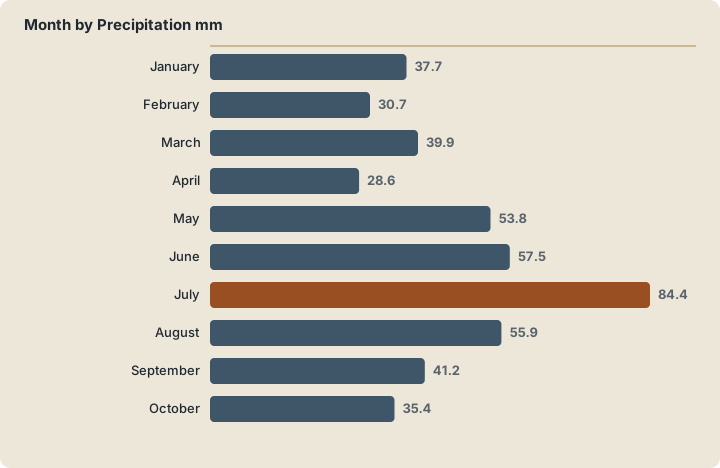
WMO's 1991-2020 climate normals for the Poznan station show the sweet spot clearly: May and September, with mean daily highs of 19.8 C and 19.5 C and only 0.4 and 0.1 frost days respectively, while July, the warmest month at a 25.2 C mean high, is also the wettest at 84.4 mm of rain, and April is the driest month at 28.6 mm. A May or September start also keeps the cathedral tower open (1 March to 15 November), the Maltanka railway in season (late May rather than late September), and the zoo on its long 9:00-19:00 hours. A winter week trades all of that for the Christmas markets and lower prices.
| Month | Mean daily high C | Mean daily low C | Precipitation mm | Frost days |
|---|---|---|---|---|
| January | 2.1 | -2.9 | 37.7 | 19.7 |
| February | 3.7 | -2.4 | 30.7 | 17.9 |
| March | 8.1 | 0.0 | 39.9 | 14.1 |
| April | 15.0 | 4.0 | 28.6 | 4.6 |
| May | 19.8 | 8.4 | 53.8 | 0.4 |
| June | 23.1 | 11.9 | 57.5 | 0.0 |
| July | 25.2 | 14.1 | 84.4 | 0.0 |
| August | 24.9 | 13.7 | 55.9 | 0.0 |
| September | 19.5 | 9.6 | 41.2 | 0.1 |
| October | 13.3 | 5.4 | 35.4 | 3.8 |
| November | 7.1 | 1.8 | 33.6 | 9.2 |
| December | 3.2 | -1.4 | 40.1 | 17.5 |
The winter variant has one fixed anchor. Betlejem Poznanskie, the city's Christmas market set, runs 14 November 2026 to 6 January 2027, with the MTP grounds from 14 November to 20 December, Plac Wolnosci from 20 November and the Old Market Square from 21 November, both to 6 January. Layer that with the POZnan Ice Festival on 11 to 13 December 2026 and the New Zoo's flat 20 zl winter ticket, and a December week works on its own terms. The Poznan in winter and Christmas market pages build that variant out.

Common Questions About A Seven-Day Poland Trip Via Poznan
What is a good 7-day itinerary for a trip to Poland?
A good seven-day plan bases itself in Poznan: two days on the Old Market Square, the Croissant Museum and Ostrow Tumski, one day on Lake Malta with the zoo and thermal baths, one day on the Imperial Castle, Enigma and the Citadel, then day trips to Gniezno, Kornik with Rogalin, and Torun or Biskupin, returning each night to the same hotel.
Is a week in Poland too long to spend in Poznan?
No. The city itself fills three to four days comfortably, and the surrounding region holds Gniezno, Biskupin, Kornik, Rogalin, Greater Poland National Park and Torun within day-trip range. Travellers who want only the city can compress it into two days; the how many days in Poznan is enough page covers that question directly.
Do I need a car for the day trips from Poznan?
Gniezno and Torun are rail trips, so no car is needed. Kornik and Rogalin are the exceptions: this desk's verified pack carries no public-transport route for them, which is why the guided tour that bundles both in one day is the recommendation for day six.
What is closed in Poznan right now?
The Town Hall museum interior is closed with no published reopening date, the Ethnographic Museum is closed for renovation, the Palm House is closed for rebuilding until part of it returns towards the end of 2028, and the Maltanka park railway runs only in season, with its 2026 season ended on 27 September. The goats on the Town Hall facade, at noon and 3 pm, remain the square's reliable sight.
Can I pay by card on Poznan trams and buses?
Not yet with a bank card. ZTM signed the PEKA modernisation contract with contactless payment expected in 2028; today's options are timed tickets, the app, ticket machines or a PEKA card. Timed tickets cost 5, 7 or 9 zl and cover all zones with transfers.
Which day trips from Poznan are best in winter?
Gniezno and Biskupin both publish winter hours (Biskupin 9:00-16:00, November to March, closed 25 December and 1 January), and the New Zoo drops to a flat 20 zl ticket in the same window. Kornik Castle closes its season on 14 December, so it belongs to the warmer months, and the Christmas markets from mid-November give December its own programme.
The week closes where it opened, on the Old Market Square: the goats at noon, a St Martin's croissant, and a train timetable with Warsaw and Berlin both inside a morning's ride.