Wolsztyn Steam Trains Day Trip From Poznan
Wolsztyn, a small town in Wielkopolskie to the west of Poznan, keeps working steam locomotives in a roundhouse depot and runs them on the national network, which makes it one of the most distinctive day trips you can take from Poznan.

Short answer
Wolsztyn lies in Wielkopolskie voivodeship west of Poznan and is reached by regional rail from Poznan Glowny; check the operator's planner for the day's connections. The town's steam depot is a working engine shed, so hours, running days and admission are set by the depot itself and must be checked on its official page before you travel.
Poznan, the capital of the Wielkopolskie voivodeship (Greater Poland) in western Poland, on the Warta river, is a city of 534,239 residents as counted by the Statistical Office in Poznan at the end of 2025, and it is also the natural base for one of the strangest and most rewarding rail day trips in Poland: Wolsztyn. Wolsztyn is a small town in the same voivodeship, and what sets it apart from every other town of its size is that it still keeps working steam locomotives in an active engine depot and sends them out onto the national network. For anyone who grew up on model railways, or who simply wants to see heavy machinery kept alive rather than mothballed behind a rope, it is a destination with almost no equivalent anywhere else in Europe.
This page is a planning guide, not a timetable. Steam operations are living machinery: the depot decides which engines are serviceable, which days they run and what the visiting public may see, and those decisions change with the maintenance calendar. Every practical detail below therefore tells you what to check and where, rather than promising a schedule that could be wrong by the time you travel. What the guide can do is frame the trip: why Wolsztyn matters, how the rail journey from Poznan works in principle, what a day there looks like, and which other Wielkopolska day trips pair well with it if steam is only part of your agenda.
Why Is Wolsztyn On Every Steam Enthusiast's Map?
Wolsztyn's depot is a working engine shed, not a museum behind glass: locomotives are maintained there, steamed there and dispatched from there onto ordinary passenger lines, an arrangement that survives in Wolsztyn as a daily operation rather than a special occasion, which is a rarity in Europe and the reason the town pulls enthusiasts from across the continent. That single distinction explains the town's pull. Most heritage steam in Europe runs as a preserved railway or a charter, but in Wolsztyn the shed answers to the needs of a functioning railway, and visitors watch a roundhouse, a turntable and a servicing yard doing the job they were built for.

The depot's own communications are the only reliable source for what is running. The shed publishes its open days, admission terms and locomotive news itself, and any visit should start there: what hours apply, whether an engine will be in steam, and whether a ride is possible on the day you intend to come. This guide deliberately prints none of those figures, because a working depot's calendar moves with the engineering schedule, and a number copied into an article goes stale the first weekend a locomotive is stripped for overhaul. Check the depot's official page, then plan the day around what it says.
The town around the depot deserves more than a drive-through. Wolsztyn has a market square, a lake within walking distance of the centre, and a pace that makes Poznan, an hour or so up the line by regional train, feel like the metropolis it is. The combination is the point: heavy industrial heritage in the morning, a small Polish town for lunch, and a lake for the afternoon if the weather cooperates. Few day trips from Poznan offer that spread within one short rail journey.
How Do You Get From Poznan To Wolsztyn?
The journey is a regional rail trip from Poznan Glowny, the city's main station, westwards through Wielkopolska, and the correct way to plan it is to open the operator's journey planner for your travel date, because regional timetables, connections and running days are set by the operator and change with the timetable period. Poznan Glowny is the same station that serves the city's long-distance links, so the day trip starts exactly where every other rail trip from Poznan starts.

Two planning habits matter here. Second, if your Poznan stay is part of a wider rail itinerary, the same station connects onward: typical direct journeys from Poznan Glowny run to Warsaw in about 2 h 20 to 3 h 20, to Berlin in about 4 h 30 to 5 h 30, to Wroclaw in about 2 h 20 to 3 h 30 and to Gdansk in about 3 h 40 to 5 h, all Grok-reported ranges that should be confirmed in the PKP Intercity planner for the day. Travellers coming from Berlin should also carry a passport or national ID: Poland has notified temporary controls at its land borders with Germany and Lithuania from 02/10/2026 to 30/03/2027. For tickets into and out of Poznan on that corridor, rail bookings from Berlin toward Poznan can be handled in one transaction.
The table below gathers the verified long-distance ranges from Poznan Glowny, useful if Wolsztyn is one stop on a Poland-by-train route rather than a standalone outing:
| Direct route from Poznan Glowny | Typical journey time (use "about", confirm in the planner) |
|---|---|
| Warsaw | about 2 h 20 to 3 h 20 |
| Berlin | about 4 h 30 to 5 h 30 |
| Wroclaw | about 2 h 20 to 3 h 30 |
| Gdansk | about 3 h 40 to 5 h |
| Krakow | about 4 h to 6 h |
For the Wolsztyn leg itself, treat the regional operator's planner as the single source of truth: it will show the day's departures, the connection points and the arrival station, none of which this article will guess at. Build the day backwards from the last sensible return train so you are never stranded in a small town after the evening service thins out, and check whether the depot's open hours overlap the arrival comfortably. A tight plan that leaves ninety minutes at the shed is worse than a loose plan that leaves half a day.
What Can You See At The Wolsztyn Steam Depot?
The core of a visit is the roundhouse and its turntable, the servicing yard where locomotives are prepared, and, on running days, the sight and sound of steam engines moving under their own power, with the depot's own page stating what is open to visitors, on which days, and at what admission, all of which must be read before travel because none of it is fixed. The shed is a working facility first and a visitor attraction second, and that ordering is exactly what makes it worth the train fare.

Photography is the activity that tends to get underestimated. A roundhouse gives you interior light, bay doors framing locomotive fronts, and the geometry of radiating tracks seen from the turntable, and the yard adds motion when an engine is moved. Late afternoon in the colder months can give you steam condensing visibly against low sun, which is the shot most people travel for. Ask the depot's staff what is permitted around the yard rather than assuming museum rules: a working shed has its own safety distances, and respecting them is both correct and the quickest way to be shown the better vantage points.
The second half of the visit is the town. The market square and the lake are close enough to the station area to be walked, and a day that combines the shed in the morning, a square-side lunch and the lake in the afternoon uses the trip well. If steam is running on the national network on your date, the depot's page will say so, and a short ride behind a working locomotive on an ordinary passenger service is the experience that separates Wolsztyn from every static collection in the country.
If you would rather outsource a day's logistics entirely, guided options out of Poznan exist for other Wielkopolska destinations, and the same reasoning applies: transport, timing and tickets handled by someone whose job it is.
The choice between the self-planned rail day and a handled tour is really a choice about how much of your holiday attention you want to spend on timetables. A guided day costs money and buys back an evening of planning; a Wolsztyn trip done alone rewards the traveller with the flexibility to linger at the shed for as long as the locomotives hold your interest. Both are legitimate answers, and the rest of this guide assumes you will make that call per day rather than per trip.
When Is The Best Time Of Year For A Wolsztyn Steam Train Day Trip?
WMO's 1991-2020 climate normals for the Poznan station (WMO 12330) show the warmest month is July at a 25.2 C mean daily high and the wettest is also July at 84.4 mm of precipitation, while April is the driest at 28.6 mm and January's mean daily low sits at -2.9 C, so late spring through early autumn gives the most comfortable depot and lake time, with winter better for photography than for lingering outdoors. Steam photographs beautifully in cold air, but a winter day trip compresses the outdoor portion of the visit and shortens the daylight window.

| Month | Mean daily high C | Mean daily low C | Precipitation mm | Days with 1 mm+ |
|---|---|---|---|---|
| April | 15.0 | 4.0 | 28.6 | 6.1 |
| July | 25.2 | 14.1 | 84.4 | 9.5 |
| October | 13.3 | 5.4 | 35.4 | 7.8 |
| December | 3.2 | -1.4 | 40.1 | 9.1 |
The normals carry a planning lesson that surprises first-time visitors: summer is not the dry season here. July pairs the warmest temperatures with the highest rainfall of the year, and April, which most people assume is showery, is actually the driest month in the table. A spring or early-autumn day trip can therefore be the better bet for standing in an open yard, with the added advantage that shoulder-season steam against cool air condenses more dramatically for photographs. Everything else covered here is indexed on Poznan Travel Guide.
Seasonality matters for the whole Wielkopolska day-trip calendar, not just Wolsztyn. Several of the region's flagship sites run reduced winter hours or close on Mondays, and the Christmas period reshuffles everything around Poznan: Betlejem Poznanskie runs 14.11.2026 to 6.01.2027, with the Stary Rynek site from 21.11.2026 and Plac Wolnosci from 20.11.2026, and the POZnan Ice Festival fills 11 to 13 December 2026. A December day trip that returns to Poznan in the evening lands the traveller in a market-lit Old Market Square, which is a strong finish to a cold day on the rails.
How Does Wolsztyn Compare With Other Day Trips From Poznan?
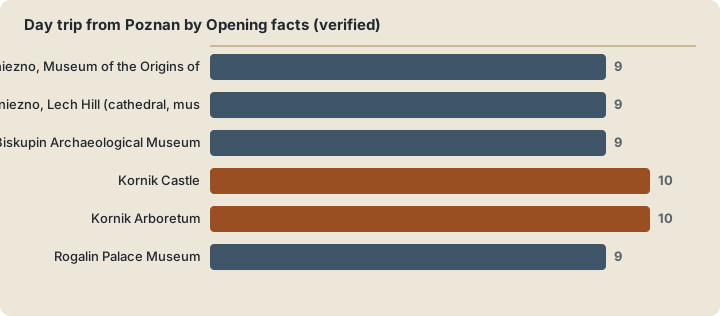
Wolsztyn is the region's specialist day trip, aimed squarely at rail enthusiasts, while the mainstream Wielkopolska circuit runs through Gniezno, Biskupin, Kornik and Rogalin, each of which has verified hours and prices that can be planned with confidence, so the honest comparison is depth versus breadth: one working depot versus a spread of castles, archaeological sites and cathedral hills. A first-time visitor to the region with three days should probably do the mainstream circuit first; a returning visitor or a dedicated enthusiast should take Wolsztyn.

The table gathers the verified practical facts for the region's other day trips, all of which make good companions or alternatives:
| Day trip from Poznan | Opening facts (verified) | Admission (zl) |
|---|---|---|
| Gniezno, Museum of the Origins of the Polish State | Daily; Oct-Apr 9:00-16:00; Sunday free admission | Sunday free, other prices on the museum's page |
| Gniezno, Lech Hill (cathedral, museum, terrace) | May-Oct Mon-Sat 9:00-17:00; on Sundays closed to tourists, terrace only 13:00-15:00 and 16:00-17:30 | Doors 16/14, vaults 14/12, terrace 12/10, museum 18/16, pass 48/42 |
| Biskupin Archaeological Museum | Nov-Mar 9:00-16:00; closed 1 Jan, Easter Sunday, 1 Nov, 25 Dec | Normal 28, reduced 19, family 2+2 75 |
| Kornik Castle | Tue-Sun; low season 10:00-15:15, last entry 14:30; 2026 season closes 14 Dec | Normal 40, reduced 20 |
| Kornik Arboretum | Daily; Nov-Mar 10:00-16:00 | Adult 10, reduced 7, family 25 |
| Rogalin Palace Museum | Mon closed; Tue-Sun 9:00-16:00 | Normal 20, reduced 13, Tuesday free |
Gniezno deserves a special note because its Sunday quirk defeats more itineraries than any other site in the region: the Museum of the Origins of the Polish State is free on Sundays, but on the same day the cathedral and the museum on Lech Hill are closed to tourists and only the viewing terrace opens, in two afternoon windows. A Sunday traveller who plans around the free admission can end up locked out of the hill itself. The fuller planning picture is in our Gniezno day trip guide, and the prehistoric open-air site at Biskupin has its own page in the Biskupin guide.
For visitors who want the region's two greatest hits in one handled package, the guided Rogalin and Kornik day tour from Poznan covers the palace and the castle with transport and timing arranged; Check availability on the operator's live listing. The Kornik Castle guide and the Rogalin Palace guide carry the full verified details for both sites if you would rather self-drive or self-plan.
What Does A Realistic One-Day Wolsztyn Itinerary Look Like?
A workable plan is: an early regional train from Poznan Glowny to Wolsztyn, the depot in the late morning while the light is best and any running locomotives are being prepared, lunch on the market square, the lake in the afternoon, and a return train chosen in the morning before travel so the day ends on your terms rather than the timetable's. The skeleton holds in every season; only the lake and the daylight change.

Morning is the depot's best window. Engines that will be used are prepared early, and a visitor who arrives at opening sees the yard at its most active, with the roundhouse bays open and the turntable in use if anything is being moved. Confirm the depot's opening arrangements on its official page the day before, and confirm your return train at the same time: the plan lives or dies on the overlap between the depot's day and the railway's.
Midday belongs to the town. The market square is the natural lunch stop, and the walk between the station area and the centre is part of the pleasure: Wolsztyn is a town that can be crossed on foot, which after a steam-shed morning is exactly the right tempo. Afternoon options split by season: the lake in warm months, an indoor hour or an early return in winter, when the 13.3 C mean October daily high and the 3.2 C December high from the WMO normals make standing outdoors a shorter business.
The evening return lands you in Poznan with the city still ahead of you. The Old Market Square after dark is the standard finish, and the goats on the Town Hall facade appear every day at noon and, since recently, also at 3 pm, though whether they perform during the current facade works is not stated officially, so do not promise yourself the show on a given evening. The square itself, the cafes around it and the walk back toward the station are covered in the Old Market Square guide. If you are building a whole Poznan stay rather than a single day, start with one day in Poznan and work outward.
What Should You Budget For A Wolsztyn Day Trip?
The honest answer is that the fixed, verifiable costs of a Wolsztyn day are small, because Poland's zloty (PLN) prices sit below Western European levels for everyday spending, the train fare and the depot admission are both set by their operators and must be read from their own pages, and the only figures this guide can responsibly print are the verified Poznan costs around the trip: museum admissions, the City Card and the city's public transport tickets. Everything else is reading-before-booking.
The Poznan City Card, sold with or without public transport, is the one bundled product worth pricing against your plans, because it covers free entry to most of Poznan's museums with each attraction usable once:
| Poznan City Card | Normal, with transport / without (zl) | Reduced, with / without (zl) |
|---|---|---|
| 24 h | 65 / 59 | 50 / 44 |
| 48 h | 83 / 72 | 65 / 55 |
| 72 h | 98 / 83 | 76 / 65 |
Two cautions from the card's own partner pages: Enigma (21/17 zl for card holders) and Porta Posnania (21 zl) are discounted, not free, so do not buy the card expecting everything included. If you skip the card, individual museum admissions are modest and some are free outright: the National Museum's branches and the Independence Museum's branches are free on Tuesdays, and the Gniezno Origins museum is free on Sundays, facts worth more than any discount on a tight itinerary.
If you use Poznan's trams and buses on your way to or from the station, the ZTM price list is verified and worth knowing: timed tickets valid in all zones are 5 zl for up to 15 minutes, 7 zl for 45 minutes and 9 zl for 90 minutes, with transfers allowed, and a 24-hour zone A ticket is 18 zl. Note two absences that catch visitors out: there is no contactless bank-card payment on vehicles yet, with effects expected in 2028, and there is no city bike system to hire from, since the scheme that ran from 2012 to 2022 has not returned. The fine for travelling without a valid ticket is 350 zl, or 175 zl if paid within 7 days, which is the strongest argument in this whole section for validating before you board.
| ZTM ticket (valid all zones, transfers allowed) | Price (zl) | Reduced (zl) |
|---|---|---|
| Timed, up to 15 minutes | 5 | 2.50 |
| Timed, up to 45 minutes | 7 | 3.50 |
| Timed, up to 90 minutes | 9 | 4.50 |
| 24 h, zone A | 18 | 9 |
| 24 h, all zones | 24 | 12 |
For the trip itself, the planning sequence is: the operator's planner for the train, the depot's page for admission and open days, and nothing quoted from memory in between. If a car suits your group better than the rails, car hire for the Wielkopolska countryside puts Gniezno, Kornik, Rogalin and Wolsztyn on one flexible route, though the region's distances and bus links are not published in verified form, so plan driving times from your own map rather than from any article's estimate.
What If It Rains, Or The Trains Are Not Running?
A wet or running-free day in Wolsztyn is best converted into a Poznan indoor day, because the city's verified indoor options are strong and several are free on Tuesdays: the Royal Castle, the Enigma Cipher Centre, the Imperial Castle and the National Museum's branches all publish hours and prices on their own pages, and the rainy day guide on this site ranks them for exactly this contingency. The depot under drizzle is still worth a shorter visit, but it is an outdoor-heavy attraction at heart.

For the full ranked list, see the rainy day guide to Poznan; the verified indoor figures for the conversion plan sit below.
| Poznan indoor site | Hours (verified) | Admission (zl) |
|---|---|---|
| Royal Castle, Museum of Applied Arts | Mon closed; Tue-Wed 10:00-16:00, Thu 10:00-18:00, Fri 10:00-20:00, Sat-Sun 10:00-17:00 | Normal 20, reduced 13, Tuesday free |
| Enigma Cipher Centre | Mon closed; Tue-Fri 9:00-18:00, Sat-Sun 10:00-19:00 | Normal 35, reduced 29, family 75 |
| Imperial Castle (CK Zamek) | Daily 12:00-19:00, tickets until 18:00 | With map 10/7, with audio guide 20/15 |
| Museum of Musical Instruments | Mon closed; Tue-Wed 10:00-16:00, Thu 10:00-18:00, Fri 10:00-20:00, Sat-Sun 10:00-17:00 | Normal 15, reduced 10, Tuesday free |
Two closures matter for the conversion plan: the Town Hall museum interior is closed for renovation with no published reopening date, and the Ethnographic Museum on Grobla is closed for renovation too, so neither belongs on a wet-day list this season. The Royal Castle's temporary exhibitions rotate, which is a reason to check its current programme even if you have visited before.
The last decision of the day is the finish. Poznan in the evening rewards a slow walk: the Old Market Square, the streets off it, and the sense of a regional capital that has just sent you out to a working steam shed and welcomed you back before midnight. That loop, a small town with heavy machinery in it and a big city to come home to, is the whole appeal of the Wolsztyn day trip, and it is one of the few itineraries in Poland that no other region can sell you.
Common Questions About Wolsztyn Steam Trains
How do I get from Poznan to Wolsztyn?
By regional train from Poznan Glowny, the city's main station. Check the operator's journey planner for the day's departures and connections, and buy your ticket through the operator's own channels; this guide prints no fare or timetable for the route because none is verified.
Can you ride a steam train at Wolsztyn?
Sometimes. The depot is a working engine shed whose locomotives run on the national network, but whether an engine is in service and whether a ride is possible depends on the maintenance calendar and the day. The depot's own page states what is running; read it before you travel rather than assuming.
What are the Wolsztyn steam depot's opening hours and prices?
Both are set by the depot itself and change with its operational schedule, so no article should quote them. Check the depot's official page for current open days, admission and any special event dates before planning the trip.
When is the best time of year to visit Wolsztyn?
Late spring through early autumn, per WMO's 1991-2020 normals for the Poznan station: July is the warmest month at a 25.2 C mean daily high but also the wettest at 84.4 mm, April the driest at 28.6 mm, and January's mean low is -2.9 C. Winter suits photography more than lingering outdoors.
Is Wolsztyn a good day trip for someone who is not a train enthusiast?
It is a good secondary day trip. The town has a market square and a lake within walking distance, so the day works without steam devotion, but the mainstream Wielkopolska circuit, Gniezno, Biskupin, Kornik and Rogalin, carries more general interest and can be planned from fully verified hours and prices.
What else can I combine with a Wolsztyn day trip?
Wolsztyn sits in western Wielkopolska, and Leszno is the region's other western day-trip town; Poznan itself, with the Old Market Square, the Royal Castle and the Enigma Cipher Centre, is the natural evening base. Check the Leszno guide for that side of the voivodeship.