What Is Poznań Famous For?
Poznan, in western Poland, is famous for its Town Hall goats, the Old Market Square, the St Martin's croissant, Cathedral Island and its trade fair tradition. Here is what the city is known for.
Poznan, the capital of the Wielkopolskie voivodeship (Greater Poland) on the Warta river in western Poland, is a city of 534,239 residents that many visitors know through a handful of vivid signatures: two mechanical goats that face off on the Town Hall facade every day at noon, a crescent-shaped croissant protected under EU law, an island cathedral holding the relics of early Polish rulers, and a trade fair ground that fills the city with visitors several times a year. This page sets out what the city is genuinely famous for, with the hours and prices each venue's own page publishes, and it flags the things people expect that are, right now, closed. For a broader verdict there is also Poznan Travel Guide itself, and for whether a visit pays off, see is Poznan worth visiting.

What Is Poznań Famous For?
Poznan is famous for the Town Hall goats that appear at noon on the Old Market Square, the St Martin's croissant protected as a Protected Geographical Indication since 2008, Cathedral Island with the tombs of Mieszko I and Boleslaw Chrobry, the Enigma codebreakers who trained here, one of central Europe's great trade fair grounds, and the rogal swietomarcinski eaten on St Martin Street each 11 November. Each of these is verifiable on an official page rather than travel-brochure folklore, and together they explain why so many itineraries pair the city with Gniezno and Biskupin rather than treating it as a stop between Berlin and Warsaw.
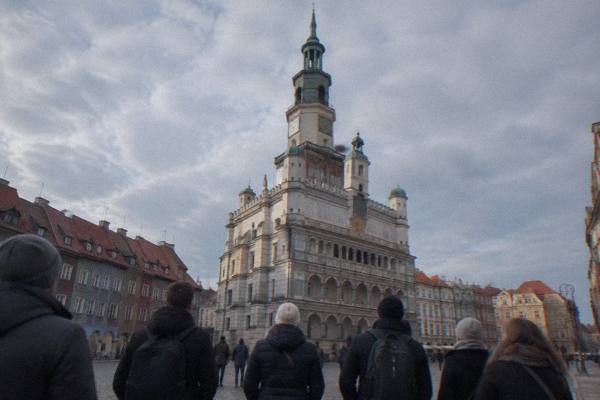
The fame divides neatly into three layers. The first is visual: the Renaissance-influenced Old Market Square and its goat show, the single image most people associate with the city. The second is edible: the croissant, plus a regional table built on pyry z gzikiem, potatoes with fresh cheese, that you can read about in what are the most famous Polish pastries. The third is historical and commercial: an island where Poland's earliest rulers are buried, three mathematicians who broke the Enigma cipher before the war, and a fair ground at MTP that has made the city a meeting place for Central European industry for generations.
Why Do The Town Hall Goats Make Poznan Famous?
Two metal goats emerge from the Town Hall's clock and lock horns every day at noon, and, the National Museum's own page states, "since recently also at 3 pm", a spectacle first installed in September 1551 by the clockmaker Bartel Wolff of Gubin and restored with a new clock in 1913, with the goats reappearing in 1922 after a repair. That is the version on the museum's dedicated goat page, and it is the safest version to repeat: many shorter guides compress the 1551 installation, the 1913 clock and the 1922 reappearance into one vague medieval date, which the museum does not support.
One caution belongs here. The Town Hall's museum interior, the Museum of the History of the City of Poznan, is listed as closed every weekday on the National Museum's visit page, with no reopening date published, because of works on the building. Whether the goats still perform on any given day during those facade works is something no official page confirms, so treat noon as the hour to be on the square and let the facade decide. The square itself, the merchants' houses and the surrounding museums are unaffected. For the full timetable question there is a dedicated page on what time the goats come out in Poznan, and the deeper story sits in our Old Market Square guide on this site.
Around the same square cluster three museums whose own pages publish hours and prices, a useful contrast to the closed Town Hall interior:
| Museum on or near Stary Rynek | Hours (own page) | Normal / reduced zl | Free day |
|---|---|---|---|
| Museum of Musical Instruments, Stary Rynek 45 | Tue-Wed 10:00-16:00, Thu to 18:00, Fri to 20:00, Sat-Sun to 17:00, Mon closed | 15 / 10 | Tuesday |
| Greater Poland Military Museum, Stary Rynek 9 | Tue-Sun 10:00-17:00, Mon closed | 15 / 10 | Tuesday |
| Museum of the Wielkopolska Uprising 1918-1919, Stary Rynek 3 | Nov-Feb Tue-Sun 10:00-16:00, Mon closed | 15 / 10 | Tuesday |
A guided walk is the efficient way to take the square, the goat legend and the Croissant Museum's building in one pass. The Check availability link beside this paragraph goes to the operator's live listing for a private Old Town tour, the featured product for this page.
The Croissant Museum at Stary Rynek 41/2, entered from Klasztorna Street 23, turns the pastry into theatre. Its own page lists Polish shows at 11:00, 12:30, 14:00 and 15:30, plus 17:00 on Saturdays, and an English "Croissant and goat show" at 14:00, daily in July and August and on Saturdays and Sundays all year, with other days per the booking calendar and a 15:30 English show added only when 14:00 fills. Goat shows end with a view of the Town Hall goats from the museum windows, tasting is included, and the page asks visitors to arrive 10 minutes early. Ticket prices appear only in the booking widget, so this page prints none.
Why Is The St Martin's Croissant Protected By EU Law?
The croissant is filled with white poppyseed, and its season peaks on 11 November, when St Martin Street celebrates its name day. One honest caveat: the 2025 edition had no parade, replaced by an all-day "Miasteczko Imieninowe" on police safety recommendations, and the 2026 programme was not published when this page was drafted. So the correct advice is to expect a street party centred on the croissant, and to check the CK Zamek programme for the format of any given year, never to promise yourself a parade.
Beyond the croissant, the city's food fame rests on regional dishes rather than fine dining, though fine dining exists: the Michelin Guide Poland 2026 lists 25 restaurants from Poznan and its surroundings, with one star for Muga and Bib Gourmand entries for Fromazeria, POSTO, SPOT., TU. REStAURANT and Farmer & Sons in Skorzewo. The everyday table is simpler. Pyry z gzikiem, boiled potatoes with a fresh cheese, chive and onion mix, is the dish locals claim first, and the question of how much a beer costs in Poznan covers the other half of the local fame, the Lech brewery's home city.

Why Does Cathedral Island Matter To Polish History?
Ostrow Tumski, the island in the Warta where Poznan Cathedral stands, holds the relics of the tombs of Mieszko I and Boleslaw Chrobry and a 10th-century baptismal bowl in crypts the cathedral's own page opens to tourists from 1 March to 15 November, weekdays 9:00-16:00 and Sundays 14:00-18:00, with crypt tickets at 10 zl normal and 8 zl reduced and the tower at 14 zl and 12 zl. The cathedral page also notes the tower has been open since 1 June 2026, so the climb is a current option rather than a memory.
Two neighbouring institutions carry the same story for people who want it explained rather than just shown. Porta Posnania, the interpretation centre at ul. Gdanska 2, is open Tue-Fri 9:00-18:00 and Sat-Sun 10:00-19:00, closed Mondays, with entries every 20 minutes in groups of up to 30, tickets at 35 zl normal and 29 zl reduced, and a cheaper 21 zl rate shown for Poznan City Card holders. Genius Loci, the archaeological reserve on ul. Ks. I. Posadzego 3, charges 20 zl normal, 15 zl reduced and 50 zl for a family of up to six. Across the footbridge, Srodka adds a lighter landmark: the mural "Opowiesc srodecka z trebaczem na dachu i kotem w tle" on the tenement at ul. Srodka 3, which the city marked as 10 years old in October 2025, fixing its date to 2015.
What Are The Enigma Codebreakers And The Trade Fairs Famous For?
Poznan is famous as the training ground of Marian Rejewski, Jerzy Rozycki and Henryk Zygalski, the three mathematicians named on the Enigma Cipher Centre's timeline who broke the German Enigma cipher before the Second World War, and the centre that tells their story at ul. Sw. Marcin 78 is open Tue-Fri 9:00-18:00 and Sat-Sun 10:00-19:00, closed Mondays, at 35 zl normal and 29 zl reduced. The three names appear on the centre's own site, and its exhibition and audio guides run in Polish, English, German, Russian and Ukrainian, which tells you how international the audience for this story has become.
The commercial half of the city's fame runs through MTP, the Poznan International Fair, whose grounds give the centre its skyline of exhibition halls. The MTP calendar for the season ahead lists Poznan Game Arena on 23 to 25 October 2026 and Cavaliada on 10 to 13 December 2026, and fair weeks visibly change the city: hotel demand rises and restaurants fill with exhibitors. Winter adds a second, softer kind of fame. Betlejem Poznanskie, the Christmas market, runs 14 November to 20 December 2026 on the MTP grounds, from 20 November at Plac Wolnosci and from 21 November on the Old Market Square, with all three strands ending by 6 January 2027. The same month brings the 20th POZnan Ice Festival, with carving contests on 11 to 13 December 2026.
For sizing the trip against these draws, how many days in Poznan is enough answers the planning question directly, and is Poznan expensive covers what the zloty prices above feel like in practice.
Common Questions About What Poznan Is Famous For
What is Poznań famous for?
It is famous for the Town Hall goats at noon, the St Martin's croissant protected as a PGI since 2008, Cathedral Island with the tombs of Mieszko I and Boleslaw Chrobry, the Enigma codebreakers Rejewski, Rozycki and Zygalski, and the Poznan International Fair. Readers curious whether the older-history claim holds up can also check which city was the first capital of Poland.
Are the Poznan goats working during the Town Hall renovation?
The goats are scheduled every day at noon and, the National Museum's page states, since recently also at 3 pm, but whether they run during the current facade works is not confirmed on any official page. The museum interior inside the Town Hall is closed with no reopening date published, so plan for the square and the show, not the museum.
Can you visit the Croissant Museum in English?
Yes. The museum's own page lists an English "Croissant and goat show" at 14:00, about 65 minutes, daily in July and August, on Saturdays and Sundays all year, and on other days shown in the booking calendar, with a 15:30 English show added when 14:00 is full. Tasting is included and the page asks for arrival 10 minutes before the start.
Is the St Martin's croissant really EU protected?
Yes, as a Protected Geographical Indication, registered by Commission Regulation (EC) No 1070/2008 of 30 October 2008.
What food is Poznan known for besides the croissant?
Pyry z gzikiem, boiled potatoes with a fresh cheese, chive and onion topping, is the regional staple, and the St Martin's croissant dominates the 11 November season. The Michelin Guide Poland 2026 also lists 25 restaurants from the city and surroundings, so the fame is no longer only homestyle.
Taken together, the goats, the croissant, the island and the fairs give Poznan a fame that is more specific than most mid-sized European cities can claim, and nearly all of it sits within easy walking distance of the Old Market Square, which is exactly why the city rewards a planned day rather than a drive-through.