Poznan Time Zone And Practical Basics
Poznan, the capital of the Wielkopolskie voivodeship in western Poland, sits on the Warta river and runs on Central European Time. Here is what the city's own operators and official pages say about clocks, money, tickets and the other basics first-time visitors ask about.

Short answer
Poznan is in the Europe/Warsaw time zone: Central European Time (UTC+1) in winter and Central European Summer Time (UTC+2) from late March to late October. Poland uses the zloty (PLN), not the euro, and the practical basics of a visit, from tram tickets to tap water, are simple once you know them.
Poznan, the capital of the Wielkopolskie voivodeship (Greater Poland) in western Poland, is a city of 534,239 residents on the Warta river, and most of the practical questions visitors ask have short, verifiable answers. The city keeps Central European Time, pays in zloty, sells tram tickets by time rather than distance, and pours drinking water from the tap. This page gathers those basics in one place, and every figure below comes from an official operator or primary source: the transport authority ZTM, the city portal, the national statistical office and the WMO climate normals for the Poznan station.
What Time Zone Is Poznan In?
Poznan keeps the Europe/Warsaw time zone, which means Central European Time (UTC+1) in winter and Central European Summer Time (UTC+2) from the last Sunday of March to the last Sunday of October, the same clock as Berlin, Prague, Rome and Paris. The whole of Poland, Poznan included, switches between the two on the common European dates, so the city is never more than an hour apart from its western neighbours and never runs on its own local clock.
That shared clock is the single most useful planning fact. A traveler flying from London gains an hour on arrival in Poznan, and a traveler arriving from New York moves six hours ahead, in both cases without any regional oddity to remember. Daylight saving ends on the last Sunday of October and resumes on the last Sunday of March, exactly as in the rest of the European Union.
The practical payoff is in the opening hours. Museums and attractions in Poznan publish their hours in local time, and the famous mechanical goats on the Town Hall facade appear at noon, with a second appearance the National Museum's page describes as recent, at 3 pm. Visitors planning around the goats can read what time the goats come out in Poznan for the full detail. If you are still choosing when to come, the seasonal breakdown in the best time to visit Poznan pairs the clock with the calendar.

What Is The Time Difference Between Poznan And Other Cities?
Poznan is one hour ahead of London and Dublin year round, six hours ahead of New York on standard time and six in summer too because both shift their clocks, and it shares the exact same hour as Berlin, Vienna, Stockholm and Rome, so no mental arithmetic is needed anywhere in Central Europe. The only differences that matter for most itineraries are with the UK, Ireland, Portugal and Iceland, the European zones that stay an hour behind, and with long-haul origins such as the United States and Canada.
The table below gives the offset as it stands for most of the year, with the summer note where a city changes its own clock on different dates or not at all.
| City | Offset from Poznan | Note |
|---|---|---|
| Berlin | Same time | Identical zone |
| Warsaw | Same time | Same zone, Europe/Warsaw |
| Prague | Same time | Identical zone |
| Rome | Same time | Identical zone |
| London | 1 hour behind Poznan | UK shifts clocks on different dates |
| Dublin | 1 hour behind Poznan | Same as London |
| Lisbon | 1 hour behind Poznan | Same as London |
| New York | 6 hours behind Poznan | Both shift clocks, offset is stable |
| Reykjavik | 1 to 2 hours behind | Iceland does not use summer time |
For train travelers the shared clock is a quiet convenience: there is no arrival-time conversion on the route from Berlin, though Poland has notified temporary border controls at its land borders with Germany and Lithuania, running from 2 October 2026 to 30 March 2027, so a passport or national ID should be carried on that train. The Berlin to Poznan train guide covers the route in detail. Direct trains from Poznan Glowny reach Warsaw in about 2 hours 20 minutes to 3 hours 20 minutes, and the Warsaw to Poznan train page collects the practical detail; the PKP Intercity journey planner is the place to confirm times for a specific day.
A shared time zone also makes guided day trips easy to schedule, and the listings above include private walks and a beer tasting that all start from central Poznan on the same clock you are already on.
What Currency Does Poznan Use, And How Do You Pay?
Poland uses the zloty (PLN), not the euro, even though the country is in the European Union and the Schengen area, so every price in Poznan, from a tram ticket to a museum entry, is quoted and paid in zloty. The euro is not the till currency anywhere in the city, and a card that works in the euro area works here too, but the amount charged is converted to zloty. Exchange rates move daily, so no fixed conversion belongs in a guide: check a live rate table on the day you travel.
Card payment is widespread in shops, restaurants and hotels, but small stalls, market traders and some ticket machines still expect cash or a local payment method. The practical habit is to carry some zloty in coins and small notes for markets and street food, and use a card for everything else. A good companion piece is the Poznan City Card guide, which sets out the card's prices and what it includes.
One warning worth repeating: never rely on paying in zloty with a contactless bank card on a tram or bus, because that does not exist in Poznan yet. The next section explains what to do instead.

How Do You Buy Tram And Bus Tickets In Poznan?
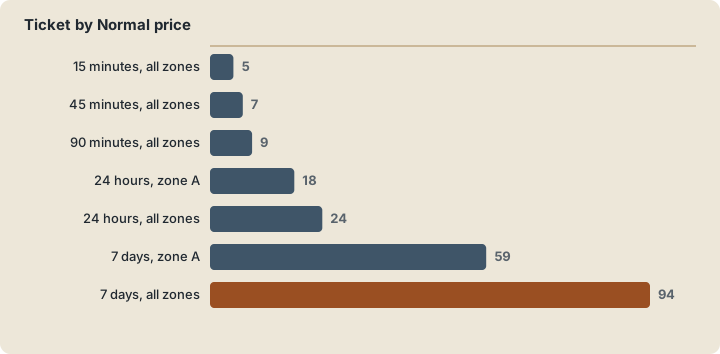
ZTM, the city transport authority, sells timed tickets valid in every zone with transfers allowed: 5 zl for up to 15 minutes, 7 zl for up to 45 minutes and 9 zl for up to 90 minutes, plus 24-hour tickets at 18 zl for zone A and 24 zl for all zones, and you cannot yet tap a bank card on the vehicle. Tickets come from machines, the operator's app, sales points or a rechargeable PEKA card, and they must be validated at the start of the journey. Real travel time counts, and two tickets cannot be combined to stretch the time.
The PEKA card itself costs 27 zl, of which 12 zl is a refundable deposit and 15 zl is travel credit, and it can be topped up with between 1 and 300 zl. The contactless bank-card option is coming with the PEKA modernisation, but ZTM expects the effects in 2028, so plan around the methods that exist today. The fine for travelling without a valid ticket is 350 zl, reduced to 175 zl if paid within 7 days.
| Ticket | Normal price | Reduced price |
|---|---|---|
| 15 minutes, all zones | 5 zl | 2.50 zl |
| 45 minutes, all zones | 7 zl | 3.50 zl |
| 90 minutes, all zones | 9 zl | 4.50 zl |
| 24 hours, zone A | 18 zl | 9 zl |
| 24 hours, all zones | 24 zl | 12 zl |
| 7 days, zone A | 59 zl | 29.50 zl |
| 7 days, all zones | 94 zl | 47 zl |
There is a weekend detail worth knowing: a 24-hour ticket validated between 20:00 on Friday and 24:00 on Saturday stays valid until 24:00 on Sunday, which effectively covers a whole weekend visit. The full fare structure, the PEKA card and the airport buses are unpacked in the Poznan public transport guide. For arrivals, lines 148 and 159 link Poznan Glowny with the airport, each running every 15 minutes at peak, and the Poznan airport to city centre page walks through the options.
A private walking tour is the other way to skip the logistics entirely: a guide meets you in the centre and you spend the ticket money on the tram only when you actually need it. You can Check availability for the Srodka district and Cathedral Island walk on the operator's live listing.

Can You Drink The Tap Water In Poznan?
Yes, the tap water in Poznan is safe to drink: the city utility Aquanet states plainly on its own page that the water from Poznan taps is safe, so filling a bottle at your hotel or apartment sink is a normal, everyday thing to do and saves both money and plastic. The utility's statement is unambiguous, and it matches the general position across Polish cities, where municipal water is treated to the national drinking standard.
For visitors this removes a small but constant cost. A refillable bottle covers a day of walking the Old Town, Citadel Park or the Lake Malta paths, and cafes will generally fill a bottle on request. It also pairs well with the free sights: several of the best ones, including the Old Zoo and the square itself, appear in free things to do in Poznan, and none of them need a paid drink to enjoy.
One related basic: the emergency number across Poland and the whole EU is 112. It is free of charge, works from landlines and mobiles, and the official government page notes it functions even from a phone without a SIM card. Everything else covered here is indexed on Poznan Travel Guide.
What Is The Weather Like In Poznan Through The Year?
WMO's 1991-2020 climate normals for the Poznan station show a genuinely four-season city: January averages a daily high of 2.1 C and a low of -2.9 C, July is the warmest month at 25.2 C and also the wettest at 84.4 mm of rain, and April is the driest at 28.6 mm, so the packing question changes completely with the season. July and August are the warm months, with mean daily highs around 25 C, while December through February brings frost on roughly 18 to 20 days a month.
| Month | Mean daily high | Mean daily low | Precipitation |
|---|---|---|---|
| January | 2.1 C | -2.9 C | 37.7 mm |
| April | 15.0 C | 4.0 C | 28.6 mm |
| July | 25.2 C | 14.1 C | 84.4 mm |
| October | 13.3 C | 5.4 C | 35.4 mm |
Two practical readings follow from the normals. Summer visitors should expect rain even in the warmest month, so a light rain layer belongs in the bag alongside sunscreen, and the wettest month is not a winter one. Winter visitors should plan around frost: January averages 19.7 frost days, and the normals record snow-relevant cold rather than any promise of snowfall. The month-by-month detail, including what it means for the Christmas market season, sits in Poznan weather by month, and the cold-season specifics are in Poznan in winter.

A rainy afternoon in Poznan is not a lost one. The city's museums are dense and central: the National Museum's branches, the Enigma Cipher Centre and the Royal Castle are all within an easy walk or short tram ride of the square, and the Poznan rainy day guide orders them by mood and opening hours. The Poznan museums page adds the free-day detail: the National Museum and Independence Museum branches are free on Tuesdays.
How Do You Get Online In Poznan?
Visitors to Poznan can get online the same ways as anywhere in Poland: hotel and apartment Wi-Fi, cafe networks, a local SIM bought in the city, or an eSIM installed before departure, and the choice is mostly about how much you want to plan before you land. The practical differences are about setup, not coverage claims: Wi-Fi needs no preparation, a physical SIM needs a shop, and an eSIM can be bought and installed from home so data works the moment the phone lands.
For navigation, the same apps that work elsewhere in Europe work in Poznan, and the ZTM app doubles as both a ticket shop and a journey planner for trams and buses. Offline maps of the centre are worth downloading in any case, because the Old Town's lanes are compact enough that a paper habit and a phone habit work equally well. If you want data sorted before you fly, an eSIM for Poland can be arranged in advance.
One honest note on two-wheeled transport: there is no city bike system in Poznan today. The previous scheme ran from 2012 to 2022 and has not returned; a council committee discussed a citizens' motion to bring it back in July 2026, but no system exists to recommend, so do not build a cycling day around public bikes. Walking, trams and the occasional taxi cover the distances comfortably.
What Entry Rules Apply To Visitors To Poland?
Poland is in the Schengen area, and the EU's Entry/Exit System (EES) has been fully operational at all external Schengen border crossings since 10 April 2026, so visa-exempt visitors from outside the EU, including UK and US travelers, may have fingerprints and a photo registered at the border, with no fee for the registration itself. UK visitors can stay up to 90 days in any 180-day period, and their passport must have been issued less than 10 years before arrival and be valid for at least 3 months after departure.
Two further points matter for land arrivals. Poland has notified temporary internal border controls at its land borders with Germany and Lithuania, running from 2 October 2026 to 30 March 2027, which means ID checks can happen on the train or bus from Berlin, so carry a passport or national ID. And the ETIAS travel authorisation, which will apply to visa-exempt visitors once it starts, has no confirmed start date or fee in official sources: check the EU's official ETIAS site before you travel rather than any secondhand date.
| Entry basic | What applies |
|---|---|
| Schengen membership | Yes, Poland is in Schengen |
| EES biometrics | Fingerprints and photo may be taken, no fee |
| UK visitors | 90 days in any 180, passport under 10 years old, 3 months validity left |
| Berlin land border | Temporary controls 2 Oct 2026 to 30 Mar 2027, carry ID |
| ETIAS | No confirmed start date or fee, check the official EU site |
First-time visitors to Poland weighing Poznan against the better-known cities can start with where to go for a first time in Poland, and the flight-side practicalities are covered in flights to Poznan and the Poznan airport guide.

What Opening Hours Should You Plan Around In Poznan?
Museums in Poznan follow a consistent weekly rhythm worth memorising: most are closed on Mondays, the National Museum and Independence Museum branches are free on Tuesdays, and the Imperial Castle is the outlier, open daily from 12:00 to 19:00 with tickets sold until 18:00, while shops and malls run longer, with the Stary Browar gallery open 9:00-21:00 Monday to Saturday. Planning a museum day around the free Tuesday is one of the easiest savings in the city.
The market rhythm differs. The Jezyce market trades Monday to Saturday from 6:00 to 20:00, with only some florists opening on Sunday, and Sunday trading laws mean many retail spaces keep limited Sunday hours. The Christmas season rewrites the calendar: Betlejem Poznanskie runs across three sites, with the MTP grounds open from 14 November to 20 December 2026, Plac Wolnosci from 20 November 2026 and the Old Market Square from 21 November 2026, both to 6 January 2027. The Poznan Christmas market guide carries the full detail.
| Venue type | Typical rhythm | Detail |
|---|---|---|
| National Museum branches | Mon closed, Tue free | Free admission on Tuesdays |
| Independence Museum branches | Mon closed, Tue free | Same Tuesday rule |
| Imperial Castle | Daily 12:00-19:00 | Tickets sold until 18:00 |
| Enigma Cipher Centre | Mon closed | Tue-Fri 9:00-18:00, Sat-Sun 10:00-19:00 |
| Stary Browar gallery | Mon-Sat 9:00-21:00 | Sunday 10:00-20:00 on trading Sundays |
| Jezyce market | Mon-Sat 6:00-20:00 | Some florists only on Sunday |
A few things are closed right now and should not be on any itinerary: the Palm House is closed for rebuilding, with part of the rebuilt pavilions due back towards the end of 2028, the Town Hall museum interior is closed with no published reopening date, and the Ethnographic Museum is closed for renovation. The facade, the square and the goats are separate from the museum interior, and whether the goats appear during the facade works is not confirmed for any given day, so treat the noon and 3 pm appearances as a hope rather than a guarantee.
What Should Families And First-Timers Know?
Families get an unusually good deal in Poznan: the Old Zoo is free to enter, the New Zoo charges 20 zl for every visitor in the winter months and 45 zl on weekdays from March to October, and the timed tram tickets mean a family can cross the city for the price of a few single fares, while the compact centre keeps almost everything within a short walk. The practical basics for kids are the same as for adults, just with more snacks.
The Poznan with kids guide collects the family itinerary in full, and the seasonal note matters there too: the Maltanka park railway, which connects the lake area with the New Zoo, is a summer-only attraction, and its 2026 season ended on 27 September, with no 2027 dates published yet. Choosing where to sleep is the other big first-timer decision, and where to stay in Poznan breaks the central districts down street by street.

For a first visit of one or two days, the honest advice is to stay central and walk. The Old Market Square, the Fara parish church, Ostrow Tumski with its cathedral and Porta Posnania, and the Srodka district with its famous mural all sit within an easy stroll of one another, and a private guide can stitch them into a single narrative. The Srodka and Cathedral Island walk mentioned earlier is exactly that: a local expert covering the islands, the mural and the stories between them, bookable with free cancellation, so the plan can change with the weather.
Day trips extend the same logic. Kornik Castle is closed on Mondays and its low-season hours run to 15:15 with last entry at 14:30, so a Tuesday combines the free museum morning in the city with an afternoon at the castle, and the Rogalin and Kornik guided tour above handles the logistics of visiting both in one day.
Common Questions About Poznan Practical Basics
What time zone is Poznan in?
Poznan keeps the Europe/Warsaw time zone: Central European Time (UTC+1) in winter and Central European Summer Time (UTC+2) from late March to late October, the same clock as Berlin, Prague and Rome.
Is Poznan one hour ahead of London?
Yes, Poznan is one hour ahead of London year round, because both shift their clocks in summer and both shift back in winter. The difference is stable at one hour even on the few days when the shifts happen on different dates.
Does Poznan use the euro?
No. Poland uses the zloty (PLN). Cards are widely accepted, but every price in the city is quoted and charged in zloty, and market stalls and small vendors often expect cash.
Can you tap a bank card on a Poznan tram?
Not yet. ZTM expects contactless bank-card payment with the PEKA modernisation, with effects in 2028. Today you buy a timed ticket from a machine, the app, a sales point or a PEKA card, and validate it on boarding.
Can you drink tap water in Poznan?
Yes. The city utility Aquanet states on its own page that tap water in Poznan is safe to drink, so refilling a bottle at your accommodation is normal practice.
What number do you call in an emergency in Poznan?
112, the common EU emergency number. It is free of charge from landlines and mobiles and works even from a phone without a SIM card.

One last habit ties all these basics together: check the live listing for anything you book, carry a little cash in zloty alongside your card, and set your watch to Warsaw time the moment you land, because everything in Poznan, from the goats at noon to the last tram of the night, runs on that clock.