Berlin To Poznan Train
The Berlin to Poznan train crosses into western Poland in a single sitting, and this guide covers every practical part of it: how long the journey takes, which documents to carry at the border, where you arrive, and how to get into the city.

Short answer
Yes, direct trains run from Berlin to Poznan, a journey of roughly four and a half to five and a half hours, arriving at Poznan Glowny station in the city centre. Carry a passport or national ID: Poland has temporary border controls with Germany until the end of March 2027.
Berlin sits closer to Poznan than many travellers might expect: Poznan is the capital of the Wielkopolskie voivodeship (Greater Poland) in western Poland, on the Warta river, and a single direct rail line links it with the German capital. This guide, from the Poznan Travel Guide editorial team, covers the whole route as a planner: what the journey involves, which documents matter at the border, where the train actually puts you down, and how the city's own transport takes over from there. Nothing here is first-hand reportage; every figure is drawn from what the operators and official bodies themselves publish.
Is There A High Speed Train From Berlin To Poland?
Yes, there is a high speed train from Berlin to Poland, and Poznan is one of the cities it serves: direct trains on the Berlin to Poznan route cover the journey in about four and a half to five and a half hours, with no change of train needed. Those times are reported from the operator's own timetable summaries, so treat them as a range and confirm the specific departure in the PKP Intercity planner for your travel day.
That answer surprises people who assume the Berlin to Poland rail link runs only to Warsaw. The Poznan route is the western entry point into the Polish network, and it is the natural one if Greater Poland is the destination. The cross-border leg is where the journey slows: the pace inside Germany and inside Poland differs from the pace through the border section, which is normal on any route that changes rail systems. Check the Berlin rail connections for the day's departures rather than relying on a remembered time, because timetables shift with the season.
This desk never prints a fare for the route: prices move with demand and booking window, and the operator's own planner is the only source worth trusting. Minute-exact journey times are off limits for the same reason; the figures are ranges read from timetable documents valid for late 2026, and a second reading could not re-confirm them to the minute. Say "about five hours" and book against the real departure, not against a guide's rounding.
| Question about the route | What the sources say |
|---|---|
| Direct train Berlin to Poznan? | Yes, direct services run, no change needed |
| Typical journey time | About 4 h 30 to 5 h 30 |
| Arrival station | Poznan Glowny, the city's main station |
| Documents at the border | Passport or national ID, see the border section below |
| Fare on this page | Never quoted: check the operator's planner for the day |
How Long Does The Train From Berlin To Poznan Take?
Direct trains from Berlin to Poznan take about four and a half to five and a half hours end to end, a range reported from the operator's timetable documents rather than a guaranteed schedule for every departure. Some connections may involve a change depending on the time of day, so the honest planning answer is: check the PKP Intercity planner for your date, and budget at least half a day door to door.
Four to five and a half hours in a seat sounds like a lot, but the route is comfortable in a way budget flights are not. There is no airport transfer at either end, no security queue, no seat-back-upright window, and the arrival station, Poznan Glowny, sits at the edge of the city centre with trams waiting outside. When the comparison is door-to-door rather than gate-to-gate, the train usually wins on total time once you add the two airport runs a flight demands.
For context, here is where Poznan's other direct rail links sit, using the same reported ranges. All of these are "about" figures from the same timetable summaries, and all of them are worth confirming for the day:
| Direct route from Poznan Glowny | Typical journey time (reported) |
|---|---|
| Berlin | About 4 h 30 to 5 h 30 |
| Warsaw | About 2 h 20 to 3 h 20 |
| Wroclaw | About 2 h 20 to 3 h 30 |
| Gdansk | About 3 h 40 to 5 h |
Those connections make Poznan a sensible first stop on a wider Polish rail trip. The Warsaw to Poznan train guide covers the capital link in detail, and the Poznan to Wroclaw train, Poznan to Krakow train and Poznan to Gdansk train pages handle the southern and northern legs. If Central Europe is the plan, the Poznan to Prague train route is another cross-border option from the same station.

What Documents Do You Need On The Berlin To Poznan Train?
You need a valid passport or national ID card on the Berlin to Poznan train, because Poland has notified temporary internal border controls at its land borders with Germany and Lithuania, running from 2 October 2026 to 30 March 2027. Do not assume the border is invisible: checks can happen on the train itself, and boarding without ID can end the trip at the frontier.
The detail matters more than many guides admit. Within Schengen, land borders are normally open, but Poland, like several member states, has used the temporary reintroduction mechanism for its German and Lithuanian land borders, and the current notified window covers the whole winter 2026/27 period in which most people would make this trip. The practical rule is simple: the document you would need to enter the Schengen area is the document you carry in your bag, not the one you leave at the hotel.
Two further entry facts shape the paperwork. The EU Entry/Exit System, EES, has been fully operational at all external Schengen border crossing points since 10 April 2026, so visa-exempt visitors arriving from outside Schengen before the Berlin leg may have fingerprints and a photo registered, at no cost. And ETIAS, the planned travel authorisation for visa-exempt visitors, has no start date or fee this desk can source: check the EU's official ETIAS site before you travel rather than trusting a date printed anywhere else. For UK visitors specifically, the rules are 90 days in any 180, a passport issued less than ten years before arrival and valid three months beyond departure.
| Situation | What applies |
|---|---|
| Train from Berlin, current window | Carry a passport or national ID: temporary Polish controls with Germany run to 30 March 2027 |
| Arriving from outside Schengen first | EES is live since 10 April 2026; fingerprints and photo may be registered, free of charge |
| UK passport holders | 90 days in any 180; passport under 10 years old, valid 3 months past departure |
| ETIAS travel authorisation | No sourced start date or fee: check the EU's official site before travel |
| Currency on arrival | The zloty (PLN); Poland is not in the euro area |
That last row catches more arrivals than any other. Poland is in the EU and Schengen but not in the euro area, and the till currency everywhere in Poznan is the zloty. Exchange rates move daily and no evergreen page should print one; the National Bank of Poland publishes mid rates every working day.
Where Does The Train Arrive In Poznan?
The Berlin train arrives at Poznan Glowny, the city's main railway station, which sits at the western edge of the centre within walking distance of the Old Market Square area and with the tram network assembled directly outside. ZTM timed tickets, apps, ticket machines and the PEKA card are the payment routes onto that network today; contactless bank-card tapping on board is not available yet and is expected in 2028.
Glowny is not a remote terminus. Step out of the hall and you are in the thick of the city: the Imperial Castle on Sw. Marcin is a short tram ride or a reasonable walk away, and the Old Market Square with its famous goats follows beyond it. The station's own street address is not something this desk can source, so the honest instruction is that every mapping app finds "Poznan Glowny" without ambiguity, and the Poznan main station guide walks through the layout, the facilities and the exits in detail.
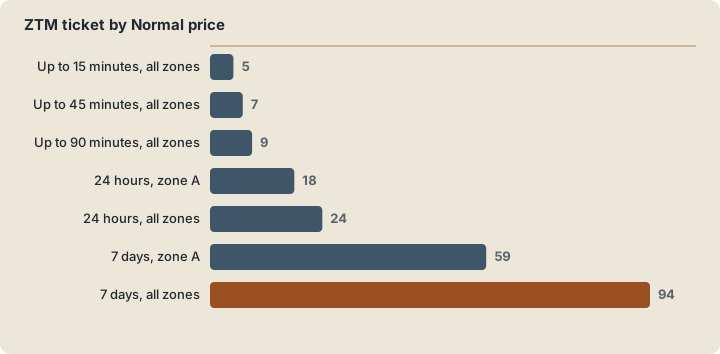
The transport handoff deserves a moment, because Poznan's ticketing has quirks. ZTM timed tickets cover all zones with transfers allowed: 5 zl buys up to 15 minutes, 7 zl up to 45 minutes, 9 zl up to 90 minutes. A 24-hour zone A ticket is 18 zl, and a 7-day zone A pass is 59 zl. The full price list and the PEKA card mechanics are covered in the Poznan public transport guide, and the fine print matters: travelling without a valid ticket costs 350 zl, cut to 175 zl if paid within seven days.
| ZTM ticket | Normal price | Reduced price |
|---|---|---|
| Up to 15 minutes, all zones | 5 zl | 2.50 zl |
| Up to 45 minutes, all zones | 7 zl | 3.50 zl |
| Up to 90 minutes, all zones | 9 zl | 4.50 zl |
| 24 hours, zone A | 18 zl | 9 zl |
| 24 hours, all zones | 24 zl | 12 zl |
| 7 days, zone A | 59 zl | 29.50 zl |
| 7 days, all zones | 94 zl | 47 zl |
One more useful quirk: a 24-hour ticket validated between 20:00 on Friday and 24:00 on Saturday stays valid until 24:00 on Sunday, a weekend promotion the operator runs deliberately.
If the plan is to arrive by train but move around by car, the Poznan car rental guide covers that side. And if luggage is the problem, the Poznan luggage storage page lists where bags can sit while the first afternoon is spent on the square.
Is Flying Better Than The Train From Berlin To Poznan?
For city-centre to city-centre travel, the train is usually the more sensible option on this route: it delivers you at Poznan Glowny beside the tram network in about four and a half to five and a half hours, while flying adds airport transfers at both ends of a very short hop. The trade-off is frequency and fare, and on both counts the operator's live planner, not a guide, is the deciding voice.
The flight case is not empty. Poznan's airport, Lawica, is close to the city and well served by public transport: bus lines 148 and 159 link the airport with Poznan Glowny, each running every 15 minutes at peak and every 20 minutes off-peak, which means a departure from the station forecourt every 7 to 8 minutes at peak times. Journey time for that bus is a figure this desk will not print, because no official page states it. The Poznan airport guide and the airport to city centre page cover the whole arrival process, and flights to Poznan handles the route map.
But the airport's role on a Berlin comparison is mostly about connections onward, not the Berlin hop itself. The airport news this desk can verify is about growth: airBaltic starts a Poznan to Gran Canaria route with first flights on 26 October 2026, and Ryanair is basing a fifth aircraft in Poznan with four new winter routes including Barcelona and Porto. From 25 October 2026 the airport also operates a "core night" with no scheduled operations between 1:00 and 5:00. None of that changes the Berlin arithmetic: the train leaves from the middle of one city and arrives in the middle of the other.

How Do You Pay For Trains In Poland?
Long distance trains in Poland, including the Berlin to Poznan route, are booked and paid through the operator's own channels, typically online in advance or at the station, with tickets tied to a specific departure; city trams and buses in Poznan are a separate system entirely, paid with ZTM timed tickets, apps, machines or a PEKA card. Neither system accepts contactless bank-card taps on board yet, with tram-side contactless expected in 2028.
The two-layer split confuses first-time visitors. The intercity layer is operator-run: you buy a seat on a named train, exactly as the Berlin leg is bought. The how do you pay for trains in Poland answer covers that layer in detail, and the is train travel expensive in Poland answer tackles the cost question, which this page will not put a number on. Practical questions like are there toilets on Polish trains also have their own pages, and the short version is: on modern long-distance rolling stock, yes.
The urban layer is where the arrival at Glowny gets practical. Everything a visitor needs is in the ZTM table earlier on this page: timed tickets valid across all zones, day passes, week passes. What does not exist yet is tapping a bank card on a tram, and the PEKA modernisation contract signed in 2026 is the reason to expect that in 2028 rather than this winter. Until then, the machine on the platform or the app on the phone is the way. The rest of the planning pages sit on Poznan Travel Guide.

Is The Berlin To Poznan Route Good For A Day Trip?
Yes, but only a long one: with about four and a half to five and a half hours each way, a Berlin to Poznan day trip consumes most of a day on the train and leaves roughly five to six usable hours in the city, which fits the Old Market Square, the cathedral island and one museum if the plan is tight. Anyone wanting Poznan at walking pace should stay a night instead.
The day-trip maths is honest but unforgiving. A morning departure puts you at Glowny before noon; an evening return gets you back to Berlin near midnight. Inside that window, the walkable core is compact: the Old Market Square, the Fara church, a crossing to Ostrow Tumski with its cathedral, and the Imperial Castle on Sw. Marcin all sit in a chain that a steady walker can cover. The Berlin to Poznan day trip itinerary lays out the hour-by-hour version, and the one day in Poznan guide is the deeper companion.
For overnighters, the pacing changes completely. Two days opens the National Museum's branches, the Enigma Cipher Centre and a lake walk at Malta; the two days in Poznan and three days in Poznan itineraries sequence it all, and the Poznan self-guided walking tour does the same on foot. Where to sleep is its own question, answered by the where to stay in Poznan guide.
Two warnings the closed-attractions list makes non-negotiable. The Town Hall museum interior on the square is closed for renovation with no published reopening date, so plan around the facade and the goats, not the galleries. And the goats themselves: the official wording says they appear every day at noon "and since recently also at 3 pm", but whether they run during the current facade works is not officially stated, so never promise yourself the show on a given day.

What Should You Do With Your First Hours In Poznan?
Most arrivals head straight for the Old Market Square, about a short tram ride or a walk from Glowny, where the Town Hall facade, the goats at noon and 3 pm, the Croissant Museum and the Fara church cluster together; from there Ostrow Tumski with its cathedral crypts and tower is the natural second stop. The Poznan City Card, 65 zl for 24 hours with transport or 59 zl without, bundles most museums and the trams into one ticket.
The card deserves its own sentence because it is the arrival decision that saves the most fuss. It covers free public transport in Poznan and Poznan County on the transport version, free entry to most museums, and each attraction once. The word "most" is doing real work: partner pages confirm Enigma (21 zl with the card against 35 without) and Porta Posnania (21 zl against 35) are discounted, not free. The full breakdown, including the 48 and 72 hour tiers, is in the Poznan City Card guide.
| Poznan City Card | With transport | Without transport |
|---|---|---|
| 24 hours, normal | 65 zl | 59 zl |
| 48 hours, normal | 83 zl | 72 zl |
| 72 hours, normal | 98 zl | 83 zl |
| 24 hours, reduced | 50 zl | 44 zl |
| 48 hours, reduced | 65 zl | 55 zl |
| 72 hours, reduced | 76 zl | 65 zl |
The square itself is covered in depth by the old market square and Poznan town hall and goats guides. Around the corner, the Croissant Museum runs its English "croissant and goat show" at 14:00, daily in July and August and at weekends all year, with other days per the booking calendar; a second 15:30 English show is added when the 14:00 one fills. Tasting is included, and the museum asks visitors to arrive ten minutes early.
If the train arrives late and the evening is all that is left, the Poznan nightlife and Poznan craft beer guides cover the after-dark city, and the Poznan food page handles the dinner question, including where the famous St Martin's croissant, a protected PGI product registered in 2008, is taken seriously.

Can You Use Poznan As A Base For Day Trips By Train?
Yes, Poznan works well as a rail base: Gniezno is about 25 to 45 minutes away by train, and the city sits on direct lines to Warsaw, Wroclaw, Gdansk and Krakow, so a multi-city Poland trip can run through Poznan Glowny without backtracking. The strongest non-rail day trips, Kornik Castle, Rogalin Palace and Biskupin, are easier with a guided tour or a car than with a timetable.
Gniezno is the rail day trip. The cathedral hill there is reachable in well under an hour, and its opening pattern rewards planners: from May to October the cathedral, museum and terrace run Monday to Saturday 9:00-17:00, but on Sundays tourists are kept out of the cathedral and museum entirely, with only the terrace opening in two afternoon windows. The Gniezno guide has the full picture, including the Museum of the Origins of the Polish State, where Sunday is free admission.
The castle circuit is different, because the timings are fiddly by public transport. Kornik Castle, 40 zl normal entry, is closed Mondays and runs a low-season day that ends at 15:15 with last entry at 14:30; its 2026 season closes on 14 December. Rogalin Palace, 20 zl, keeps a Tuesday-to-Sunday 9:00-16:00 standard schedule. The Kornik Castle and Rogalin Palace guides cover each, and for travellers who would rather not parse three timetables, there is a guided option:
Beyond the region, Poznan is a legitimate hub for a longer Polish itinerary. The Warsaw rail leg takes about 2 h 20 to 3 h 20 direct, and the city-pair guides for Krakow, Gdansk and Prague sequence the rest. The seven days in Poland via Poznan itinerary is the fullest version of the idea.
When Is The Best Time Of Year For This Trip?
The most comfortable months for the Berlin to Poznan train and the walking that follows are May to September, when WMO's 1991-2020 normals for the Poznan station show mean daily highs from 19.8 C in May to 25.2 C in July; July is also the wettest month at 84.4 mm, so pack for warmth and rain together, while April is the driest month at just 28.6 mm.
The climate table is where a Poznan plan should start, because the city rewards being outdoors. Winter arrivals should know that January's mean daily low is -2.9 C with 19.7 frost days in an average month, and December runs 3.2 C highs. That is not a reason to stay away: the Poznan in winter guide makes a full case, and the Poznan weather by month page has all twelve months in detail, with the best time to visit Poznan weighing the trade-offs.
| Month | Mean daily high | Mean daily low | Precipitation |
|---|---|---|---|
| January | 2.1 C | -2.9 C | 37.7 mm |
| April | 15.0 C | 4.0 C | 28.6 mm |
| July | 25.2 C | 14.1 C | 84.4 mm |
| October | 13.3 C | 5.4 C | 35.4 mm |
| December | 3.2 C | -1.4 C | 40.1 mm |
One winter window stands out for German visitors in particular: the Christmas market. Betlejem Poznanskie runs 14 November 2026 to 6 January 2027, with the MTP grounds open 14 November to 20 December, Plac Wolnosci from 20 November and the Old Market Square from 21 November, all to 6 January. A Berlin departure in late November puts a German and a Polish Christmas market in the same weekend, a comparison the Poznan Christmas market guide makes properly. The POZnan Ice Festival follows on 11 to 13 December 2026.

Is The Berlin To Poznan Train Trip Worth It?
Yes, for any traveller whose real question is whether Poznan repays five hours on a train, and the honest answer is that it does: a walkable old core, a cathedral island, the Enigma story, a lake district inside the city and a food scene that now counts 25 restaurants in the Michelin Guide Poland 2026, including the one-star Muga, make it one of Poland's most rewarding mid-size cities.
The Michelin detail is worth spelling out because it surprises people. The 2026 guide lists 25 restaurants from Poznan and its surroundings, with Muga holding one star and Bib Gourmands going to Fromazeria, POSTO, SPOT., TU. REStAURANT and Farmer & Sons in nearby Skorzewo. The best restaurants in Poznan guide sorts the list for visitors.
Beyond the table, the city's spread is wider than a day trip can hold. Ostrow Tumski carries the cathedral with its crypts and tower (open to tourists 1 March to 15 November, tower 14 zl normal). The Enigma Cipher Centre on Sw. Marcin tells the story of the three Polish codebreakers, Marian Rejewski, Jerzy Rozycki and Henryk Zygalski, in five languages, 35 zl normal entry. Lake Malta and Termy Maltanskie give the city a spa-and-water afternoon, the Poznan zoo pages cover a free Old Zoo and a ticketed New Zoo, and the Citadel Park offers the largest park in the city a 15-minute walk from the square.

For the arrival itself, one last practical option: a private transfer with an E Class or similar car can meet the train at Glowny or a flight at Lawica, which suits travellers with luggage, groups or a tight onward schedule. Check availability for your dates.
Common Questions About The Berlin To Poznan Train
Is There A High Speed Train From Berlin To Poland?
Yes. Direct trains run from Berlin to Poznan in about four and a half to five and a half hours, the fastest rail option into western Poland. Times are reported from the operator's timetable summaries, so confirm your specific departure in the PKP Intercity planner for the travel day.
How Long Does The Train From Berlin To Poznan Take?
About 4 h 30 to 5 h 30 for a direct train. This desk never quotes a minute-exact time or a fare for the route: both depend on the departure and the booking window, and the operator's live planner is the authoritative source.
Do You Need A Passport On The Berlin To Poznan Train?
Yes, carry a passport or national ID. Poland has temporary border controls at its land borders with Germany from 2 October 2026 to 30 March 2027, and checks can happen on the train. Never assume the border is uncontrolled on this route.
Can You Tap A Bank Card On Poznan Trams After Arriving?
Not yet. Contactless bank-card payment on Poznan vehicles is expected in 2028 under the signed PEKA modernisation contract. Today, buy a ZTM timed ticket (5, 7 or 9 zl), use an app, a platform machine or a PEKA card.
Is Poznan Worth A Stop Between Berlin And Warsaw?
Yes. Poznan sits roughly between the two, has a walkable old core, a cathedral island, the Enigma Cipher Centre and 25 restaurants in the Michelin Guide Poland 2026, and connects onward by direct trains to Warsaw in about 2 h 20 to 3 h 20.
What Currency Do You Need In Poznan?
The Polish zloty (PLN). Poland is in the EU and Schengen but not in the euro area, so the euro is not the till currency. Exchange rates move daily and no fixed rate should be trusted from a guide.
This desk's honest summary: the Berlin to Poznan train is the calm way into one of Poland's most underrated cities, provided you carry your ID for the border window, buy your tram ticket from a machine rather than a card reader, and check the operator's planner for the day rather than any remembered timetable.