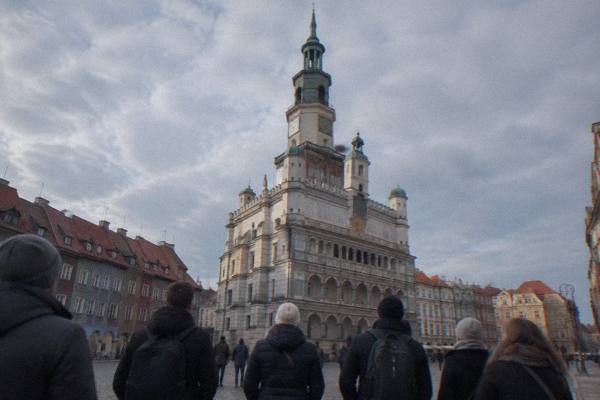
What Time Do The Goats Come Out In Poznan?
The Poznan Town Hall goats appear daily at noon and, since recently, also at 3 pm. Times, history, the Croissant Museum view and what to check on the day.
Every day at noon, two metal goats emerge from the clock on Poznan's Town Hall and lock horns above the Old Market Square, and the National Museum in Poznan, which runs the building, says that "since recently" a second show has been added at 3 pm. The show is free, it lasts a few minutes, and it has been the signature moment of a visit to Poznan, the capital of the Wielkopolskie voivodeship in western Poland, for over a century in its current form. The goats are the reason crowds gather on the square at midday, and the detail most first-time visitors get wrong is simply the clock: there are now two times a day, not one.

One caveat belongs at the top, because it is the single most useful thing a visitor can know. The Town Hall facade is undergoing works, and the National Museum's own goat page does not state whether the show runs on any given day during those works. The honest instruction is to check the museum's page on the day you plan to watch, or ask at the Tourist Information point on the square. Everything below is what the official sources do say.
What Time Do The Goats Come Out In Poznan?
The goats come out every day at noon, and the National Museum's official goat page adds that "since recently also at 3 pm", so there are two daily shows on the Town Hall clock. Each appearance is brief, the goats emerge from the sides of the clock, meet, lock horns, and disappear again, and the display is free to watch from anywhere on the Old Market Square.
The noon show is the original and the one many people plan around. It draws the biggest crowd, especially on weekends and on bright days, and it coincides neatly with a late breakfast or an early lunch on the square. The 3 pm show is newer, officially confirmed by the museum that operates the Town Hall, and typically attracts fewer people, which makes it the calmer option for anyone photographing the facade.
A practical rule of thumb for either show: arrive ten to fifteen minutes early. The square is large, and the goats are small figures high on the tower, so the best viewing spots fill first. Directly in front of the Town Hall's main facade, looking up at the clock, is where most people stand.
| Show | Time | Notes |
|---|---|---|
| Midday show | 12:00 daily | The original show, largest crowds |
| Afternoon show | 15:00 daily | Recently added per the National Museum's page |
| Duration | A few minutes | The goats emerge, lock horns, and withdraw |
| Cost | Free | Watched from the square, no ticket |
Where Exactly Do The Goats Appear?
The goats appear on the facade of the Town Hall (Ratusz) at Stary Rynek 1, on the clock set high in the tower above the main entrance, facing the middle of the Old Market Square in central Poznan. The building dates to the early 14th century, houses the Museum of the History of the City of Poznan, a branch of the National Museum, since 1954, and its tower collapsed in 1945 and was rebuilt.
The viewing geometry matters more than visitors expect. The clock is on the tower, and the goats are visible from the whole western half of the square, but they read best from a distance of a few tens of metres, far enough back to see the tower without craning. People with long lenses often stand near the fountain end of the square; people who just want the moment stand anywhere with a clear sightline to the clock.
The museum inside is a separate question, and here the official record is blunt: the National Museum's visit page lists the Town Hall museum as closed every weekday, and no reopening date is published. The facade, the square and the goat show are not the museum, and the goats' clock display is not affected by museum opening hours in any way the official pages describe. Treat the museum as closed until its own page says otherwise, and enjoy the square itself, which is open, free and unmissable. The dedicated Poznan Town Hall and goats guide on this site collects the full history and visiting detail.
Between the two daily shows, the square keeps you busy. Three National Museum and Independence Museum branches sit right on Stary Rynek, all closed Mondays and all free on Tuesdays, which makes a Tuesday visit to Poznan unusually good value.
| Museum on Stary Rynek | Address | Hours | Tickets (zl) |
|---|---|---|---|
| Greater Poland Military Museum | Stary Rynek 9 | Tue-Sun 10:00-17:00 | 15 / 10, Tue free |
| Museum of Musical Instruments | Stary Rynek 45 | Tue-Wed 10:00-16:00, Thu to 18:00, Fri to 20:00, Sat-Sun 10:00-17:00 | 15 / 10, Tue free |
| Museum of the Wielkopolska Uprising 1918-1919 | Stary Rynek 3 (Odwach) | Nov-Feb Tue-Sun 10:00-16:00 | 15 / 10, Tue free |
Why Do The Goats Come Out At Noon?
A clock with goats was first installed on the Town Hall in September 1551, made by clockmaker Bartel Wolff of Gubin, and the National Museum's history page records that the current tradition was restored with a new clock installed in 1913, with the goats reappearing on 25 August 1922 after a repair. The daily noon appearance is a Renaissance-era custom carried into the present day.
That lineage is what makes the show more than a gimmick. Mechanical goats announced noon in Poznan while the square below hosted daily trade, and although the tower collapsed in 1945 and the building was conserved in stages including a 1910-1913 conservation, the goat display returned and stayed. Today's goats are the descendants of a mechanism nearly five centuries old in origin, which is why the National Museum maintains an entire page about them.
The story most often told to explain the goats involves two animals that strayed into a banquet, and the clockmaker's design is said to commemorate the fight. The museum's page does not commit to that tale, and neither will this one; what is documented is the 1551 installation, the 1913 clock and the 1922 reappearance. If a guide on the square tells the banquet story, enjoy it as folklore rather than as museum record.
For visitors who want a deeper walk through the square's history, a guided option is worth considering alongside independent wandering; you can Check availability for a private walking city tour that covers the Old Market Square and its stories, and self-guided visitors can also compare audio tour options for the same route.
Can You Watch The Goats From The Croissant Museum?
Yes: the Croissant Museum at Stary Rynek 41/2 (entrance from Klasztorna Street 23) runs "goat shows" that end with a view of the Town Hall goats from the museum's windows, and its English "Croissant and goat show" plays at 14:00, about 65 minutes long, daily in July and August and on Saturdays and Sundays all year, with other days per the booking calendar.
The timing is the clever part. A 14:00 English show does not end in time for the 15:00 goat display, but the Polish-language shows at 14:00 and 15:30 bracket the afternoon goat show, and the museum's own page pitches the window view of the goats as the finale of the goat show format. Tasting is included in the price of a show, whatever that price is: ticket costs are only visible in the museum's booking widget, so check the listing rather than trusting a number quoted anywhere else. Arrive ten minutes before the start.
| Croissant Museum show | Language | Time | Availability |
|---|---|---|---|
| Croissant and goat show | English | 14:00 | Daily July-August, weekends all year, other days per calendar |
| Extra croissant show | English | 15:30 | Only opens when the 14:00 show is full |
| Standard shows | Polish | 11:00, 12:30, 14:00, 15:30 | Plus 17:00 on Saturdays |
The croissant itself carries European protection: the rogal swietomarcinski, the St Martin's croissant, is a Protected Geographical Indication registered by Commission Regulation (EC) No 1070/2008 of 30 October 2008. Getting the designation right matters, because plenty of copy online calls it something stronger than it is; PGI is the accurate label.
If the square at midday leaves you with an afternoon to fill, the Interactive PRL Museum, which recreates everyday life in communist-era Poland, is one of the city's more unusual indoor attractions, and its entry ticket can be booked ahead. The entry ticket price and opening details render on the operator's live listing, so treat the listing as the source of truth when planning.
What If The Goats Do Not Appear On Your Day?
If the goats do not appear, the likely reason is the facade works on the Town Hall: whether the show runs during the works is not stated on any official page, so the National Museum's goat page and the Tourist Information point on the square are the places to check before you commit your midday. The show is mechanical, tied to the clock, and there is no announced suspension, but no official promise either.
That is the honest position, and it is better to plan around it than to be disappointed on the square. The rest of the Old Market Square does not depend on the goats: the colourful merchant houses, the three museums listed above, the Croissant Museum across the square and the Fara church a short walk away on Golebia street, open daily 6:00 to 19:30 outside Mass times, all stand on their own.
For timing a whole trip around the show, the best time to visit Poznan guide on this site covers the seasons, and the WMO 1991-2020 climate normals for the Poznan station show July is both the warmest month (mean daily high 25.2 C) and the wettest (84.4 mm), while April is the driest (28.6 mm). December, when the square hosts the Betlejem Poznanskie Christmas market from 21 November 2026 to 6 January 2027, has a mean high of just 3.2 C, so the noon show in midwinter is a short, cold, atmospheric affair.

Once you have seen the goats, the practical questions shift to the rest of the day: how long to stay, what else the city is famous for and how to get around on the ZTM trams with timed tickets. This site's guides on how many days in Poznan is enough and the Poznan time zone and practical basics cover those, and the homepage of Poznan Travel Guide collects the full range of things to do in the city.
Common Questions About The Poznan Goats
What time do the goats come out in Poznan?
Every day at noon, and, as the National Museum's official page states, "since recently also at 3 pm". Both shows are free to watch from the Old Market Square, and each lasts only a few minutes.
Do the goats come out at 3 pm too?
Yes. The National Museum's goat page, the official source for the display, confirms a second daily appearance at 3 pm alongside the traditional noon show. Check the museum's page on the day, because it does not state whether the show runs during the current facade works.
Can you go inside the Town Hall museum?
No. The National Museum's visit page lists the Town Hall museum, the Museum of the History of the City of Poznan, as closed every weekday, and no reopening date has been published. The facade, the square and the goat clock remain fully visible from outside.
How old are the Poznan goats?
A clock with goats was first installed in September 1551 by Bartel Wolff, a clockmaker from Gubin. The current clock dates from 1913, and after a repair the goats reappeared on 25 August 1922.
Where is the best place to watch the goats?
Anywhere on the Old Market Square with a clear view of the Town Hall tower clock. Arrive ten to fifteen minutes before noon, or before 3 pm, for the best standing spots. The Croissant Museum's "goat shows" also end with a view of the goats from the museum's windows.
How much does it cost to see the goats?
Nothing. The goat display is part of the Town Hall clock and is watched from the public square, so there is no ticket, no gate and no fee. Only the surrounding museums and the Croissant Museum shows are ticketed.