Leszno Day Trip From Poznan
Leszno is one of the Wielkopolskie region's towns within easy reach of Poznan, and a day trip there pairs well with the verified practical facts about trains, tickets and opening hours every visitor from Poznan should carry.

Short answer
Leszno is a day-trip-sized town in the Wielkopolskie voivodeship, reached by rail from Poznan Glowny. This guide covers how to plan the journey, what to verify before you go, and how Leszno compares with the region's better-documented day trips.
Leszno sits in the Wielkopolskie voivodeship, the same western Polish region whose capital is Poznan, a city of 534,239 residents on the Warta river. Travellers who have already walked Poznan's Old Market Square often look south for a slower day out, and Leszno is one of the towns that fits that brief. This page is a planning guide written by the Poznan Travel Guide editorial desk: nobody on this desk has visited Leszno, so instead of borrowed impressions it sticks to what official sources state, flags everything that must be checked on the day, and compares Leszno honestly against the region's day trips whose hours and prices are published and verified.
Where Is Leszno And Why Day-Trip There From Poznan?
Leszno is a town in the Wielkopolskie voivodeship, the Greater Poland region whose capital is Poznan, and it works as a day trip for visitors who want a smaller, walkable Polish town after the big-city sights of Poznan. The appeal is contrast: a slower rhythm, a market square, regional food, and a place that does not revolve around tourism. The desk does not publish a distance or a journey time for Poznan to Leszno, because no official operator page in this site's fact pack carries one. Leszno belongs to that same family of regional destinations.
The appeal is contrast. Poznan concentrates its sights around the Old Market Square, the cathedral island of Ostrow Tumski and the museums of the National Museum network. A day trip exists to leave that behind for a few hours. Leszno, like other Wielkopolskie towns, delivers the slower rhythm: a market square, regional food, and the feeling of a place that does not revolve around tourism. That is the honest pitch, and it is also why this guide spends real effort on the "check before you go" habit, because smaller towns publish their opening hours less loudly than big-city museums do.
There is a second, practical reason to consider Leszno specifically. The verified pack of day trips around Poznan is dominated by heavyweights: Gniezno with its cathedral hill, Kornik Castle, Rogalin Palace and the archaeological reserve at Biskupin. All four are excellent, and this guide compares them later in a table. But they are also the trips every guidebook lists. Leszno is the kind of destination that suits a second visit to the region, or a traveller who has already done the famous four and wants somewhere quieter, with fewer crowds and no coach parties.

For the practical basics that apply the moment you leave Poznan, the one day in Poznan itinerary shows how the city's own sights stack up, and the how much money do I need per day in Poland answer covers budgeting. If you would rather have a guide handle the day, the operator's live listing shows what is available:
How Do You Get From Poznan To Leszno?
Gniezno, the closest comparable regional hop, runs about 25 to 45 minutes by Koleje Wielkopolskie train. Leszno is a regional journey in that same spirit, but no figure for it is printed here. What can be stated with confidence is how rail travel from Poznan works in practice. Poland's train system uses the zloty, never the euro, so any ticket is priced in PLN.
Departures leave from Poznan Glowny, and the planner on the operator's site is the single source of truth for the day's timetable, since engineering works and seasonal adjustments change regional schedules. Book or buy at the station, and keep the ticket with you on board.

One border rule matters if your Leszno day trip is part of a wider Polish itinerary that started in Germany. Poland has notified temporary internal border controls at its land borders with Germany and Lithuania, running from 2 October 2026 to 30 March 2027. That means the train from Berlin to Poznan can carry checks, and every traveller should carry a passport or national ID. It does not affect domestic journeys such as Poznan to Leszno, but it is the kind of detail that catches visitors out on the inbound leg of the trip. The verified long-distance context, kept honest with "about" wording:
| Route From Poznan Glowny | Typical Direct Journey (Reported) | How To Confirm |
|---|---|---|
| Warsaw | about 2 h 20 to 3 h 20 | PKP Intercity planner for the day |
| Berlin | about 4 h 30 to 5 h 30 | PKP Intercity planner, carry ID |
| Wroclaw | about 2 h 20 to 3 h 30 | PKP Intercity planner for the day |
| Gdansk | about 3 h 40 to 5 h | PKP Intercity planner for the day |
| Gniezno | about 25 to 45 min | Koleje Wielkopolskie timetable |
| Leszno | no figure printed | operator's planner for the day |
If rail booking is part of a bigger Poland-wide plan, rail tickets for the Warsaw leg and the Berlin connection can be arranged ahead. For travellers who prefer four wheels, car hire in Poznan is the other route to a Leszno day, with the usual reminder that street parking in central Poznan is paid Monday to Friday 8:00-20:00 for drivers who are not Poznan taxpayers, at 5 to 7 zl per hour in the cheapest tier and up to 9.50 to 13 zl in the dearest.
What Can You See In Leszno On A Day Trip?
Leszno's sights are town-scale rather than headline-scale, and this desk prints no opening hours, prices or sight list for Leszno because no official Leszno source sits in the verified fact pack, so the working method is: plan the day around the town's market square and historic core, and verify museums and interiors on the town's own official channels before you commit. That is not a hedge, it is the difference between a guide written from a fact pack and one written from a brochure. What the pack does verify is the regional pattern: Wielkopolska's smaller towns typically centre on a market square, a town hall and one or two regional museums, all of which keep shorter, more seasonal hours than Poznan's big institutions.
The comparison with what is verified nearby makes the point. Kornik Castle, a full-scale castle attraction, is closed Mondays and in its low season from 1 October to 30 November runs 10:00-15:15 with last entry at 14:30, then closes its 2026 tourist season entirely on 14 December. Rogalin Palace Museum is likewise closed Mondays and opens Tue-Sun 9:00-16:00 in its standard schedule. Biskupin, the archaeological reserve, keeps seasonal hours of 9:00-16:00 from November to March. If destinations of that size close on Mondays and shut mid-afternoon in the cold half of the year, a town museum in Leszno will not be more generous. Plan any Leszno interior visit for a Tuesday to Saturday, earlier rather than later.

A realistic Leszno day therefore looks like this: arrive mid-morning, walk the historic core at the pace it deserves, have a proper regional lunch, and give any museum or interior a generous buffer before closing time. Build the day so that a closed door does not ruin it. This is the same logic the desk recommends for rainy days in Poznan, where the fallback list matters as much as the plan. In a small town the fallback is simpler: the square, the cafes, the walk. Those do not close on Mondays.
For visitors who want a guided experience in English rather than self-direction, a guided day trip from Poznan is the stronger option, and the listings below render live prices and availability from verified data:
The flagship castle day trip from the roster pairs Rogalin and Kornik, which suits visitors who decide that interiors with published hours beat a quiet town on this particular visit.
How Does Leszno Compare With Poznan's Other Day Trips?
**Leszno's honest role is the alternative, for travellers who have done those or who want a day without a checklist.
| Day Trip | What The Sources Confirm | Key Hours | Key Prices (zl) |
|---|---|---|---|
| Gniezno | Cathedral hill, museum open daily, cathedral closed to tourists on Sundays May-Oct, terrace open Sun afternoons | Museum daily 9:00-16:00 Oct-Apr | Museum free on Sundays; all-inclusive hill pass 48 / 42 |
| Kornik Castle | Castle with library, closed Mondays | Low season 10:00-15:15, season ends 14 Dec 2026 | 40 / 20 |
| Rogalin Palace | National Museum branch, palace and park, closed Mondays | Tue-Sun 9:00-16:00 | 20 / 13, Tuesday free |
| Biskupin | Archaeological reserve, open daily by season | Nov-Mar 9:00-16:00 | 28 / 19 |
| Leszno | Town-scale destination, no hours or prices published | verify locally | verify locally |
Two structural notes follow from that table. First, Mondays are the graveyard day for Wielkopolska day trips: Rogalin and Kornik both close, and only Biskupin and the Gniezno state museum stay open. Any Leszno day trip planned for a Monday should assume interiors may be shut and the day should stand on the town itself. Second, free days cluster on Tuesdays: Rogalin Palace Museum is free on Tuesdays, and the Gniezno museum is free on Sundays, while back in Poznan the National Museum and Independence Museum branches are free on Tuesdays. A Tuesday Leszno-plus-something itinerary can therefore be built around free entry at the Poznan end.

For visitors weighing Leszno against a longer-haul Polish city, Torun is the natural rival: bigger, further, famous for its medieval brick core, and a harder day trip because of it. Leszno is the low-effort option in that pairing. The same trade-off thinking runs through the seven days in Poland via Poznan plan, which sequences the region's destinations across a week. If your trip report needs a castle, choose Kornik. If it needs a first-capital history hit, choose Gniezno. If it needs a quiet square and an unhurried lunch, Leszno earns its ticket.
What And Where Do You Eat On A Leszno Day Trip?
Regional Wielkopolska food travels with you from Poznan to Leszno, and the two dishes to look for are pyry z gzikiem, potatoes with cottage cheese, and the rogal swietomarcinski, the crescent pastry registered in the EU as a Protected Geographical Indication by Commission Regulation (EC) No 1070/2008 of 30 October 2008. The rogal's protected status is a regional fact worth knowing before any day trip: it is a PGI product, tied to Poznan and its surroundings, and bakeries across Wielkopolska sell their own versions.
Pyry z gzikiem is the everyday counterpart: potatoes served with a tangy quark-style cheese, historically the farmer's plate of the region, and today the reliable vegetarian anchor of a Wielkopolska lunch menu. Any town restaurant in the region will have a version. Milk bars, the state-era canteens that survive across Poland, are the budget alternative, and Poznan's own are covered in the site's milk-bar guide; whether Leszno's equivalents are open on the day is exactly the kind of detail to verify locally rather than assume.

For context on what a food-focused half day looks like with a guide attached, two city listings from the roster show the format and render current prices from live data:
Michelin recognition gives a sense of the regional food scene's standing. The Michelin Guide Poland 2026 lists 25 restaurants from Poznan and its surroundings, with Muga holding one star and Bib Gourmand awards for Fromazeria, POSTO, SPOT., TU. REStAURANT and Farmer & Sons in Skorzewo. None of that is in Leszno, but it frames the region's cooking culture and sets a fair expectation: a Leszno lunch will be honest regional fare, not a tasting menu, and that is precisely the point of the day.
| Regional Item | What It Is | Where It Sits In The Tradition |
|---|---|---|
| Pyry z gzikiem | Potatoes with cottage cheese | Everyday Wielkopolska farm dish, widely served |
| Rogal swietomarcinski | Crescent pastry with filling | EU Protected Geographical Indication since 2008, tied to the St Martin's Day tradition of 11 November |
| Milk-bar lunch | Canteen-style Polish meals | Budget option across the region, hours vary by town |
| Regional lagers | Local Wielkopolska beer | The same brewing tradition as Poznan's own breweries |
What Should You Know About Money, Tickets And City Logistics?
Poland uses the zloty (PLN) everywhere, including Leszno, and the only Poznan transport figures worth memorising are the verified ZTM timed tickets, 5 zl for 15 minutes, 7 zl for 45 and 9 zl for 90, with a 24-hour zone A pass at 18 zl, plus the fact that contactless bank-card payment on trams and buses does not exist yet, with effects expected in 2028. Cards and apps and machines and the PEKA card are today's payment methods on Poznan's network, and the fine for travelling without a valid ticket is 350 zl, or 175 zl if paid within 7 days. None of this applies on a train to Leszno, which is a rail ticket, but every visitor passes through Poznan's system to reach the station.
Exchange rates move daily, so the desk never prints a fixed rate. Poland is in the EU and Schengen but not in the euro area, so prices everywhere in the region, from a Poznan tram ticket to a Leszno lunch, are quoted in PLN. Cards are widely accepted in Polish towns, but carrying some cash for small-town bakeries and market stalls remains sensible advice across the region.

Two Poznan passes can be weighed against a Leszno ticket. The Poznan City Card costs 65 zl for 24 hours with transport (59 zl without), 83 zl for 48 hours with transport (72 zl without), and 98 zl for 72 hours with transport (83 zl without), giving free entry to most Poznan museums and free public transport in the transport versions. Partners such as the Enigma Cipher Centre (21 / 17 zl with card) and Porta Posnania (21 zl with card) are discounted rather than free. The card is a Poznan product, not a Leszno one, so it only pays if the day trip shares the trip with serious museum time in the city.
| Poznan Transport Ticket | Price (zl) | Reduced (zl) | Notes |
|---|---|---|---|
| 15 minutes | 5 | 2.50 | all zones, transfers allowed |
| 45 minutes | 7 | 3.50 | all zones, transfers allowed |
| 90 minutes | 9 | 4.50 | all zones, transfers allowed |
| 24 hours zone A | 18 | 9 | weekend promo: validate Fri 20:00-Sat 24:00, valid to Sun 24:00 |
| 24 hours all zones | 24 | 12 | covers Poznan County too |
| 7 days zone A | 59 | 29.50 | for longer stays |
For international visitors, entry rules are stable and simple to state. The EU Entry/Exit System has been fully operational at all external Schengen border crossing points since 10 April 2026, and visa-exempt travellers, including UK and US passport holders, may have fingerprints and a photo registered at the border, at no cost. UK visitors get 90 days in any 180 in the Schengen area, with the passport issued less than ten years before arrival and valid at least three months past departure. ETIAS is the one open question: its start date and fee are unsourced in this desk's pack, so the advice is to check the EU's official ETIAS site before you travel.
When Is The Best Season For A Leszno Day Trip?
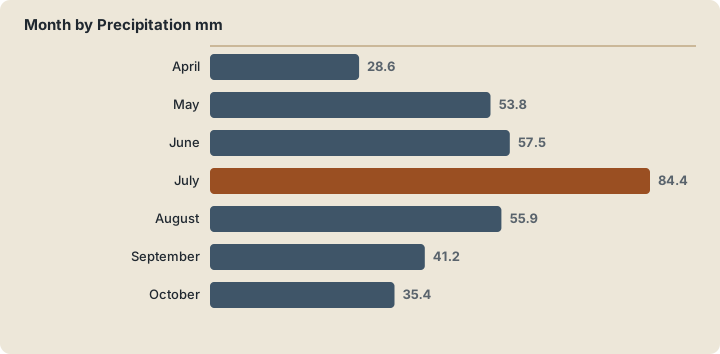
Late spring through early autumn is the best window for a Leszno day trip, because WMO's 1991-2020 climate normals for the Poznan station show the warm, usable months run from May, with a mean daily high of 19.8 C, through July and August at about 25 C, while winter brings January lows averaging -2.9 C and nearly 20 frost days a month. July is both the warmest and the wettest month at 84.4 mm of rain; April is the driest at 28.6 mm. Those normals describe the Poznan station, but the whole of Wielkopolska shares the pattern, and a day built around walking a town square is a day that wants the warm half of the year.
The seasonal table, straight from the WMO station sheet:
| Month | Mean High C | Mean Low C | Precipitation mm | Frost Days |
|---|---|---|---|---|
| April | 15.0 | 4.0 | 28.6 | 4.6 |
| May | 19.8 | 8.4 | 53.8 | 0.4 |
| June | 23.1 | 11.9 | 57.5 | 0.0 |
| July | 25.2 | 14.1 | 84.4 | 0.0 |
| August | 24.9 | 13.7 | 55.9 | 0.0 |
| September | 19.5 | 9.6 | 41.2 | 0.1 |
| October | 13.3 | 5.4 | 35.4 | 3.8 |
September is the sleeper pick: 19.5 C mean highs, barely any frost risk, and thinner crowds than July. Winter, by contrast, is when the region's sights tighten their hours, as the Kornik and Biskupin schedules above show, and while a frost-dusted market square has its charm, a short winter day narrows any small-town itinerary.

There is a winter exception worth flagging. If a Leszno day trip is being planned around the Christmas period, Poznan's own Betlejem Poznanskie markets run 14 November 2026 to 6 January 2027, with the MTP grounds from 14 November to 20 December, Plac Wolnosci from 20 November and the Old Market Square from 21 November, both to 6 January. A December visitor may find the city itself outcompetes any day trip. And if the trip doubles as a football weekend, the Lech Poznan match day guide covers the other big Poznan Saturday.
Common Questions About A Leszno Day Trip
How Do I Get From Poznan To Leszno?
By regional train from Poznan Glowny. This desk prints no journey time or fare for the route; check the operator's planner for the day. Comparable regional hops, such as Poznan to Gniezno, run about 25 to 45 minutes by Koleje Wielkopolskie train.
Is Leszno Worth A Day Trip From Poznan?
Yes, for visitors who want a quiet, walkable Wielkopolska town and have already seen Poznan's headline sights. It is a second-trip or slow-day choice rather than a first-visit rival to Gniezno or Kornik Castle, whose published hours and prices make them the region's headline day trips.
What Should I Check Before Going To Leszno?
Museum and interior opening hours, on the town's official channels. The regional pattern is Monday closures and short afternoon hours outside summer: Kornik Castle and Rogalin Palace both close on Mondays, and seasonal attractions tighten hours from November. Plan a Leszno interior visit for Tuesday to Saturday, earlier in the day.
What Currency Does Leszno Use?
The Polish zloty (PLN), like all of Poland. Poland is in the EU and Schengen but not in the euro area, so prices are never quoted in euros, and the desk never prints a fixed exchange rate because rates move daily.
Do I Need My Passport On A Day Trip To Leszno?
Not for the domestic journey itself, but carry ID if your wider trip crosses from Germany: Poland has temporary internal border controls at its land borders with Germany and Lithuania from 2 October 2026 to 30 March 2027, so the Berlin to Poznan train can carry checks.
When Is The Best Time Of Year For A Leszno Day Trip?
May to September. WMO's 1991-2020 normals for the Poznan station show July and August mean highs of about 25 C, with July also the wettest month at 84.4 mm. April is the driest month, and September combines 19.5 C mean highs with thin crowds.
A Leszno day trip rewards exactly the traveller who plans it with open eyes: verify the interiors on official channels, ride the regional rail from Poznan Glowny with the day's timetable checked in advance, eat the region's protected pastry and its farmhouse potatoes, and let a small Wielkopolska square do the rest.