Poznan World War Two Sites
Poznan, the capital of the Wielkopolskie voivodeship in western Poland, keeps the record of the Second World War in specific, visitable places: a cipher centre on Sw. Marcin, two army museums in Citadel Park and military collections ringing the Old Market Square. This guide sticks to what the museums' own pages state.

Short answer
The main Poznan WW2 sites are the Enigma Cipher Centre (closed Mondays, 35 zl normal), the Museum of Armaments and Museum of the Poznan Army in Citadel Park (15 zl and 10 zl, Tuesdays free), the Greater Poland Military Museum and the Odwach uprising museum on the Old Market Square (15 zl each, Tuesdays free), and the June 1956 monument near the Imperial Castle.
Poznan, the capital of the Wielkopolskie voivodeship (Greater Poland) in western Poland, on the Warta river, is a city whose modern history is unusually legible on the ground. The war years left their marks in specific places, and the institutions that interpret them publish their hours and prices on their own pages. Nothing here comes from a visit, because nobody on this desk has made one; everything comes from what the museums, the city portal and ZTM themselves state.
What Happened In Poznan In Wwii?
The record here is concrete rather than sweeping: the Town Hall's tower collapsed in 1945, the museum inside the Ratusz has told the city's story since 1954, and the places that interpret the war years today are the Enigma Cipher Centre, the two army museums in Citadel Park, and the military collections on the Old Market Square. The National Museum's own pages carry those facts.
What this site will not do is fill the gaps with a narrative no official page in the research pack supports. Readers who want the destruction question answered directly have a dedicated page, was Poznan destroyed in WWII, which handles that thread on its own evidence.
What can be said with sources is architectural and institutional. The Town Hall, a building dated to the early 14th century and conserved in 1910-1913, lost its tower in 1945; the structure you look up at on the square today is the postwar reality. The Museum of the History of the City of Poznan has occupied the Ratusz since 1954, though its interior is currently closed, with the National Museum's visit page listing every weekday as closed and no reopening date published. The square itself, the museums around it and the goats on the facade are all still there, and the goats appear every day at noon, and since recently also at 3 pm, though whether they run during the current facade works is not something any official page confirms.

The interpretive weight of the war story has shifted to the sites that are open. The Enigma Cipher Centre tells the codebreaking thread. Citadel Park, described by the city portal as the largest park in Poznan and a relic of a 19th-century fortress described as the largest artillery fort in Europe at the time, holds two military museums in its grounds. The Old Market Square holds three more collections within a minute's walk of one another. Together they make a coherent two-day route, and the rest of this page is the practical layer for it.
Where To See The War Story In Poznan Today
Five clusters hold the story: the Enigma Cipher Centre on Sw. Marcin, the Museum of Armaments and the Museum of the Poznan Army inside Citadel Park, the military museums of the Old Market Square, the Town Hall facade whose tower collapsed in 1945, and the June 1956 monument on the same street as the castle. Every one of them sits inside the area covered by a 24-hour tram ticket.
The table below is the short version. The sections that follow unpack each cluster in full, with seasonal hours where they vary.
| Site | Focus | Closed | Normal ticket |
|---|---|---|---|
| Enigma Cipher Centre, ul. Sw. Marcin 78 | Codebreaking, with Rejewski, Rozycki and Zygalski on the timeline | Monday | 35 zl |
| Museum of Armaments, Park Cytadela | Artillery and military hardware | Monday | 15 zl |
| Museum of the "Poznan" Army, Park Cytadela | The army story of the region | Monday | 10 zl |
| Greater Poland Military Museum, Stary Rynek 9 | Regional military history | Monday | 15 zl |
| Museum of the Wielkopolska Uprising 1918-1919, Stary Rynek 3 | The 1918-1919 uprising | Monday | 15 zl |
A pattern worth noticing: every museum in the table closes on Monday and admits visitors free on Tuesday. That is not a coincidence of policy at one building; it is how the National Museum network and the Independence Museum network run their branches, and it shapes the whole itinerary. A Tuesday arrival turns the most expensive museum day of a Poznan trip into the cheapest.
For readers who prefer a guided frame over self-direction, the operators below run bookable products that touch this theme and the wider region; prices and current schedules render from each operator's live listing.
What Does The Enigma Cipher Centre Cover And What Does It Cost?
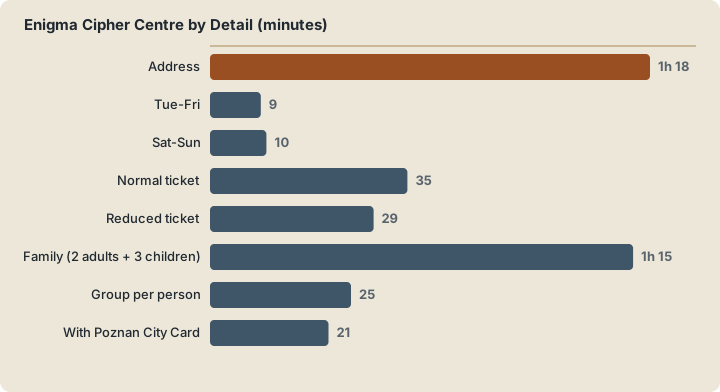
The Enigma Cipher Centre at ul. Sw. Marcin 78 is closed on Mondays, open Tue-Fri 9:00-18:00 and Sat-Sun 10:00-19:00, with last admission one hour before closing; tickets are 35 zl normal, 29 zl reduced, 75 zl for a family of two adults and three children, and 21 zl with the Poznan City Card. Its own timeline names Marian Rejewski, Jerzy Rozycki and Henryk Zygalski.
The centre sits at number 78 on Sw. Marcin, two doorways down from the Imperial Castle, which makes it the easiest museum stop to bolt onto any walk along the city's main ceremonial street. The exhibition and the audio guides run in five languages: Polish, English, German, Russian and Ukrainian, which the centre's plan-your-visit page states plainly. That language spread matters for the codebreaking story, since the three mathematicians the centre's own timeline names, Marian Rejewski, Jerzy Rozycki and Henryk Zygalski, are figures whose work is claimed and retold across Europe; the centre is the place where Poznan's own account of them is laid out.
| Enigma Cipher Centre | Detail |
|---|---|
| Address | ul. Sw. Marcin 78, 61-809 Poznan |
| Monday | Closed |
| Tue-Fri | 9:00-18:00 |
| Sat-Sun | 10:00-19:00 |
| Last admission | One hour before closing |
| Normal ticket | 35 zl |
| Reduced ticket | 29 zl |
| Family (2 adults + 3 children) | 75 zl |
| Group per person | 25 zl |
| With Poznan City Card | 21 zl normal, 17 zl reduced |

One honest note on the City Card: the card's own page promises free admission to most museums, and the Enigma centre is one of the partners where that promise becomes a discount instead. Card holders pay 21 zl rather than walking in free, so anyone doing the arithmetic on a card should count this stop at its discounted rate, not at zero. Visitors who like to move at their own pace through the city's layers can also look at self-guided audio tours of Poznan as a complement to the museum visits.
The centre's subject is not battlefield history but the intelligence war, and it is the one stop on this route where the story runs on mathematics rather than artillery. Budget an unhurried visit: the last-admission rule one hour before closing means a 17:00 arrival on a weekday buys the full hour, and nothing more.
What Do The Citadel Museums Show And When Are They Open?
The Museum of Armaments in Citadel Park opens Tue-Sun, 10:00-16:00 from November to February and 10:00-17:00 Tuesday to Saturday from March to October, with Sunday closing at 16:00; tickets are 15 zl normal and 10 zl reduced, a combined ticket with the Museum of the Poznan Army is 20 zl, and Tuesday is free. The museum's own page allows 45 to 90 minutes for a visit.
Citadel Park is the physical anchor of the military story. The city portal describes it as the largest park in Poznan and as a relic of a 19th-century fortress, at its time described as the largest artillery fort in Europe. Two museums sit in those grounds. The Museum of Armements holds the hardware side, and the Museum of the "Poznan" Army holds the regional army story, at 10 zl normal and 6 zl reduced, with the same combined-ticket option of 20 zl normal and 12 zl reduced that the Armements page lists. Children up to 7 enter free, and the last tickets of the day sell 30 minutes before closing.
| Citadel museum | Season | Hours | Normal | Reduced | Combined |
|---|---|---|---|---|---|
| Museum of Armaments | Nov-Feb | Tue-Sun 10:00-16:00 | 15 zl | 10 zl | 20 zl |
| Museum of Armaments | Mar-Oct | Tue-Sat 10:00-17:00, Sun 10:00-16:00 | 15 zl | 10 zl | 20 zl |
| Museum of the "Poznan" Army | Same network hours | Tue-Sun | 10 zl | 6 zl | 20 zl |
The park itself costs nothing and is worth the walk on its own. The portal puts it a 15-minute walk from the Old Market Square, which is the one distance figure the sources support and therefore the only one printed here. Visitors walking that route should expect parkland and monuments rather than a fortress interior; the fort's surviving structure is part of the landscape, not a tourable casemate with published hours.

For travelers who want the hardware story with a guide and a vehicle rather than in display cases, the tank museum heritage tour below is the bookable version of this thread.
What Can You See At The Old Market Square Museums?
Three branches ring the square: the Greater Poland Military Museum at Stary Rynek 9 and the Museum of Musical Instruments at Stary Rynek 45, both 15 zl normal and 10 zl reduced, and the Museum of the Wielkopolska Uprising 1918-1919 in the Odwach at Stary Rynek 3, also 15 zl. All three are closed on Mondays and free on Tuesdays.
The square cluster is the densest part of the route. The Greater Poland Military Museum, at number 9, opens Tue-Sun 10:00-17:00. The Museum of Musical Instruments, at number 45, spreads its week: Tue-Wed 10:00-16:00, Thu 10:00-18:00, Fri 10:00-20:00, Sat-Sun 10:00-17:00. The Odwach, the small guardhouse building at number 3 that houses the Museum of the Wielkopolska Uprising 1918-1919, keeps winter hours of Tue-Sun 10:00-16:00 from November to February. The uprising it documents belongs to 1918-1919, an earlier chapter than the war this page is built around, but it is the museum that comes to mind when Poznan and armed struggle are mentioned, and it sits at the heart of the square. The wider set of guides lives on Poznan Travel Guide.
| Museum | Address | Hours | Normal | Reduced |
|---|---|---|---|---|
| Greater Poland Military Museum | Stary Rynek 9 | Tue-Sun 10:00-17:00 | 15 zl | 10 zl |
| Museum of Musical Instruments | Stary Rynek 45 | Tue-Wed 10:00-16:00, Thu 10:00-18:00, Fri 10:00-20:00, Sat-Sun 10:00-17:00 | 15 zl | 10 zl |
| Museum of the Wielkopolska Uprising 1918-1919 | Stary Rynek 3 (Odwach) | Nov-Feb Tue-Sun 10:00-16:00 | 15 zl | 10 zl |

The Town Hall itself, at Stary Rynek 1, is the fourth building in the cluster but not currently a fourth museum stop. Its interior, home to the Museum of the History of the City of Poznan since 1954, is closed for renovation, the visit page lists every weekday as closed, and no reopening date has been published, so this guide prints none. The facade, the square and the noon goat appearance on it are all still part of the walk; the museum inside is not, and any page promising a 2027 reopening is ahead of the official record.
Is The Tank Museum Heritage Tour Worth Booking?
The tank museum heritage tour by army car is the one bookable product on this site that builds a day around the hardware side of the story, and its price, rating and current schedule all render from the operator's live listing rather than from this page. It pairs naturally with a morning in Citadel Park, since the museums there cover the same army story in display cases.
This is a fair question to ask before spending a day on it, and the honest answer is that the decision rests on what the listing shows on the day you book. What this page can say is structural: the tour takes the museum-and-monument thread of this guide and puts wheels under it, which suits visitors who would rather not puzzle out the tram connections in the section below, and it is the featured product of this article. The practicalities, including cancellation terms, sit on the operator's live listing: Check availability.
Readers weighing it against a self-guided day should read the transport section next, then decide. The museums themselves are cheap and close together; the tour's value is in the guiding and the vehicle, not in access you cannot otherwise buy.
How Do You Get Between The Sites Without A Car?
Timed ZTM tickets cover all zones and allow transfers: 5 zl for up to 15 minutes, 7 zl for 45 minutes and 9 zl for 90 minutes, while a 24-hour ticket is 18 zl for zone A and 24 zl for all zones. There is no contactless bank-card payment on board yet; the PEKA modernisation is expected to bring it in 2028, so buy from a machine, an app or a customer point before boarding.
The transport layer of this itinerary is simple because the sites cluster. The square museums, the Enigma centre and the Imperial Castle all sit within the walkable core, and Citadel Park is a 15-minute walk from the square per the city portal. Trams and buses matter mainly for arrival days, luggage and tired legs, and ZTM's price list is flat and zone-wide: a timed ticket is valid in all zones, not just the centre, and transfers within the ticket's time are allowed. Real travel time counts, and tickets cannot be combined to stretch the clock.
| ZTM ticket | Validity | Normal | Reduced |
|---|---|---|---|
| 15 minutes | All zones, transfers allowed | 5 zl | 2.50 zl |
| 45 minutes | All zones, transfers allowed | 7 zl | 3.50 zl |
| 90 minutes | All zones, transfers allowed | 9 zl | 4.50 zl |
| 24 hours, zone A | Zone A | 18 zl | 9 zl |
| 24 hours, all zones | Zones A+B+C+D | 24 zl | 12 zl |

Two warnings worth repeating from the fare pages. Travelling without a valid ticket costs 350 zl, dropping to 175 zl if paid within 7 days, and even running up to 5 minutes over the ticket's time costs 175 zl. And the card-tap habit from other European cities will not work here: contactless bank-card payment on vehicles is planned with the PEKA modernisation, with effects expected in 2028, and until then the options are timed tickets, apps, machines or a PEKA card. The full detail, including the weekend 24-hour promotion, is on the Poznan public transport guide.
What Else In Poznan Carries The Wartime And Postwar Story?
The June 1956 monument stands in the city's memory as the marker of the Poznan events of that name, and this site's sources give no visiting details for a museum of them, so the monument itself, the castle district around it and the uprising museum on the square are the honest itinerary. The Imperial Castle across the street is open daily 12:00-19:00, 10 zl with a map.
The 1956 events belong to the decade after the war, but no honest account of the city's postwar story leaves them out, and the monument is the fixed point of that memory. What this guide will not do is invent a museum around it: the verified pack carries the events and the monument but no address, hours or prices for a dedicated exhibition, so none are printed. The street the monument stands on, Sw. Marcin, is also the street of the Imperial Castle, whose visiting page gives daily opening 12:00-19:00 with tickets sold until 18:00, at 10 zl normal and 7 zl reduced with a map, or 20 zl and 15 zl with an audio guide.

East of the centre, Ostrow Tumski adds the deeper layer. The cathedral crypts hold the tombs of Mieszko I and Boleslaw Chrobry and a 10th-century baptismal bowl, open to tourists from 1 March to 15 November, weekdays 9:00-16:00 and Sundays 14:00-18:00, with crypts at 10 zl normal and the tower at 14 zl. That is medieval rather than modern history, but the island is the quietest stretch of a heavy itinerary and the ferry of centuries it offers is a genuine palate cleanser.
Not every evening needs to stay on theme. A candlelit piano concert is the operator-listed alternative to a second museum afternoon, and it books from the live listing below.
For a day beyond the city, the Rogalin and Kornik guided excursion below covers a palace, a castle and ancient oaks in one bookable trip, again with all figures rendering from the operator's listing.
How Many Days Should You Give The Wwii Sites?
Two full days is the honest minimum: one for the Old Market Square cluster, the Enigma centre and the castle district, and one for Citadel Park with its two museums and the park itself. A 48-hour Poznan City Card at 83 zl with transport or 72 zl without covers most museum entries once each plus the trams between them, and Tuesday is the free day at the National Museum branches.
The arithmetic favors planning around Tuesday. The three square museums and the two Citadel museums are all free that day; the Enigma centre never is, even for card holders, but its 21 zl card rate softens it. The card's own page states the inclusions plainly: free public transport in Poznan and Poznan County on the transport version, free admission to most museums, each attraction usable once, and validity until midnight on the last day. The full price ladder is below, and the Poznan City Card guide works through the break-even sums in detail.
| Poznan City Card | With transport | Without transport |
|---|---|---|
| 24 hours | 65 zl | 59 zl |
| 48 hours | 83 zl | 72 zl |
| 72 hours | 98 zl | 83 zl |

For the shape of the days themselves, the two days in Poznan itinerary is the ready-made scaffold, and the free things to do in Poznan guide shows how much of a tight budget can survive a museum-heavy plan. Winter visitors should note the shorter museum hours from November and check the Poznan in winter guide before locking dates, and anyone caught by rain has indoor options sorted on the rainy day guide.
If a guided frame still appeals after all of the above, these are the bookable products that fit this route, with every price and schedule rendered live from the operators' listings.
Common Questions About Poznan Wwii Sites
What happened in Poznan in WWII?
The Town Hall tower collapsed in 1945, and the institutions that interpret the war years today are the Enigma Cipher Centre, the two army museums in Citadel Park and the military collections on the Old Market Square. This page deliberately prints no battle narrative beyond those sourced facts.
Are the Poznan war museums free on any day?
Yes, on Tuesdays. The National Museum branches and the Independence Museum branches, including the Greater Poland Military Museum, the Museum of Musical Instruments, the Odwach uprising museum and both Citadel museums, admit visitors free on Tuesdays. The Enigma Cipher Centre is a paid partner every day, with a Poznan City Card discount of 21 zl instead of free entry.
Is the Enigma Cipher Centre open on Mondays?
No. The centre's plan-your-visit page lists Monday as closed, with Tue-Fri 9:00-18:00 and Sat-Sun 10:00-19:00, and last admission one hour before closing.
Can I pay by tapping my bank card on the tram?
Not yet. ZTM signed the PEKA modernisation contract with contactless bank-card and phone payment expected to follow, with effects in 2028. Until then, buy timed tickets from machines, apps or customer points, or use a PEKA card.
How much is the fine for travelling without a ticket?
ZTM's fees page sets it at 350 zl, reduced to 175 zl if paid within 7 days. Even exceeding a timed ticket by up to 5 minutes costs 175 zl, or 87.50 zl on the same prompt-payment terms.
Where is the Museum of the Wielkopolska Uprising?
In the Odwach, the small guardhouse building at Stary Rynek 3 on the Old Market Square. It documents the 1918-1919 uprising, opens Tue-Sun, and from November to February keeps hours of 10:00-16:00. Tuesday admission is free.