Two Days In Poznan
Two days is enough to cover Poznan's Old Town, the cathedral island of Ostrow Tumski and the Lake Malta quarter, and this itinerary is built only from what the museums, the transport operator and the city's own pages publish.

Short answer
Two days in Poznan cover the compact core: Day One for the Old Market Square, the Town Hall goats, the Croissant Museum and the evening food streets, Day Two for Ostrow Tumski, Porta Posnania and the Lake Malta quarter, moving on timed ZTM tickets that cost 5 to 9 zl per ride.
Poznan, the capital of the Wielkopolskie voivodeship (Greater Poland) in western Poland, sits on the Warta river and holds 534,239 residents, according to the Statistical Office in Poznan. Two days is the length most first-time visitors give it, and it is a workable amount: the historic core is compact, the two headline districts, the Old Town and the cathedral island of Ostrow Tumski, sit within an easy walk or short tram ride of each other, and the Lake Malta quarter adds a half day of park, zoo and thermal baths. This itinerary is assembled from what the venues' own pages, the ZTM transport operator and the city portal actually publish, so every price and hour below is a verified one rather than a guess.
Is Two Days Enough For Poznan?
Two days is enough for Poznan's core if the plan is honest about what is closed: the Town Hall museum interior is closed for renovation, the Palm House is closed for rebuilding until part of it returns towards the end of 2028, and the Maltanka park railway has finished its 2026 season, so a two-day visit works best around the Old Market Square, Ostrow Tumski, Porta Posnania, the Imperial Castle and Lake Malta. That still leaves a full weekend of open doors: the National Museum branches on and around the square, the Enigma Cipher Centre, the Royal Castle, the cathedral crypts and tower, and the free Old Zoo beside the paid New Zoo.
The question of trip length is argued in more detail on How Many Days In Poznan Is Enough, and if two days turn into three, the extended plan on Three Days In Poznan adds the Citadel and the Jezyce district. For a first visit, though, two days is not a compromise. The city's tourist geography is unusually kind: the square, the Fara church, the Croissant Museum and Stary Browar form one walkable cluster, and Ostrow Tumski is a short stroll across the Warta from there.

The one thing a two-day plan must not do is promise things that are currently shut. The National Museum's visit page lists the Town Hall museum, the Museum of the History of the City of Poznan, as closed every weekday, with no reopening date published. The goats on the facade are a separate matter and are covered below. The Palm House in Park Wilsona is closed to visitors for a two-stage rebuild, with the city aiming to reopen part of the pavilions towards the end of 2028 and works running until 2030. Neither belongs in an itinerary right now.
Where Should You Base Yourself For Two Days In Poznan?
The Old Town and the streets just south of it are the practical base for a two-day Poznan trip, because Day One's whole route is on foot from there and the trams to Ostrow Tumski and Lake Malta stop within a few minutes' walk; the city's hotel stock runs from the Hotel Kolegiacki near the square through the PURO Poznan on the central ring to the Opera Hostel for budget travellers. Staying central removes the only real friction a short trip has, which is the morning transfer between districts.
For flexibility on dates and rates, a booking search with free-cancellation filters is the sensible first move: compare flexible stays in Poznan. Mid-range travellers can check midrange hotel rates for the weekend, and anyone travelling cheaply can look at hostel beds near the centre. Specific properties worth a look, without quoting any rate, are Hotel Kolegiacki in the heart of the old core and PURO Poznan close to Stary Browar; on the quiet side, a guesthouse in Srodka puts you across the river from the cathedral, and an apartment by Lake Malta suits anyone planning a heavy Malta day.

The neighbourhood choice also shapes the evenings. Srodka, the small district just across the Bishop Jordan Bridge from Ostrow Tumski, is known for its mural "Opowiesc srodecka z trebaczem na dachu i kotem w tle" on the tenement at ul. Srodka 3, which the city marked as ten years old in October 2025, and for a cluster of small restaurants that do well out of the cathedral-island foot traffic. The Old Town itself quiets after the day-trippers leave. The Srodka guide and the Old Town guide describe both in more depth.
What Should Day One In Poznan Look Like?
Day One belongs to the Old Market Square and the streets behind it: the goats on the Town Hall facade at noon, the Croissant Museum's 14:00 English show, the Fara church, one or two of the square's museums, Stary Browar in the late afternoon and dinner in Srodka, all on foot and all within a few hundred metres of each other. The square itself is the anchor, and its full story is on the Old Market Square page.
Start mid-morning at Stary Rynek. The Renaissance Town Hall has stood in some form since the early 14th century, conserved in 1910 to 1913, with its tower rebuilt after collapsing in 1945, and its museum interior has been home to the Museum of the History of the City of Poznan since 1954. That museum is closed for renovation, so the building's role in a two-day plan is its facade and its clock. The National Museum's page on the goats states that two metal goats appear every day at noon, and since recently also at 3 pm. The same page records that a clock with goats was first installed in September 1551 by the clockmaker Bartel Wolff of Gubin, and that the current tradition was restored with a new clock in 1913. Facade works are under way on the square, and whether the goats run on any given day during the works is not stated officially, so plan for noon but do not build the day around a guarantee.

The Croissant Museum sits at Stary Rynek 41/2, with the entrance from Klasztorna Street 23, and its English "Croissant and goat show" runs at 14:00, about 65 minutes, daily in July and August, on Saturdays and Sundays all year, and on other days as the booking calendar shows; a 15:30 English show opens only when the 14:00 one is full. The show ends with a view of the Town Hall goats from the museum's windows, tasting is included, and the museum asks visitors to arrive ten minutes early. Ticket prices are not published outside the booking widget, so check the calendar for the day's rate. The St Martin's croissant itself, the rogals sold across the city on and around 11 November, is a Protected Geographical Indication under Commission Regulation (EC) No 1070/2008 of 30 October 2008, a status the Polish agriculture ministry's page spells out. The museum's story is told fully on the Croissant Museum page.
For a structured first morning, a guided walk is the efficient option: the listing for the guided walking tour of the Old Town covers the square's key stories in a single loop, and the tour card below shows its current price and rating. There is also a free, tip-based option: "The Best of Poznan (Small group)" by Mateusz, a GuruWalk PRO guide, which you can see on GuruWalk here. It is free and tip based, so no price belongs in this paragraph at all.
The afternoon can absorb one museum. The square carries three branches of the city's museum networks, and their published prices are below. Tuesday is the free day at the National Museum branches and the Independence Museum branches, which is worth knowing if the weekend can be stretched.
| Museum on Stary Rynek | Address | Hours | Normal / reduced |
|---|---|---|---|
| Museum of Musical Instruments | Stary Rynek 45 | Tue-Wed 10:00-16:00, Thu 10:00-18:00, Fri 10:00-20:00, Sat-Sun 10:00-17:00, Mon closed | 15 / 10 zl, Tuesday free |
| Greater Poland Military Museum | Stary Rynek 9 | Tue-Sun 10:00-17:00, Mon closed | 15 / 10 zl, Tuesday free |
| Museum of the Wielkopolska Uprising 1918-1919 | Stary Rynek 3 (Odwach) | Nov-Feb Tue-Sun 10:00-16:00, Mon closed | 15 / 10 zl, Tuesday free |
| Town Hall museum (Museum of the History of the City) | Stary Rynek 1 | Closed for renovation, no reopening date published | 20 / 13 zl when open |
Late afternoon belongs to Stary Browar, the shopping and arts centre at ul. Polwiejska 42, open Monday to Saturday 9:00-21:00 and Sunday 10:00-20:00 on trading Sundays. Its mix of galleries, shops and restaurants makes it the standard bad-weather bolt-hole, and the Stary Browar page covers what is inside. Dinner in Srodka, a short walk over the river, closes the day; the district's mural and restaurant scene are described in the Srodka guide.
Evening options split by mood. A private Polish beer tasting runs as a bookable experience, and the listing carries the current price and duration: Check availability. The card below shows the same product in full.
What Should Day Two In Poznan Look Like?
Day Two starts on Ostrow Tumski, the cathedral island, with the Poznan Cathedral crypts and tower, Porta Posnania and the Genius Loci archaeological reserve, then crosses back for the Imperial Castle or the Enigma Cipher Centre, and finishes at Lake Malta with the Old Zoo, the New Zoo and, if the season suits, the thermal baths. The island's full description is on the Ostrow Tumski page.
The Archcathedral Basilica of St Peter and St Paul opens its crypts and viewing tower to tourists from 1 March to 15 November, weekdays 9:00-16:00 and Sundays 14:00-18:00, unless an extra service is on. The crypts hold the tombs of Mieszko I and Boleslaw Chrobry and a 10th-century baptismal bowl; crypts cost 10 zl normal, 8 zl reduced, 25 zl family, and the tower 14 zl normal, 12 zl reduced, 40 zl family. The cathedral's own page notes the tower has been open since 1 June 2026. The cathedral page has the detail.
Porta Posnania, the visitor centre at ul. Gdanska 2, is closed Mondays, runs Tuesday to Friday 9:00-18:00 and Saturday to Sunday 10:00-19:00, with entries every 20 minutes in groups of up to 30 and last entry an hour before closing. Tickets are 35 zl normal, 29 zl reduced, and 21 zl with the Poznan City Card, which makes it one of the card's discounted rather than free partners. The Genius Loci archaeological reserve at ul. Ks. I. Posadzego 3 charges 20 zl normal, 15 zl reduced and 50 zl family for up to six people; its opening hours are not published in this pack, so check before going. Everything else covered here is indexed on Poznan Travel Guide.

Back across the river, the Imperial Castle on ul. Sw. Marcin opens Monday to Sunday from 12:00 to 19:00, with tickets sold until 18:00: 10 zl normal and 7 zl reduced with a map, 20 zl and 15 zl with an audio guide. Two streets away, the Enigma Cipher Centre at ul. Sw. Marcin 78, closed Mondays, runs Tuesday to Friday 9:00-18:00 and Saturday to Sunday 10:00-19:00, at 35 zl normal, 29 zl reduced, 75 zl family and 21 / 17 zl with the City Card; its exhibition and audio guides come in Polish, English, German, Russian and Ukrainian, and its timeline names the three codebreakers Marian Rejewski, Jerzy Rozycki and Henryk Zygalski. The Royal Castle on Gora Przemysla, also closed Mondays, charges 20 zl normal and 13 zl reduced, free on Tuesdays, and is showing a temporary exhibition of medals by Anna Krzymanska from 25 September 2026 to 10 January 2027 alongside "Japonska Fala", a display of ukiyo-e woodblock prints, from 1 September to 15 November 2026.
| Day Two stop | Hours as published | Normal / reduced |
|---|---|---|
| Poznan Cathedral crypts and tower | 1 Mar to 15 Nov, weekdays 9:00-16:00, Sundays 14:00-18:00 | Crypts 10 / 8 zl, tower 14 / 12 zl |
| Porta Posnania | Tue-Fri 9:00-18:00, Sat-Sun 10:00-19:00, Mon closed | 35 / 29 zl, 21 zl with City Card |
| Genius Loci reserve | Hours not published in this pack | 20 / 15 zl, family 50 zl |
| Imperial Castle | Daily 12:00-19:00, tickets to 18:00 | 10 / 7 zl with map, 20 / 15 zl with audio guide |
| Enigma Cipher Centre | Tue-Fri 9:00-18:00, Sat-Sun 10:00-19:00, Mon closed | 35 / 29 zl, family 75 zl |
| Royal Castle | Tue-Wed 10:00-16:00, Thu 10:00-18:00, Fri 10:00-20:00, Sat-Sun 10:00-17:00, Mon closed | 20 / 13 zl, Tuesday free |
The Lake Malta quarter finishes the day. The Old Zoo on ul. Zwierzyniecka is free and open daily, 9:00-16:00 from November to February, 9:00-17:00 in March and October, 9:00-19:00 from April to September. The New Zoo on ul. Krancowa 81 charges 45 zl on weekdays and 55 zl on Saturdays and holidays from March to the end of October, dropping to 20 zl for everyone from November to the end of February, with family tickets at 80 zl in the weekday season and 35 zl in winter. Termy Maltanskie, the geothermal complex on the lake shore, runs its aquapark daily 9:00-23:00, with the daily-rate first table listing 46 zl for one hour, 61 for two, 75 for three and 109 for the whole day, reduced rates at 37 / 52 / 65 / 94 zl. The Maltanka park railway that links the lake to the zoo finished its 2026 season on Sunday 27 September and has no published 2027 start date, so leave it out of a winter or spring plan. The Lake Malta page and the Termy Maltanskie page cover the quarter in full.

How Much Does Two Days In Poznan Cost?
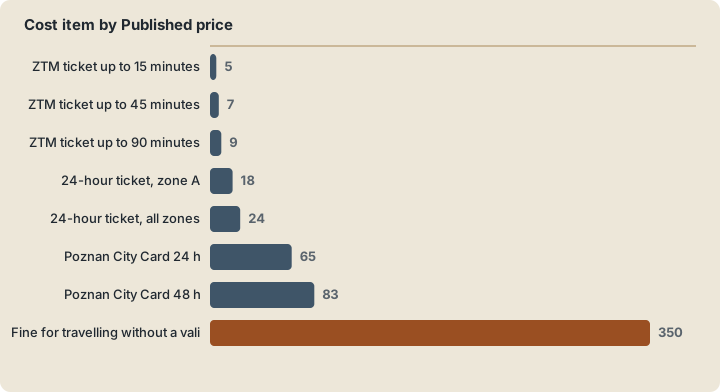
Two days in Poznan run on the zloty, not the euro, and the fixed published costs are low: timed ZTM tickets at 5, 7 and 9 zl, museum entries mostly between 10 and 35 zl, the free Old Zoo and free Tuesdays at the National Museum and Independence Museum branches, so a two-day sightseeing budget is built from small single figures rather than big bookings. Poland is in the EU and Schengen but not in the euro area, and rates move daily, so no fixed conversion belongs in a plan.
| Cost item | Published price |
|---|---|
| ZTM ticket up to 15 minutes | 5 zl (reduced 2.50) |
| ZTM ticket up to 45 minutes | 7 zl (reduced 3.50) |
| ZTM ticket up to 90 minutes | 9 zl (reduced 4.50) |
| 24-hour ticket, zone A | 18 zl (reduced 9) |
| 24-hour ticket, all zones | 24 zl (reduced 12) |
| Poznan City Card 24 h | 65 zl with transport, 59 zl without |
| Poznan City Card 48 h | 83 zl with transport, 72 zl without |
| Fine for travelling without a valid ticket | 350 zl, or 175 zl if paid within 7 days |
The Poznan City Card is worth counting out for a two-day stay. The 48-hour version at 83 zl with transport or 72 zl without covers free entry to most museums, with each attraction usable once, and the transport version is valid until midnight on the last day. But the card's own partner pages show the edges: Enigma and Porta Posnania are discounted, at 21 / 17 zl and 21 zl respectively, not free. Whether the card beats single tickets depends on how many of the paid museums a plan actually includes; the Poznan City Card guide works through the arithmetic.
How Do You Get Around Poznan In Two Days?
Day One of this itinerary needs no ticket at all, and Day Two needs at most a couple of timed ZTM tickets or a 24-hour pass, because Poznan's tram and bus network sells zone-wide timed tickets at 5, 7 and 9 zl that allow transfers, and there is no contactless bank-card payment on board yet, so tickets come from machines, apps or a PEKA card. The contactless option is expected only in 2028, after the PEKA modernisation ZTM signed in 2026.
The timed tickets are valid in all zones A, B, C and D, transfers are allowed, and real travel time counts, so a 45-minute ticket comfortably covers a cross-centre journey with one change. The weekend promotion is worth knowing: a 24-hour ticket validated between 20:00 Friday and 24:00 Saturday stays valid until 24:00 Sunday, which suits a Saturday-to-Sunday two-day trip. There is no city bike system to recommend: the Poznan City Bike ran from 2012 to 2022 and has not returned, with a council committee only discussing a revival in July 2026. The public transport guide has the full ticket map, and the bike rental page explains the honest state of cycling options.

For arrivals, the Poznan Airport To City Centre guide covers the run in from Lawica. The only published detail worth carrying here is frequency: lines 148 and 159 link Poznan Glowny station with the airport, each every 15 minutes at peak and every 20 minutes off-peak and at weekends, giving a departure every 7 to 8 minutes at peak from the stops along the route. Standard ZTM tickets apply. Journey time is not published, so none is quoted.
What If The Weather Turns During Your Two Days?
Poznan's climate normals for 1991-2020 from the WMO station show July as both the warmest and the wettest month at 25.2 C mean daily high and 84.4 mm of rain, April as the driest at 28.6 mm, and January mean lows of -2.9 C, so a two-day plan needs a wet-weather fallback in summer and a warm one in winter, and the city supplies both in the Enigma Cipher Centre, the museums and Termy Maltanskie's 9:00-23:00 aquapark.
| Month | Mean daily high | Mean daily low | Precipitation |
|---|---|---|---|
| January | 2.1 C | -2.9 C | 37.7 mm |
| April | 15.0 C | 4.0 C | 28.6 mm |
| July | 25.2 C | 14.1 C | 84.4 mm |
| October | 13.3 C | 5.4 C | 35.4 mm |
The indoor spine of the city is strong enough to absorb a lost day: the Enigma Cipher Centre, the Royal Castle, the Imperial Castle, the Museum of Musical Instruments and Stary Browar are all within a short walk or one tram of each other, and the thermal baths run late. The Palm House, the classic rainy-day answer in older guides, is closed for rebuilding and must stay off the list. The rainy day guide and the winter guide carry full alternatives, and the weather by month page has the whole normals table.
Should You Swap Day Two For A Day Trip?
If the Old Town has been covered on Day One, a full-day trip to Gniezno and Biskupin is a real alternative to a second in-city day, with Gniezno's cathedral hill open Monday to Saturday 9:00-17:00 from May to October (closed to tourists on Sundays, when only the terrace opens 13:00-15:00 and 16:00-17:30), Biskupin open 9:00-16:00 from November to March at 28 zl normal and 19 zl reduced, and the train to Gniezno reported at about 25 to 45 minutes. The Gniezno pages carry the full ticket list, including the Gniezno Doors at 16 / 14 zl and the all-inclusive pass at 48 / 42 zl.
A booked tour removes the transfer planning entirely. The listing for the full-day Gniezno, Biskupin and Wenecja trip from Poznan carries its current price and duration, and the card below shows it in full.
The trade is honest: a day trip spends Day Two outside the city and leaves Ostrow Tumski and Lake Malta for a return visit. The Gniezno guide, the Biskupin guide and the Berlin To Poznan Day Trip itinerary frame the alternatives. For a longer route through the region, Poznan And Wroclaw In Five Days and Seven Days In Poland Via Poznan build on the same core.

Common Questions About Two Days In Poznan
Is Two Days In Poznan Enough?
Two days cover the Old Market Square, the Croissant Museum, Ostrow Tumski, Porta Posnania, one castle and the Lake Malta quarter, which is the core of a first visit. It is not enough to add Gniezno or Biskupin comfortably; those need a third day or a booked day trip.
What Time Do The Goats Come Out In Poznan?
The National Museum's page states the goats appear every day at noon, and since recently also at 3 pm. Facade works are under way on the Town Hall and no official statement promises the show on any given day during them, so plan for noon without treating it as guaranteed.
Can You Visit The Town Hall Museum In Poznan?
No. The National Museum's visit page lists the Town Hall museum, the Museum of the History of the City of Poznan, as closed every weekday, and no reopening date is published. The facade, the square and the goats are separate from the closed interior.
How Do You Pay For Trams In Poznan?
With timed paper tickets from machines, an app, or a PEKA card. Timed tickets cost 5 zl for up to 15 minutes, 7 zl for 45 and 9 zl for 90, valid in all zones with transfers. Contactless bank-card payment on board is expected only in 2028, after the PEKA modernisation.
Is The Palm House In Poznan Open?
No. The Palm House is temporarily closed to visitors for rebuilding, under a notice of 31 August 2026, with the city aiming to reopen part of the pavilions towards the end of 2028 and works running until 2030. No hours or prices are published for the closure period.
What Is The Best Month For Two Days In Poznan?
WMO's 1991-2020 normals for the Poznan station show July as the warmest month at a 25.2 C mean daily high but also the wettest at 84.4 mm, and April as the driest at 28.6 mm with a 15.0 C mean high. May, June and September balance warmth against rainfall better than midsummer.
Two days in Poznan, spent this way, leaves the city's two great clusters, the Old Town and the cathedral island, properly seen, with Lake Malta as the flexible half day that bends to the weather.