Poznan SIM Cards And Mobile Data
Poznan, the capital of the Wielkopolskie voivodeship in western Poland, is a compact city where a little planning keeps you online for the whole trip. This guide lays out the SIM card and eSIM options, the roaming rules for UK, EU and US visitors, and the honest limits of what is known about buying connectivity on arrival.

Short answer
For most short visits to Poznan, an eSIM bought before departure or a prepaid SIM from a phone shop in the city centre covers everything a traveler needs. Poland uses the zloty, shops cluster around the Old Market Square and Stary Browar, and there is no sourced price list for SIMs or eSIMs, so this guide describes the options generically and points to what official sources confirm.
Poznan, the capital of the Wielkopolskie voivodeship (Greater Poland) in western Poland, sits on the Warta river and hosts a population of 534,239, according to the Statistical Office in Poznan. It is a walkable city with a tram network, a busy airport and a railway hub that connects to Warsaw, Berlin, Wroclaw and beyond. All of that makes mobile data genuinely useful here: live tram timetables, museum booking pages, e-tickets and map navigation all run through a phone. This guide from the Poznan Travel Guide editorial desk sets out what is actually known about SIM cards, eSIMs and mobile data in the city, and just as importantly, what no official source confirms, so nothing below is a guess dressed up as advice.
Every connectivity option below is therefore described generically, the way a guidebook that has not been to the city should describe it. Where a figure exists, such as tram ticket prices or train journey ranges, it is stated with its source basis. Where none exists, this page stays silent rather than inventing a number.
Do You Need A SIM Card Or An eSIM In Poznan?
Most short-stay visitors to Poznan do not need a local SIM card at all: hotel and cafe Wi-Fi, an eSIM bought before departure, or a home operator's roaming package covers a typical city break. Travelers who plan to use the ZTM journey planner live, book museum time slots on the move, or take day trips to Gniezno or Kornik will get more value from a dedicated data plan, and an eSIM is usually the fastest route because it needs no shop visit.
The honest way to frame the decision is by how much of your day depends on a live connection. Poznan's Old Market Square, Ostrow Tumski and the Citadel park area are compact enough that a paper map and offline map downloads handle navigation comfortably. The moments that punish a dead phone are practical ones: pulling up a timed tram ticket in the ZTM app, showing an e-ticket at the Croissant Museum, or rebooking a train on the PKP Intercity planner when a plan changes.
Data also matters for the practical pages this site maintains. If you are working out how to reach the centre from the airport, comparing trains from Berlin, or checking flights to Poznan, you will be doing it on a phone in a station or an arrivals hall. That is the real case for connectivity in this city: not social media, but logistics.
A useful distinction is between "always online" travelers and "online at anchor points" travelers. The second group can genuinely skip a SIM purchase. Poznan's museums, malls and transport hubs are the kind of places where a few minutes of Wi-Fi at the start of the day covers a full day of offline maps. The first group, which includes anyone working remotely from Poznan, should treat a data plan as part of the trip budget, set up before arrival.
Where To Buy A SIM Card In Poznan
Physical SIM cards in Poznan are sold through phone shops in the city's shopping centres, operator-branded stores on the main streets, and kiosks and newsagents around the Old Market Square and the station area; no official source publishes a price list, an exact storefront inventory or an airport kiosk roster, so treat any specific price quote as unverified. Bring an ID document, because Polish registration rules for prepaid SIMs are standard practice in EU states, and expect staff in city-centre shops to handle English.
The practical starting point for most visitors is the shopping-centre route. Stary Browar, on ul. Polwiejska 42, lists its gallery hours on its own contact page as Monday to Saturday 9:00-21:00 and Sunday 10:00-20:00 on trading Sundays, which makes it the longest-window indoor shopping option near the Old Market Square. Phone retailers in galleries of this type are the most reliable places to find staff who can activate a prepaid plan on the spot and set an APN correctly.
The second route is street-level operator stores, which cluster on the main pedestrian and shopping streets radiating from the Old Market Square. The advantage over a kiosk is activation support; the advantage a kiosk has is that you can buy a top-up voucher in two minutes on the way to a museum. Neither this site nor any verified source lists which operators run stores at which addresses, so the honest advice is to check a map app on arrival rather than trust a stale storefront list.
The third route is Poznan-Lawica airport, which is close to the city and linked by bus lines 148 and 159. The Poznan airport guide covers the layout in detail. What no verified source confirms is which SIM kiosks, if any, operate in the terminal, so this page will not claim one exists. If a connection at the arrivals door matters to you, an eSIM installed the night before is the only option this desk can recommend without hedging.
| Purchase channel | What to bring | Best suited to |
|---|---|---|
| Phone shop in a shopping centre | Passport or national ID | First-time visitors who want activation help |
| Operator store on a main street | Passport or national ID | Travelers comparing prepaid bundles in person |
| Kiosk or newsagent | Cash in zloty | Quick top-ups once a SIM is already active |
| Airport (unverified inventory) | Passport or national ID | Only if you cannot set up an eSIM in advance |
Getting to any of these shops is cheap on public transport. ZTM's current price list, published on its ticketing pages, sets timed single tickets that are valid in all zones with transfers allowed: up to 15 minutes for 5 zl (reduced 2.50), up to 45 minutes for 7 zl (3.50), and up to 90 minutes for 9 zl (4.50). A 24-hour zone A ticket is 18 zl (reduced 9), a 24-hour all-zones ticket is 24 zl (12), and 7-day tickets are 59 zl for zone A or 94 zl for all zones. The public transport guide explains how validation works and why combining two timed tickets to extend time is not allowed.
One caution that belongs next to any purchase advice: contactless bank-card payment on Poznan's trams and buses is not available yet. ZTM has signed the PEKA modernisation contract, and its announcement says contactless bank-card and phone payment on the stop-based tariff will follow, with effects expected in 2028. Until then, tickets come from machines, apps, the PEKA card or paper, so a working data connection or a pre-bought paper ticket is what gets you on a tram.
Once your phone is online, the city opens up in a different way. The interactive PRL museum, an experience this site features for its hands-on look at communist-era Poland, is exactly the kind of attraction whose entry ticket you want stored on a working phone; you can Check availability alongside reading the full page.
How Much Mobile Data Does A Poznan Trip Use?
A city break in Poznan that relies on maps, messaging, journey planners and museum booking pages is a light-data trip by the standards of streaming or video calls, and a small prepaid bundle can be planned around rather than a large one; no verified source publishes per-operator bundle sizes for Poland, so this page gives a usage framework rather than a gigabyte figure, and heavy use such as navigation with live traffic or remote work video calls is the category that changes the calculation.
The honest framework is to sort your trip's phone use into three buckets. The first bucket is logistics: map lookups, the ZTM planner, museum pages, e-tickets. This is text-and-light-graphics traffic, the kind a modest bundle absorbs easily. The second bucket is media: streaming music while walking the Citadel park or uploading photos from the Old Market Square. The third bucket is work: video calls, cloud files, live collaboration. Only the third bucket reliably demands a large plan, and only you know whether your trip includes it.
| Trip profile | Typical data reliance | Sensible approach |
|---|---|---|
| Two-day city break, offline maps downloaded | Light, logistics only | Small prepaid bundle or roaming add-on |
| Week with day trips to Gniezno and Kornik | Moderate, planners and bookings on the move | Mid-size bundle, top-up option |
| Remote work stay | Heavy, calls and cloud sync | Large bundle or home operator's roaming plan |
| Christmas market trip in December | Light, mostly maps and photos | Small bundle, Wi-Fi at the hotel |
Two Poznan-specific realities shape the calculation. The first is that the city's main indoor venues have generous hours, so there are natural anchor points in a day for Wi-Fi. Stary Browar's gallery is open Monday to Saturday 9:00-21:00 and Sunday 10:00-20:00 on trading Sundays. The Termy Maltanskie aquapark on the shore of Lake Malta is open daily 9:00-23:00. The Old Zoo on ul. Zwierzyniecka is open daily, and entry is free. None of that replaces a data plan, but it changes how much of your day genuinely needs cellular data versus how much can happen on venue networks.
The second reality is seasonal. If you are visiting for the Betlejem Poznanskie Christmas markets, which the official programme lists as running 14 November 2026 to 6 January 2027, with the MTP grounds from 14 November to 20 December, Plac Wolnosci from 20 November and the Old Market Square from 21 November, you will be outdoors in the evening cold, phone out for photos and meeting points. The Poznan in winter and Christmas market pages cover the programme; from a data standpoint, December evenings are when a dead battery and a dead data plan feel the same, so charge and top up before the market run.
How An eSIM Works For Poznan
An eSIM is a digital SIM profile downloaded to a compatible phone before or during a trip, and for Poznan it removes the shop visit entirely: you buy a data plan from an online provider, install the profile at home on Wi-Fi, and it connects when the phone lands in Poland; no verified source in this destination's pack quotes eSIM prices or coverage for Poznan specifically, so this desk recommends the mechanism, not a named plan, and travelers who want a data point should compare live listings themselves.
The mechanics are the reason this option suits short trips. A physical SIM needs a purchase transaction, an ID check and often an APN setting change, all in a shop you have to find. An eSIM needs a compatible handset, a purchase on the provider's site, and a QR code or in-app install. The profile activates on the local network when you arrive, and your home SIM stays in the phone for calls and texts. Dual-SIM handsets make this the standard setup for travel now: home number for identity, eSIM for data.
For Poznan specifically, the advantages compound. You land at Lawica, install nothing at the airport, and can pull up the bus 148 or 159 connection to Poznan Glowny while walking to the stop. You can validate a ZTM timed ticket in the app on day one without hunting a ticket machine's English menu. And because the city's key logistics pages, from museum booking calendars to the PKP Intercity planner, are all mobile-first, you arrive with the tool that matches how the city actually works.

The one decision point is coverage versus convenience, and this is where honesty matters. This site's verified pack carries no operator coverage map for Poznan, no eSIM price and no speed promise, and a guide that printed one would be inventing it. What can be said is structural: Poznan is a voivodeship capital with a major airport, a university population and a trade-fair economy, the category of Polish city where all national operators maintain networks. If a remote-work trip depends on a specific speed, test the connection on arrival day and keep the option to top up or switch.
Travelers who want to compare eSIM plans for Poland can start from a live marketplace listing rather than a printed price: compare eSIM plans for Poland. The listing carries the current prices; this page deliberately does not.
A final practical note for eSIM users: install the profile before you leave home, while on reliable Wi-Fi, and test that the plan's activation policy matches your arrival date. Some plans activate on first connection to the destination network, others on installation. A five-minute check at your kitchen table prevents a stand in the arrivals hall with no signal and no easy fix.
Where To Find Free Wi-Fi In Poznan
Free Wi-Fi in Poznan is available generically through hotels, cafes, shopping centres and museum venues, the standard pattern for a European city of this size, but no official source publishes a city-wide free Wi-Fi map or a venue-by-venue network list, so this desk describes the reliable categories rather than naming specific network names, and any traveler with an eSIM or SIM should treat public Wi-Fi as a supplement for battery and convenience rather than a plan.
The categories worth planning around are the ones with confirmed hours. Shopping centres are the most dependable: Stary Browar's long gallery hours, Monday to Saturday 9:00-21:00 and Sunday 10:00-20:00 on trading Sundays, make it the natural midday stop between the Old Market Square and the river. Museums are the second category, with the caveat that their hours vary by branch and day; the Poznan museums guide carries the branch-by-branch detail, including which branches close on Mondays and which are free on Tuesdays. Cafes and hotels complete the picture, and hotel networks are the most reliable of all because they are tied to your booking.
| Venue category | Confirmed hours basis | Planning note |
|---|---|---|
| Stary Browar gallery | Mon-Sat 9:00-21:00, Sun 10:00-20:00 (trading Sundays) | Longest indoor window near the Old Market Square |
| Termy Maltanskie aquapark | Daily 9:00-23:00 | Late-evening option on the Lake Malta shore |
| Old Zoo, ul. Zwierzyniecka 19 | Daily, Nov-Feb 9:00-16:00, April-September 9:00-19:00 | Free entry, park setting |
| Porta Posnania, ul. Gdanska 2 | Tue-Fri 9:00-18:00, Sat-Sun 10:00-19:00, Monday closed | Plan around the Monday closure |
| Hotel networks | Tied to your booking | Most reliable category for a working session |
Security belongs in any honest Wi-Fi section. Public networks are shared by definition, so the standard habits apply: avoid banking portals on venue networks, prefer your cellular data for anything involving a card, and let messaging apps do their own encryption rather than trusting the network. A traveler with a working eSIM has the simpler life, using venue Wi-Fi to save battery and cellular data for the moments that matter.

There is also a seasonal angle. In summer, the free things to do in Poznan list leans on parks, the free Old Zoo and the riverside, which are exactly the places without venue Wi-Fi. In the run of winter events, from the Christmas markets starting 14 November 2026 to the POZnan Ice Festival on 11 to 13 December 2026, the outdoor programme again puts you beyond cafe range. The pattern is simple: the more of Poznan you see outdoors, the more your connectivity depends on cellular rather than venue networks.
What Roaming Rules Apply In Poland?
Poland is in the EU and in Schengen, so EU-based visitors move without border formalities and should check their home operator's roaming terms directly, while UK visitors stay visa-free for up to 90 days in any 180-day period with a passport issued under 10 years before arrival and valid 3 months past departure, and US visitors follow the same Schengen short-stay rules as other visa-exempt nationals; the EU Entry/Exit System has been fully operational at all external Schengen borders since 10 April 2026, and it may register fingerprints and a photo at no cost.
The distinction that matters for data is where your phone plan, not your passport, comes from. A phone on an EU operator's plan moves into Poland under whatever roaming arrangement that operator publishes, and no verified source in this pack summarizes those tariffs, so the honest instruction is to read your own operator's page before departure rather than trust a third-party summary. A phone on a UK or US plan after Brexit-style arrangements is a different matter, and for those travelers a local SIM or eSIM is usually the cheaper route, which is precisely why this guide exists.
| Traveller origin | Entry and roaming basis | What to check before departure |
|---|---|---|
| EU/Schengen resident | No internal border checks | Home operator's roaming terms |
| UK visitor | Visa-free 90 days in any 180, passport under 10 years since issue, valid 3 months past departure | Roaming add-on versus eSIM cost |
| US visitor | Same Schengen short-stay rules as other visa-exempt nationals | Roaming plan versus prepaid SIM on arrival |
| Any non-EU visitor | EES fully operational since 10 April 2026; fingerprints and photo may be registered, no fee | ETIAS status on the EU's official site |
Two entry facts deserve their own paragraph because they affect the phone in your pocket at the border. The Entry/Exit System is not a future project: it has been fully operational at all external Schengen border crossing points since 10 April 2026, and visa-exempt visitors may have fingerprints and a photo registered, with no cost for registration. And on the land routes, Poland has notified temporary internal border controls at its land borders with Germany and Lithuania, running from 2 October 2026 to 30 March 2027, so anyone arriving by train or bus from Berlin should carry a passport or national ID. The Berlin to Poznan train guide covers the route; the border detail is why your documents should be reachable, not buried in a backpack.
ETIAS, the planned travel authorisation for visa-exempt visitors, is the one topic this page refuses to date. The verified pack holds no sourced start date and no sourced fee, and two live reads of the official material disagreed. The safe instruction, and the only honest one, is to check the EU's official ETIAS site before you travel. A guide that printed a date here would be guessing, and a wrong guess strands a reader at a border.
Staying Connected On Day Trips From Poznan
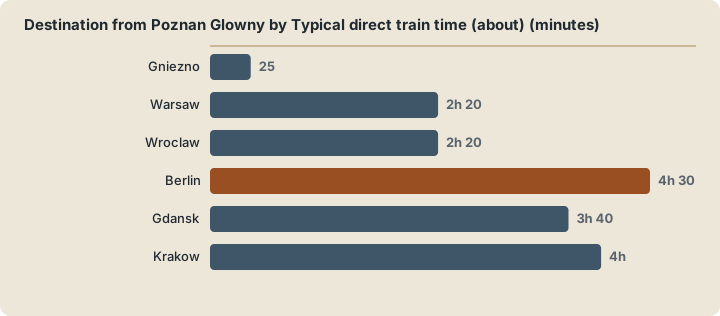
Day trips from Poznan run on the same national networks as the city, so a SIM or eSIM that works in Poznan works in Gniezno, Kornik and Biskupin, and the connectivity risk on these routes is not coverage but battery and planning: trains take about 25 to 45 minutes to Gniezno, about 2 hours 20 to 3 hours 20 to Warsaw and about 4 hours 30 to 5 hours 30 to Berlin by current timetable ranges, so download tickets and offline maps before the longer rides.
The train figures above come from PKP Intercity timetable material read for this site's research, and they are ranges, not promises. The instruction that follows from them is practical: for any journey longer than an hour, have the ticket on the phone before boarding, have an offline map of the destination, and note that the Warsaw to Poznan train and Poznan to Wroclaw train pages each carry the route detail. Train times move with the timetable, so the PKP Intercity planner is the live source on the day.
| Destination from Poznan Glowny | Typical direct train time (about) | Connectivity note |
|---|---|---|
| Gniezno | 25 to 45 minutes | Short hop; offline map of the cathedral hill is enough |
| Warsaw | 2 h 20 to 3 h 20 | Download tickets and entertainment before boarding |
| Wroclaw | 2 h 20 to 3 h 30 | Same preparation as Warsaw |
| Berlin | 4 h 30 to 5 h 30 | Border controls with Germany run to 30 March 2027; keep ID reachable |
| Gdansk | 3 h 40 to 5 h | Long ride; charge before departure |
| Krakow | 4 h to 6 h | Longest common route; plan around battery life |
The destination pages carry the sightseeing detail, and connectivity shapes how each of them runs. The Gniezno guide covers a city where the cathedral hill's viewing terrace has Sunday-only hours in the May to October season, so a live check of opening times on the day is worth mobile data. The Kornik Castle guide covers a site that closes on Mondays and runs a low-season schedule of 10:00-15:15 with last entry at 14:30 from 1 October to 30 November, closing its 2026 season on 14 December; the kind of detail that rewards a phone check the night before.

Guided day trips are the other half of this story, and they change the data equation in your favour. A booked excursion with a fixed meeting point, a guide and a return time removes most of the live-lookup moments that drain a data plan, which is one reason this site features them alongside independent travel. The Rogalin and Kornik guided tour pairs two of the region's castle destinations in one day, and the Gniezno and Biskupin full-day trip covers the two flagship archaeology and origins sites; both are the kind of day where the phone is a camera and a ticket wallet, not a journey planner.
For the Gniezno and Biskupin route, the same logic applies with a longer day attached. Biskupin's official pages list winter hours of 9:00-16:00 from November to March and closure on 1 January, Easter Sunday, 1 November and 25 December, while the Museum of the Origins of the Polish State in Gniezno runs October to April hours of 9:00-16:00 with free admission on Sundays. A guided structure absorbs all of that scheduling; an independent traveler needs the data plan to absorb it instead.
Practical Tips For Mobile Data In Poznan
The habits that keep a phone useful in Poznan are unglamorous: download offline maps of the city centre, Ostrow Tumski and any day-trip destination before leaving Wi-Fi, keep a paper or app backup for tram tickets, carry a portable battery for market evenings and long train rides, and set data-hungry apps to update on Wi-Fi only, because no verified source promises charging points or socket availability on Polish regional trains.
The offline-first habit deserves the top of the list because it works with every connectivity choice, including no connectivity at all. Poznan's core, from the Old Market Square across Ostrow Tumski to the Cathedral, is a compact walking district, and offline maps cover it completely. The self-guided walking tour and one day in Poznan itineraries are designed to work exactly this way: a route you can follow with a phone in airplane mode if the data plan runs dry.

Battery is the second habit, and Poznan's event calendar is the reason it earns its place. A December evening that moves from the Old Market Square Christmas market, open from 21 November 2026, to the Ice Festival sculptures on 11 to 13 December is hours outdoors in cold weather, and cold drains a battery faster than a warm cafe does. The same applies to a match day or a long afternoon in Citadel park, the largest park in the city according to the official visit page, a 15-minute walk from the Old Market Square.
| Habit | Why it matters in Poznan | When it pays off most |
|---|---|---|
| Offline maps downloaded | Core city is walkable without live data | Whole trip |
| Paper or app tram ticket backup | Contactless card payment on trams arrives only with PEKA in 2028 | Every tram ride |
| Portable battery carried | Cold-weather market evenings and long train rides | December events, Krakow rides |
| Apps set to Wi-Fi-only updates | Preserves a small prepaid bundle | Week-long stays |
| Tickets on phone before boarding | Long routes and border-control queues on the Berlin line | Day trips |
The third habit is payment hygiene, and it ties back to the city's own timetable for change. Until the PEKA modernisation delivers contactless bank-card payment on vehicles, with effects expected in 2028, a traveler in Poznan is using machines, apps, the PEKA card or paper for transport, and a card everywhere else. Keep the transactions that matter on your own cellular connection rather than a shared venue network, and keep the phone charged enough to show an e-ticket at a museum door, because the Croissant Museum's booking calendar and similar venues run on timed entry.

The fourth habit is timing your connectivity around the city's rhythm. Museum branches close on Mondays, Tuesdays are free-admission days at the National Museum and Independence Museum branches, and the Gniezno Origins museum is free on Sundays, all details the Poznan City Card guide and practical basics guide unpack. A traveler who knows which day is which plans the heavy-online moments, booking and checking, for the evening before, on hotel Wi-Fi, and spends the day with the phone mostly in a pocket.

Finally, the honest summary of this whole topic. Poznan does not punish the unprepared: it is a compact, well-signed voivodeship capital where the connectivity decisions are low-stakes. An eSIM sorted before departure is the smoothest path for most visitors, a prepaid SIM from a city-centre phone shop is the flexible path for longer stays, and a phone left on airplane mode with offline maps still gets a traveler across the Old Market Square, up the Cathedral tower in the March-to-November season, and home again. What this page will not do is print a price, a coverage map or a kiosk inventory that no official source confirms, because a plausible number that nobody verified is exactly how a good guide goes wrong.
Common Questions About Poznan SIM Cards And Mobile Data
Can I Buy A SIM Card At Poznan Airport?
No verified source confirms which SIM kiosks or operator counters, if any, operate at Poznan-Lawica airport, so this desk cannot promise one exists. The airport is linked to Poznan Glowny by bus lines 148 and 159, each running every 15 minutes at peak and every 20 minutes off-peak, and the city-centre phone shops are reachable by the same ZTM tickets. If you need data the moment you land, an eSIM installed before departure is the option this site can recommend without hedging.
Is An eSIM Better Than A Physical SIM For Poznan?
For a short city break, an eSIM is usually the more convenient choice because it removes the shop visit, the ID check and the activation wait entirely, and your home number stays active for calls and texts. A physical prepaid SIM suits longer stays, since topping up a local SIM in a shop is straightforward once it is active. No verified source quotes prices for either option in Poznan, so compare live listings rather than printed figures.
Will My UK Or US Phone Work In Poznan?
Yes, if the handset supports the network bands used in Poland, which modern European and North American phones do. UK visitors stay visa-free for up to 90 days in any 180-day period with a passport issued under 10 years before arrival and valid 3 months past departure, and US visitors follow the same Schengen short-stay rules as other visa-exempt nationals. The Entry/Exit System has been fully operational since 10 April 2026 and may register fingerprints and a photo at no cost. Check your home operator's roaming rates before relying on them, or use an eSIM for data.
Is There Free Wi-Fi Across Poznan?
Free Wi-Fi is available through the standard European categories: hotels, cafes, shopping centres and museum venues. Stary Browar's gallery is open Monday to Saturday 9:00-21:00 and Sunday 10:00-20:00 on trading Sundays, and the Termy Maltanskie aquapark is open daily 9:00-23:00. No official source publishes a city-wide free Wi-Fi map, so treat venue networks as a supplement for battery and convenience, not a plan.
Can I Pay For Tram Tickets With My Phone Data Plan?
Mobile data is what makes the ZTM app work, so yes in that sense. But contactless bank-card payment on the vehicles themselves is not available yet: ZTM has signed the PEKA modernisation contract, and its announcement places the effects in 2028. Until then, tickets come from machines, apps, the PEKA card or paper, with timed singles at 5 zl for 15 minutes, 7 zl for 45 minutes and 9 zl for 90 minutes.
How Do I Keep Data Costs Down In Poznan?
Download offline maps of the city centre and any day-trip destination before you leave, set app updates to Wi-Fi only, and do your bookings and timetable checks on hotel or venue networks in the evening. Poznan's core is walkable enough that a phone in airplane mode still covers the Old Market Square, Ostrow Tumski and the Cathedral, and the long train rides, about 2 hours 20 to 3 hours 20 to Warsaw and about 4 hours 30 to 5 hours 30 to Berlin, are best boarded with tickets already on the device.

A last word on how this page was kept honest: every figure above, from the 534,239 population the Statistical Office reports to the ZTM ticket prices and the WMO-backed climate context, comes from a verified official source, and every topic those sources do not cover, from SIM prices to airport kiosks, is described as unknown rather than estimated. Plan your data around what Poznan confirms, and let the rest stay offline.