Poznan Churches
Poznan, the capital of the Wielkopolskie voivodeship in western Poland, packs its sacred architecture into a walkable core: the Fara by the Old Market Square and the cathedral on the river island of Ostrow Tumski, plus a cluster of museum-churches and monastic buildings within a few tram stops of each other.

Short answer
The two churches most visitors come for are the Fara, the Collegiate Basilica of Our Lady of Perpetual Help, St Mary Magdalene and St Stanislaus at ul. Golebia 1, open daily 6:00-19:30 with free entry outside Mass times, and Poznan Cathedral on Ostrow Tumski, whose crypts and viewing tower are open 1 March to 15 November, weekdays 9:00-16:00 and Sundays 14:00-18:00.
Poznan, the capital of the Wielkopolskie voivodeship (Greater Poland) in western Poland, on the Warta river, is a city whose church towers do most of the skyline's talking. Two sacred buildings anchor any church-focused visit: the Fara, the Collegiate Basilica of Our Lady of Perpetual Help, St Mary Magdalene and St Stanislaus, standing a street back from the Old Market Square, and Poznan Cathedral, the Archcathedral Basilica of St Peter and St Paul, on the river island of Ostrow Tumski. Between them sit parish churches, former monastic complexes and museum interiors that reward a slow afternoon, and none of it needs a car. This guide lays out what each site's own page says about hours and tickets, how to behave inside a working Catholic church, and how the ZTM tram network ties the whole route together.
What Are The Most Important Churches In Poznan?
The two headline churches are the Fara at ul. Golebia 1, the city's great Collegiate Basilica of Our Lady of Perpetual Help, St Mary Magdalene and St Stanislaus, and the Archcathedral Basilica of St Peter and St Paul on Ostrow Tumski, which holds the tombs of Mieszko I and Boleslaw Chrobry in its crypts. Around them the Old Market Square's former church buildings now house National Museum branches, and the island's Porta Posnania interpretive centre frames the cathedral district's story.
The Fara is the working parish church most first-time visitors stumble into first, because it sits one block off the Old Market Square and charges no entry fee. The cathedral is the destination with real weight: its crypts hold the relics of the tombs of Mieszko I and Boleslaw Chrobry, plus a 10th-century baptismal bowl, and its viewing tower has been open to tourists since 1 June 2026 according to the cathedral's own visitor page. Between the two, Ostrow Tumski as a whole, the island framed by the Warta, works as a single half-day walk, and the Old Market Square guide covers the square's church-adjacent buildings in more detail.

A sensible framework is to treat the churches in three rings: the square itself, the island, and the streets beyond it. On the square, the museum interiors inside former ecclesiastical buildings currently have limited access: the Town Hall museum, home of the Museum of the History of the City of Poznan since 1954, lists every weekday as closed on the National Museum's visit page, and no reopening date is published. The Museum of Musical Instruments at Stary Rynek 45 and the Museum of the Wielkopolska Uprising 1918-1919 at Stary Rynek 3 are open as normal, Tuesday to Sunday, with Monday closed. For planning the wider trip, where to stay in Poznan matters more than you might expect: sleeping between the square and the island puts every major church within a twenty-minute walk.
| Church or sacred site | Location | Status | Entry |
|---|---|---|---|
| Fara (Collegiate Basilica) | ul. Golebia 1 | Open daily 6:00-19:30 | No ticket listed; no sightseeing during Mass |
| Poznan Cathedral (St Peter and St Paul) | Ostrow Tumski | Church open; crypts and tower seasonal | Crypts 10/8 zl, tower 14/12 zl |
| Porta Posnania interpretive centre | ul. Gdanska 2 | Tue-Fri 9:00-18:00, Sat-Sun 10:00-19:00, Mon closed | 35/29 zl, 21 zl with Poznan City Card |
| Museum of Musical Instruments | Stary Rynek 45 | Tue-Sun, Mon closed | 15/10 zl, Tuesday free |
| Museum of the Wielkopolska Uprising 1918-1919 | Stary Rynek 3 (Odwach) | Nov-Feb Tue-Sun 10:00-16:00 | 15/10 zl, Tuesday free |
One honest caveat from the start: this desk has not visited Poznan, and the facts below are what the venues' own pages state. Where a page is silent, so is this guide.
When Can You Visit The Fara, And What Does A Visit Involve?
The Fara's own visiting page gives daily opening from 6:00 to 19:30, with no ticket listed for individual visits and one firm rule: no sightseeing during Mass. The basilica stands at ul. Golebia 1, a single street behind the Old Market Square's eastern side, and on Saturdays it holds organ concerts at 12:15 followed by a guided tour, though the tour's price is not published on the site.
Early morning is the quiet window. Doors open at 6:00, and the basilica's visitor page frames the space as free to enter outside liturgy, so a call-in at 7:00 or 8:00 typically means an empty nave and soft light through the windows. By midday, tour groups moving between the square and the cathedral pass through steadily. Saturday is the day with a built-in event: the 12:15 organ concert, with the guided tour afterwards. Because tour prices are not published, treat the concert as the certain part and ask on arrival about the tour.
The building's dedication is a mouthful, Our Lady of Perpetual Help, St Mary Magdalene and St Stanislaus, and locals simply say "the Fara", a Polish term for the main parish church of a town. It is a living parish first and a monument second, which is exactly why the Mass-time rule matters: check the parish schedule rather than assuming a free run of the nave at 11:00 on a Sunday. For a wider walk that strings the Fara together with the square and the goats on the Town Hall facade, which the National Museum's page says appear every day at noon and, since recently, also at 3 pm, the city also offers a themed option: Check availability on the spy-themed walking game, a hosted hunt through these same streets.

Pairing the Fara with the square's other sights fills a morning comfortably. The Poznan food guide points to bakeries selling the rogal swietomarcinski, the croissant registered in the EU as a Protected Geographical Indication by Commission Regulation (EC) No 1070/2008, and several sit within two streets of the basilica's doors. A realistic Fara visit runs thirty to forty-five minutes, longer on a Saturday with the organ concert.
What Can You See Inside Poznan Cathedral On Ostrow Tumski?
Poznan Cathedral, the Archcathedral Basilica of St Peter and St Paul, offers two ticketed attractions besides the church itself: the crypts, holding the relics of the tombs of Mieszko I and Boleslaw Chrobry and a 10th-century baptismal bowl, and a viewing tower the cathedral's page says has been open since 1 June 2026. Both run 1 March to 15 November, weekdays 9:00-16:00 and Sundays 14:00-18:00, unless an extra service is on.
The crypts are the reason most people cross the river. Inside are the relics of the tombs of Mieszko I and Boleslaw Chrobry, rulers whose names anchor every Polish school history lesson, together with the 10th-century baptismal bowl displayed as an artefact of the country's early Christianity. The tower adds the panorama: the island, the Warta's channels and the red roofs of the CATHEDRAL district beyond. Both attractions share the seasonal calendar above, so a visit between mid-November and the end of February means the church interior only, not the underground spaces or the view.
The walk onto the island is part of the appeal. Ostrow Tumski sits between the Warta's branches, reachable on foot from the square in well under half an hour, and the Ostrow Tumski district guide alternatives matter here too, because the island's indoor options, the cathedral and the Porta Posnania centre, carry a rainy afternoon. Porta Posnania, at ul. Gdanska 2, runs entries every 20 minutes in groups of up to 30, Monday closed, and its audio walks of the island run Tue-Fri 9:00-16:00 and Sat-Sun 10:00-17:00, in winter weekends only 10:00-16:00. Its page also lists Happy Hours: the last entry of the day, 17:00 Tue-Fri and 18:00 Sat-Sun, sold at a lower price.
Fancy the island and Srodka with a local guide? Book a private walking tour here.

| Cathedral attraction | Season | Weekday hours | Sunday hours | Normal / reduced | Family |
|---|---|---|---|---|---|
| Crypts | 1 Mar to 15 Nov | 9:00-16:00 | 14:00-18:00 | 10 / 8 zl | 25 zl |
| Viewing tower | 1 Mar to 15 Nov | 9:00-16:00 | 14:00-18:00 | 14 / 12 zl | 40 zl |
| Church interior | Year round | Around services | Around services | No ticket listed | - |
Note the Sunday pattern: the tower and crypts only open at 14:00, after the morning liturgies. Plan the island for a Sunday afternoon, or use a weekday morning when everything opens at 9:00.
How Much Does A Church-Focused Day In Poznan Cost?
A day built around the Fara and the cathedral can be nearly free: the Fara lists no ticket, and the cheapest full-price church day pairs it with the cathedral crypts at 10 zl and the tower at 14 zl, or 24 zl for both. Adding Porta Posnania at 35 zl normal brings a full sacred-sites day to 59 zl per adult before transport, and Tuesday is the free day at the National Museum's and Independence Museum's branches.
The Poznan City Card complicates the arithmetic in a useful way. The card costs 65 zl for 24 hours with transport included, 59 zl without, per the official Visit Poznan page, and it covers free admission to most of the city's museums with each attraction usable once. But two church-adjacent partners are discounted rather than free: Porta Posnania charges card holders 21 zl instead of 35, and the Enigma Cipher Centre at ul. Sw. Marcin 78 charges 21/17 zl instead of 35/29. The card makes sense when the museum list is long, not when churches alone are the goal, since the two headline churches either charge nothing or a modest box-office fee. The Poznan City Card guide runs the full break-even maths.
Getting to the island is cheap regardless. ZTM timed tickets cover all zones with transfers: 7 zl for 45 minutes, 9 zl for 90, and a 24-hour zone A ticket is 18 zl. Those figures come straight from ZTM's current price list, and the fine for travelling without a valid ticket is 350 zl, or 175 zl if paid within 7 days, a number worth knowing before you decide a short hop is worth risking. The public transport guide explains the ticket machines, the PEKA card and the apps in detail.
| ZTM ticket | Normal | Reduced |
|---|---|---|
| Up to 15 minutes | 5 zl | 2.50 zl |
| Up to 45 minutes | 7 zl | 3.50 zl |
| Up to 90 minutes | 9 zl | 4.50 zl |
| 24 h, zone A | 18 zl | 9 zl |
| 24 h, all zones | 24 zl | 12 zl |
| 7 days, zone A | 59 zl | 29.50 zl |
One payment fact to plan around: contactless bank-card payment on trams and buses is not available yet. ZTM signed the PEKA modernisation contract in 2026 with effects expected in 2028, so today it is timed tickets from machines and apps or a PEKA card, never a tap-and-ride with the same card you use for coffee.
What Is Church Etiquette In Poznan?
The working rule in Poznan's churches is that they are active Catholic parishes first: sightseeing stops during Mass, the Fara's page states plainly, dress modestly, keep voices low, and photography should be discreet and flash-free unless a sign says otherwise. Sunday mornings belong to the congregations, which is why the cathedral's paid attractions do not open until 14:00 on Sundays, and a visit at 11:00 on a Sunday means a service, not an empty nave.
Practical points follow from that. Shoulders covered, hats off indoors, and phones silenced are the baseline. If you hear a service in progress, the honest move is either to sit quietly at the back or come back after; the Fara's visiting page makes "no sightseeing during Mass" its only printed rule, and it is the rule locals will notice you breaking. During winter's early darkness, church interiors close earlier too: the Fara's 19:30 daily close holds year round on paper, but the cathedral's attractions end at 16:00 on weekdays in season regardless. The full index of guides sits on Poznan Travel Guide.

Concerts and services blur in a good way. The Fara's Saturday 12:15 organ concert is a performance visitors can attend, and the guided tour that follows is the basilica's own offer; because prices are not published, ask at the door. For travellers who want structure rather than self-guiding, audio commentary is the other route through the city's religious history: audio tour options cover the Old Town's church architecture at your own pace.
Which Sacred Sites Sit Within Day-Trip Range Of Poznan?
Gniezno's cathedral hill is the standout church day trip from Poznan, about 25 to 45 minutes away by train, with individual tickets at 16/14 zl for the famous Gniezno Doors, 14/12 zl for the cathedral vaults and 12/10 zl for the viewing terrace, and an all-inclusive pass with audio guide at 48/42 zl. Kornik Castle and the Rogalin Palace Museum round out the sacred-and-historic circuit at 40/20 zl and 20/13 zl respectively.
Go on a weekday. The Museum of the Origins of the Polish State in Gniezno, daily 9:00-16:00 from October to April, is free on Sundays, one of the few Sunday free days in the region. Train times are reported ranges, about 25 to 45 minutes depending on the service, so check the operator's planner for your departure rather than trusting a single number.

| Day-trip site | Hours highlights | Normal / reduced | Free or discount day |
|---|---|---|---|
| Gniezno cathedral hill, viewing terrace | Sun 13:00-15:00 and 16:00-17:30 (May-Oct) | 12 / 10 zl | - |
| Gniezno Doors | Mon-Sat 9:00-17:00 (May-Oct) | 16 / 14 zl | - |
| Museum of the Origins of the Polish State, Gniezno | Daily 9:00-16:00 (Oct-Apr) | Prices not published | Sunday free |
| Kornik Castle | Tue-Sun 10:00-15:15 low season, last entry 14:30 | 40 / 20 zl | - |
| Rogalin Palace Museum | Tue-Sun 9:00-16:00 | 20 / 13 zl | Tuesday free |
Closer to home, the Kornik and Rogalin circuit pairs well with a half-day private tour, and the Chocolate Museum workshop in central Poznan gives families a secular counterweight to a morning of naves and crypts. Both appear in the picks band below.
How Do You Get Between Poznan's Churches Without A Car?
Every major church in Poznan sits within walking or short-tram distance of the others: the Fara and the Old Market Square cluster are central, Ostrow Tumski is a riverside walk from the square, and a 24-hour zone A ticket at 18 zl covers unlimited tram and bus rides, with a weekend quirk ZTM publishes: a 24-hour ticket validated between 20:00 Friday and 24:00 Saturday stays valid until 24:00 Sunday.
The geography is forgiving. The Fara to Ostrow Tumski walk crosses the Warta's branch and lands you at Porta Posnania's door, from which the cathedral is a short stroll across the island. The Imperial Castle cultural centre on Sw. Marcin, with visiting daily 12:00-19:00 and tickets at 10/7 zl with a map or 20/15 zl with an audio guide, sits on the tram corridor back toward the station, so a church day can fold it in without detouring. If you are arriving from farther afield, the Berlin to Poznan train guide has one current detail worth repeating here: Poland has temporary border controls on land borders with Germany until 30 March 2027, so carry ID on the train.

Cycling is the one mode this desk cannot recommend, because Poznan currently has no city bike system: the municipal scheme ran from 2012 to 2022 and has not returned, with only a council committee discussion on the record about reviving it. Walking, trams and buses carry a church itinerary comfortably.
When Is The Best Time Of Year For Church Visiting In Poznan?
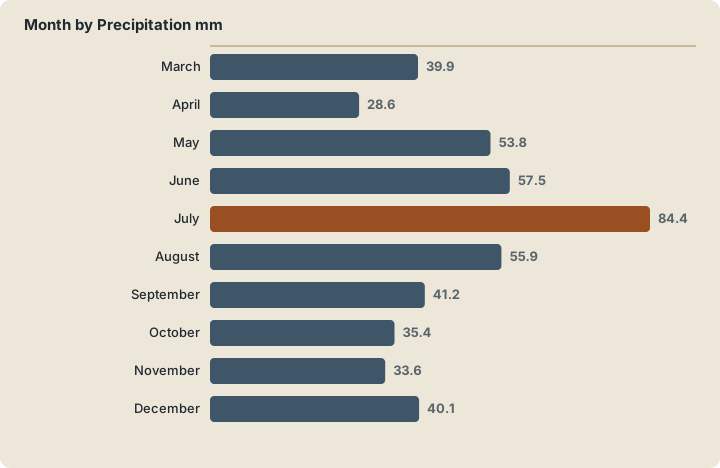
Late spring through early autumn is the safest window for church-focused travel in Poznan, because the cathedral's crypts and tower only run 1 March to 15 November; WMO's 1991-2020 climate normals for the Poznan station show July as both the warmest month (mean daily high 25.2 C) and the wettest (84.4 mm), while April is the driest (28.6 mm), and December draws a separate crowd for Betlejem Poznanskie, the Christmas market running 14.11.2026 to 6.01.2027.
The climate table below, drawn from the WMO 1991-2020 normals for the Poznan station, shapes the choice. May and June balance warmth against moderate rain; July trades the best temperatures for the heaviest showers, so an island day needs a backup indoor stop, and Porta Posnania's timed entries are exactly that. April, the driest month on the sheet, suits photographers who want clean light on brick facades without summer crowds. Winter shifts the whole itinerary indoors: the cathedral's paid attractions close from mid-November, but the Fara keeps its 6:00-19:30 hours, the Christmas market runs across three sites, with Stary Rynek hosting from 21.11.2026 to 6.01.2027, and the Poznan in winter guide covers the season in full.
| Month | Mean daily high C | Mean daily low C | Precipitation mm |
|---|---|---|---|
| March | 8.1 | 0.0 | 39.9 |
| April | 15.0 | 4.0 | 28.6 |
| May | 19.8 | 8.4 | 53.8 |
| June | 23.1 | 11.9 | 57.5 |
| July | 25.2 | 14.1 | 84.4 |
| August | 24.9 | 13.7 | 55.9 |
| September | 19.5 | 9.6 | 41.2 |
| October | 13.3 | 5.4 | 35.4 |
| November | 7.1 | 1.8 | 33.6 |
| December | 3.2 | -1.4 | 40.1 |
The 2025 edition had no parade, replaced by an all-day "Miasteczko Imieninowe", so check the CK Zamek programme rather than expecting a procession; the St Martin's Day guide tracks what is confirmed.

Common Questions About Poznan Churches
Is Poznan Cathedral open to visitors every day?
The church interior is open year round around services, but the crypts and viewing tower run only 1 March to 15 November, weekdays 9:00-16:00 and Sundays 14:00-18:00, unless an extra service is on. The cathedral's own page notes the tower has been open to tourists since 1 June 2026.
How much does it cost to enter the Fara in Poznan?
The Fara's visiting page lists no ticket for individual visits. The basilica is open daily 6:00 to 19:30, with sightseeing paused during Mass, and Saturday organ concerts at 12:15 followed by a guided tour whose price is not published on the site.
What can you see in the crypts of Poznan Cathedral?
The crypts hold the relics of the tombs of Mieszko I and Boleslaw Chrobry and a 10th-century baptismal bowl. Tickets are 10 zl normal and 8 zl reduced, with a family ticket at 25 zl, sold during the seasonal opening hours from 1 March to 15 November.
Can you climb the tower at Poznan Cathedral?
Yes, in season. The viewing tower is open 1 March to 15 November, weekdays 9:00-16:00 and Sundays 14:00-18:00, and the cathedral's page states it has been open to tourists since 1 June 2026. Tickets are 14 zl normal, 12 zl reduced, family 40 zl.
Are Poznan's churches open on Sundays?
The Fara is open daily 6:00-19:30, but Sunday mornings belong to the liturgy and sightseeing pauses during Mass. The cathedral's crypts and tower do not open until 14:00 on Sundays, and at Gniezno the cathedral and museum are closed to tourists on Sundays from May to October, with only the terrace opening in the afternoon.
Do you need to pay to visit churches in Poznan?
The Fara lists no entry ticket. The cathedral charges only for its crypts (10/8 zl) and tower (14/12 zl), both seasonal. Poznan City Card holders get discounted rather than free entry at some church-adjacent sites, for example 21 zl at Porta Posnania instead of 35 zl, so the card is not automatically the cheapest route for a churches-only trip.
Poznan's churches reward exactly the kind of unhurried, mid-week visiting this guide maps out: an early hour at the Fara, a walk over the Warta to the cathedral's crypts and tower while the season allows, and a museum or concert to close the day, all held together by a five-zloty tram ticket and a little planning around Mass times.