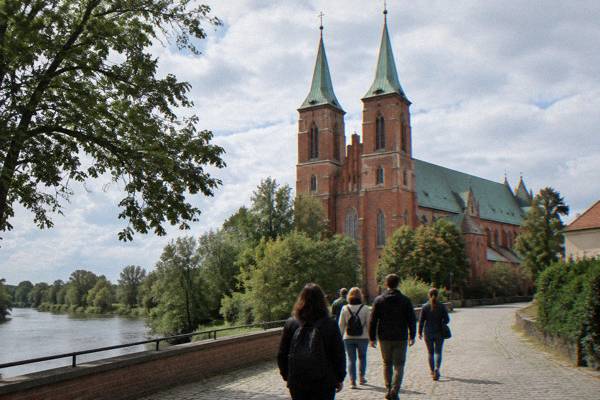
Lichen Basilica Day Trip From Poznan
Lichen Basilica is one of Poland's great pilgrimage destinations, and it sits close enough to Poznan to fill a single day. This guide covers how to plan the trip, what it costs, when to go and what else to see along the way.

Short answer
Lichen Basilica, the Marian sanctuary at Stary Lichen near Konin, works as a full-day excursion from Poznan by car or coach. There is no train station at the sanctuary itself, so the trip is planned around road travel, and the sanctuary's own page is the place to confirm opening hours and any visitor rules before you set out.
Lichen Basilica, the great Marian sanctuary at Stary Lichen near Konin, makes a full-day excursion from Poznan, the capital of the Wielkopolskie voivodeship (Greater Poland) in western Poland, on the Warta river. Pilgrims travel there from across Poland through the year, and the sanctuary's scale, its parkland and its church interior give the trip a rhythm quite different from a museum morning in the city. This guide sets out what the trip involves, how to plan the road travel, what a day there costs, which season suits the visit, and how Lichen compares with the other classic day trips from Poznan, from Gniezno to Kornik Castle.
Where a figure matters to your plan, the sanctuary's own page and the coach or car operator you choose are the sources to check. Everything with a number in the sections below, from ZTM tram tickets to Kornik Castle prices, comes from a verified official source.
Why Visit Lichen Basilica On A Day Trip From Poznan?
Lichen is Poland's major Marian pilgrimage sanctuary, a complex built around a church, a pilgrimage tradition and an extensive park, and it rewards a slow half day of walking, quiet and interior sightseeing rather than a rushed photo stop, which is exactly the pace a day trip from Poznan allows.
The sanctuary sits at Stary Lichen, a village in the Konin district of the Wielkopolska region, the same voivodeship as Poznan itself. Pilgrimage is the defining activity: groups arrive through the year, and the church, its grounds and the surrounding paths are laid out for visitors who spend hours rather than minutes. The contrast with Poznan's Old Market Square, close to everything urban, is the point of the trip. A day at Lichen is a countryside day.
What the sanctuary offers in practical terms is space. The basilica is the centrepiece, and the complex around it includes parkland and walking routes that can be used between services and visits to the church. Unlike a city museum, nothing here is timed in 20-minute entry slots. You set your own pace, and the day-trip format from Poznan, with a morning departure and an evening return, fits that pace well.
For travellers who like to weigh one destination against another before committing a day, here is how Lichen sits beside the other classic excursions from Poznan, using only the hours and prices this site has verified on official pages.
| Day trip from Poznan | Character | Opening pattern (verified) | Tickets (verified) |
|---|---|---|---|
| Lichen Basilica | Marian pilgrimage sanctuary, parkland, walking | Check the sanctuary's own page before travel | None printed in this site's verified pack |
| Gniezno | Cathedral hill, origins museum, viewing terrace | Museum daily, Sundays free; cathedral closed to tourists on Sundays May-Oct | Terrace 12/10 zl, Gniezno Doors 16/14 zl |
| Kornik Castle | Castle interiors and famous arboretum | Tue-Sun, Monday closed; 2026 season closes 14 December | Castle 40/20 zl, arboretum 10/7 zl |
| Biskupin | Reconstructed Iron Age settlement | Daily by season, Nov-Mar 9:00-16:00 | 28/19 zl, family 2+2 75 zl |
| Rogalin Palace | Palace museum and ancient oaks park | Tue-Sun, Monday closed, 9:00-16:00 autumn | 20/13 zl, Tuesday free |
If your instinct is churches and quiet, Lichen wins. If your instinct is castles and gardens, the Rogalin and Kornik day trip from Poznan is the closer match, and the guided version of that route is covered later in this guide.

How Do You Get From Poznan To Lichen Basilica?
There is no rail station at the sanctuary, so the trip runs by road: a hired car or a coach connection, with the journey planned around the operator's own timetable rather than any printed duration, and the sanctuary's own page confirming hours and access before you leave Poznan.
The honest position on travel time is that this site's verified pack carries no journey time or distance for the Poznan to Lichen route, so none is printed here. Any number you see elsewhere for that drive should be checked against the route planner you actually intend to use on the day you travel. What can be said firmly is the shape of the trip: road travel east out of Poznan, through the Wielkopolska countryside toward Konin, with the sanctuary at Stary Lichen beside the final approach.
A hired car gives you the most control, and for a pilgrimage site with no fixed entry slots that control is worth having. Compare car hire options for Poznan before deciding, and check the collection point against where you are staying. Coaches run toward Konin and the surrounding towns; confirm the stop nearest Stary Lichen with the operator, because the sanctuary is a short onward ride from the town connections, and timetables change between seasons.
A hired car gives you control over the day's timing. Book a rental car here.
If you are staying in Poznan without a car, the practical morning is a tram or bus to Poznan Glowny, the main station, and the onward coach from the station forecourt or the adjacent coach stops. Poznan's city transport uses ZTM tickets across all zones, and the timed tickets allow transfers, which matters when you are connecting from a hotel in Jezyce or Srodka to the station. The verified prices:
| ZTM ticket | Validity | Normal price | Reduced price |
|---|---|---|---|
| 15-minute | All zones, transfers allowed | 5 zl | 2.50 zl |
| 45-minute | All zones, transfers allowed | 7 zl | 3.50 zl |
| 90-minute | All zones, transfers allowed | 9 zl | 4.50 zl |
| 24-hour zone A | One day, zone A | 18 zl | 9 zl |
| 24-hour all zones | One day, zones A+B+C+D | 24 zl | 12 zl |
| 7-day zone A | Seven days, zone A | 59 zl | 29.50 zl |
| 7-day all zones | Seven days, zones A+B+C+D | 94 zl | 47 zl |
ZTM's own price list also notes a weekend promotion: a 24-hour ticket validated between 20:00 Friday and 24:00 Saturday stays valid until 24:00 Sunday. If your Lichen day is a Saturday, that quirk can cover your station transfer and your Sunday morning tram with one ticket. There is no contactless bank-card payment on Poznan trams and buses yet; ZTM says the PEKA modernisation will bring it, with effects expected in 2028, so today the options are timed tickets from machines and apps or a PEKA card.

What Does A Day Trip To Lichen Basilica Cost?
The sanctuary itself is a pilgrimage site rather than a ticketed attraction, so the cost of the day is dominated by road travel and food, with no verified entry price printed here; the honest budget method is to price the car or coach first, then plan meals as you would for any Polish day trip, in zloty rather than euros.
Poland's currency is the zloty (PLN, written "zl"), and the country is not in the euro area. Every price you meet on this trip, from a coach fare to a bowl of soup near the sanctuary, will be in zloty, and exchange rates move daily, so no fixed conversion belongs in a plan. Cash is still worth carrying in the smaller towns around Konin, though cards are accepted widely in Poznan itself.
The travel line of the budget is the one to research. A day's car hire priced against the days either side, fuel for the round trip, and parking at the sanctuary are the car costs; a coach return is usually the cheaper and simpler line, at the cost of fixing your return time before you know how the day feels. Price both against the day you actually intend to travel.
Food at a pilgrimage site follows pilgrimage patterns: simple, filling and inexpensive, aimed at groups rather than food tourists. Back in Poznan, the full range opens up again, from milk bars to the restaurants of the 2026 Michelin Guide selection, which lists 25 restaurants from Poznan and surroundings with Muga holding one star. A day that ends with dinner in Poznan is a day that ends well.
If you would rather spend your day-trip budget on a guided route with the logistics handled, the region's castle trips are the strongest alternative, and the guided Rogalin and Kornik excursion covers a palace, a castle and the ancient oaks in one organised day. Check availability for your dates if that format appeals more than a self-driven Lichen day.
For travellers who want a city pass for the Poznan end of the trip, the Poznan City Card is worth a look, with one honest caveat from the card's own terms: it gives free entry to most museums, but partners such as the Enigma Cipher Centre and Porta Posnania are discounted rather than free, and each attraction can be used once.
| Poznan City Card | With transport | Without transport |
|---|---|---|
| 24 hours | 65 zl | 59 zl |
| 48 hours | 83 zl | 72 zl |
| 72 hours | 98 zl | 83 zl |

What Can You See At Lichen Basilica And On The Way Back?
The sanctuary's core is the basilica itself, its interior and its parkland, and the day around it is filled by the walking paths, the pilgrim facilities and the countryside of the Konin district, with the return leg to Poznan best used for a second sight rather than a straight drive.
Inside the sanctuary, the rhythm is church first, grounds second. The basilica is a working pilgrimage church, so services take priority over sightseeing, exactly as at Poznan's own Fara on Golebia 1, which is open daily 6:00 to 19:30 with no sightseeing during Mass. Dress for a church: shoulders covered, quiet voice, and a willingness to wait through a service if one is running. The park and paths around the complex carry no such constraints and are where most of a slow afternoon goes. The full index of guides sits on Poznan Travel Guide.
Photography etiquette follows the same line. Interiors at pilgrimage sites are usually the sensitive spot, and flash inside a church during a service is unwelcome anywhere in Poland. The exterior, the towers and the parkland are the generous subjects, and the light in late afternoon, coming across the flat Wielkopolska countryside, is the light that suits them.
The return leg is where a second sight fits. Travelling back toward Poznan from the Konin district, you pass through the same region that carries several of the verified day-trip destinations in the table above. Gniezno, with its cathedral hill, its Museum of the Origins of the Polish State, open daily and free on Sundays, and its viewing terrace, is the natural pairing if you want history after a morning of pilgrimage. The Sunday caveat matters: on Sundays from May to October the Gniezno cathedral and museum are closed to tourists, and only the viewing terrace opens, from 13:00 to 15:00 and 16:00 to 17:30.
If you would rather end the day inside Poznan itself, the Old Town circuit is the easiest re-entry: the Old Market Square, the Town Hall facade with its famous goats at noon and, since recently, 3 pm, and the cathedral island of Ostrow Tumski with Poznan Cathedral and Porta Posnania. A private walking tour of the Old Town is the guided version of that re-entry, and it pairs naturally with a Lichen day that returns to the city by late afternoon.

When Is The Best Time Of Year To Visit Lichen Basilica?
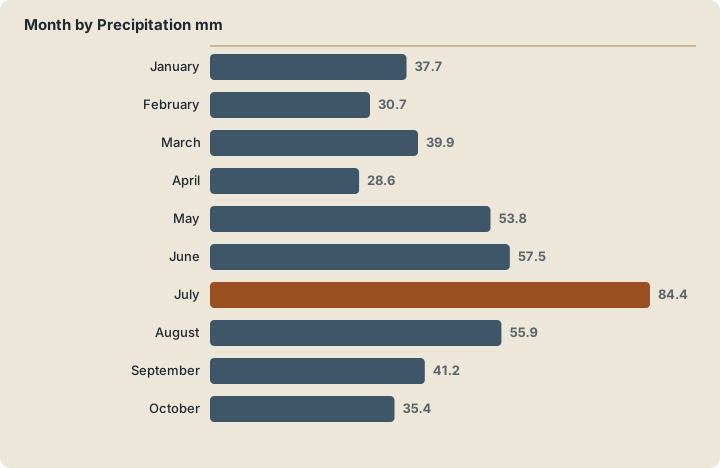
Late spring through early autumn, roughly May to September, gives the warmest and driest walking weather for a sanctuary built around outdoor paths, with WMO's 1991-2020 normals for the Poznan station showing July the warmest month at a 25.2 C mean daily high and April the driest at 28.6 mm of precipitation.
The climate logic is straightforward. Lichen is a walking destination, and the parkland around the basilica is half the reason to go. The Poznan station's normals, the nearest verified dataset to the sanctuary's countryside, show the mean daily high climbing from 8.1 C in March to 19.8 C in May and 25.2 C in July, then easing through 19.5 C in September. Frost is essentially absent from May to September, and the wettest month is July at 84.4 mm, with rain falling on roughly nine days a month through summer.
| Month | Mean daily high C | Mean daily low C | Precipitation mm |
|---|---|---|---|
| January | 2.1 | -2.9 | 37.7 |
| February | 3.7 | -2.4 | 30.7 |
| March | 8.1 | 0.0 | 39.9 |
| April | 15.0 | 4.0 | 28.6 |
| May | 19.8 | 8.4 | 53.8 |
| June | 23.1 | 11.9 | 57.5 |
| July | 25.2 | 14.1 | 84.4 |
| August | 24.9 | 13.7 | 55.9 |
| September | 19.5 | 9.6 | 41.2 |
| October | 13.3 | 5.4 | 35.4 |
| November | 7.1 | 1.8 | 33.6 |
| December | 3.2 | -1.4 | 40.1 |
Winter travel is possible and pilgrims do it, but the trade-offs are real: January's mean daily low sits at -2.9 C, December brings 40.1 mm of precipitation, and the days are short. The upside of a winter visit is that the sanctuary is at its most atmospheric in low light, and if your trip falls in late November or December, Poznan's Christmas markets are running: Betlejem Poznanskie opens on 14 November 2026 at the MTP grounds, with Plac Wolnosci from 20 November 2026 and the Old Market Square from 21 November 2026, all running to 6 January 2027. A cold Lichen morning followed by a hot wine evening on the Old Market Square is a genuinely good winter day.
Pilgrimage calendars matter as much as weather. Major Marian feast days draw large crowds, and the sanctuary's own page is the only reliable calendar for them. If your dates are flexible, avoid the biggest feast weekends unless you want the full pilgrimage experience, and check the service schedule before you plan an interior visit.

What Other Day Trips From Poznan Rival Lichen Basilica?
Gniezno, Kornik Castle, Biskupin and Torun are the four trips that most often compete with Lichen for a day out of Poznan, and each suits a different traveller: Gniezno for early Polish history, Kornik for a castle and garden, Biskupin for archaeology, Torun for a full historic city, and Lichen for pilgrimage and calm.
Gniezno is the closest in spirit and in distance. The train from Poznan to Gniezno takes about 25 to 45 minutes, a Grok-reported range from the Koleje Wielkopolskie timetable, and the day divides neatly between the cathedral hill, the origins museum and the terrace. The Sunday closure of the cathedral to tourists is the one trap, and it is covered above.
Kornik pairs a castle with one of the finest arboretums in this part of Europe, with about 3,000 species and varieties in the collection. The castle is closed Mondays, the low season runs 10:00 to 15:15 with last entry at 14:30, the 2026 tourist season closes on 14 December, and tickets are 40 zl normal and 20 zl reduced. The arboretum is open every day, 10:00 to 16:00 from November to March. The Kornik Castle guide on this site covers the detail.
Biskupin is the archaeology day: a reconstructed Iron Age settlement with a museum, open daily by season and 9:00 to 16:00 from November to March, closed 1 January, Easter Sunday, 1 November and 25 December, at 28 zl normal and 19 zl reduced. The Biskupin guide has the full picture.
Torun is the long-haul option, a full historic city reachable by rail, and the Torun day trip guide covers it. Train times from Poznan Glowny, for Torun or any other city, are "about" ranges only in this site's verified material, and the honest habit is to check the PKP Intercity planner for the specific day:
| Direct train from Poznan Glowny | Typical direct time (reported range, check the planner) |
|---|---|
| Warsaw | about 2 h 20 to 3 h 20 |
| Berlin | about 4 h 30 to 5 h 30 |
| Wroclaw | about 2 h 20 to 3 h 30 |
| Gdansk | about 3 h 40 to 5 h |
| Krakow | about 4 h to 6 h |
For visitors coming from Berlin or heading on after Poznan, one border note belongs here: Poland has temporary controls at its land borders with Germany and Lithuania, running from 2 October 2026 to 30 March 2027, so carry a passport or national ID on the train or bus from Berlin. The EU's Entry/Exit System is fully operational at all external Schengen border crossing points since 10 April 2026, and visa-exempt visitors may have fingerprints and a photo registered. For the ETIAS travel authorisation, the start date and fee are not yet settled in any source this site trusts, so check the EU's official ETIAS site before you travel.

How Do You Plan The Perfect Lichen Day From Poznan?
Start with the sanctuary's own page for hours and any visitor rules, book the road travel with a return time you can move if needed, keep the day in zloty with a card and some cash, and leave Poznan early enough that the basilica gets your morning and the park gets your afternoon.
The practical sequence works like this. The evening before, confirm the sanctuary's opening pattern and service times, check the weather against the normals table above, and decide the road plan: hired car collected the evening before, or a coach with a return leg you have noted. On the day, take the ZTM tram or bus to Poznan Glowny if you are coach-bound, or collect the car early. A 15-minute ticket at 5 zl covers a hotel-to-station hop; a 45-minute ticket at 7 zl covers most cross-city connections with a transfer.
At the sanctuary, church first while your legs are fresh and the light is still building, grounds and paths after, food in the middle of the day, and a final slow circuit of the exterior before you leave. The return leg is where the optional second sight fits, Gniezno being the most natural, or a straight run back to Poznan for an evening in the Old Town.
What to pack follows the season. May to September: sun protection, water and comfortable shoes, plus a rain layer for July and August, the two wettest summer months at 84.4 mm and 55.9 mm. October to April: serious layers, because the mean daily low drops below freezing from December through February, and the parkland offers no shelter from the wind. Shoulders covered for the church in every season, and a scarf does that job in winter as well.
If rain closes in on the Poznan end of the day, the city has good indoor options, and the Poznan rainy day guide on this site lists them. The chocolate museum with its workshop is a warm, dry, child-friendly closer to any wet day trip, and it sits in the city centre.
Budget planning for the whole Polish leg of a trip, not just this one day, is covered in the site's answer on how much money you need per day in Poland, which works through the zloty figures in plain terms. For a first Poznan visit that frames this day trip inside a fuller itinerary, the one day in Poznan guide is the companion piece, and the St Martin's Day guide covers the November festival that fills the street this sanctuary's name day echoes.

Common Questions About Lichen Basilica
Is Lichen Basilica Worth The Trip From Poznan?
For travellers with any interest in Polish pilgrimage, churches or simply a countryside day out of the city, yes. The sanctuary is one of Poland's major Marian destinations, the complex is built for slow walking rather than quick sightseeing, and a full day from Poznan is the right format for it. If churches are not your interest, the castle and archaeology trips, Kornik and Biskupin, will repay the day better.
How Do You Get To Lichen Basilica Without A Car?
By coach toward Konin, with the final connection to Stary Lichen confirmed with the operator, since the sanctuary has no rail station of its own. In Poznan, a ZTM tram or bus to Poznan Glowny starts the trip, with a 15-minute ticket at 5 zl or a 45-minute ticket at 7 zl covering the station hop. Check the coach timetable for the specific day, because this site prints no journey time or distance for the route.
What Are Lichen Basilica's Opening Hours?
Pilgrimage churches generally keep long daily hours, but the sanctuary's own page is the source for the actual times, for service schedules and for any seasonal changes to access. Check it the day before you travel.
Does Lichen Basilica Charge Admission?
Polish pilgrimage sanctuaries are typically free to enter, with donations welcome and charges only for museums or towers where those exist, but the sanctuary's own page is the place to confirm what applies at Lichen before you budget the day.
What Is The Best Time Of Year For A Lichen Day Trip?
May to September, using the WMO 1991-2020 normals for the Poznan station as the nearest verified climate data: mean daily highs run from 19.8 C in May to 25.2 C in July, frost is absent from May through September, and the parkland is at its best. July is the wettest month at 84.4 mm, so pack a rain layer. Winter visits work for the atmosphere, with January's mean low at -2.9 C.
Can You Combine Lichen Basilica With Another Sight?
Yes, on the return leg toward Poznan. Gniezno is the natural pairing, with its cathedral hill and the Museum of the Origins of the Polish State, open daily and free on Sundays, though on Sundays from May to October the cathedral and museum are closed to tourists and only the viewing terrace opens. Alternatively, return to Poznan for an evening in the Old Town around the Old Market Square.
A Lichen Basilica day trip from Poznan is a plan built on honest logistics: road travel priced against your own dates, a sanctuary whose hours you confirm on its own page, weather chosen from real climate normals, and a return leg with a second sight if the day allows. Built that way, it stands comfortably beside Gniezno, Kornik and Biskupin as one of the great days out of this city.