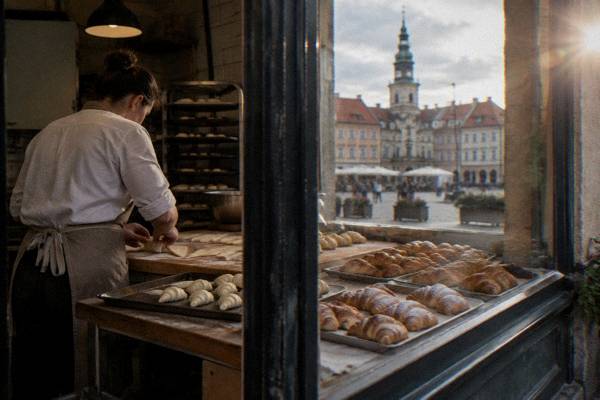
What Are The Most Famous Polish Pastries?
The most famous Polish pastries, from paczki to Poznan's own protected St Martin's croissant, with where to try each one in Poznan.
Poland's bakery counters are a serious business, and Poznan, the capital of the Wielkopolskie voivodeship (Greater Poland) in western Poland on the Warta river, guards one of the country's most protected sweets. The most famous Polish pastries are paczki, deep-fried jam-filled doughnuts eaten on Fat Thursday; rogale swietomarcinskie, the crescent croissants that Poznan has registered with the EU; drozdzowki, sweet yeast buns with cheese or fruit; and sernik, Polish cheesecake. The St Martin's croissant is the only one of these with a European protected name, and Poznan is where it belongs. The city portal and the registry itself trace that protection to Commission Regulation (EC) No 1070/2008 of 30 October 2008, which entered the croissant as a Protected Geographical Indication.

What Are The Most Famous Polish Pastries?
The most famous Polish pastries are paczki (jam-filled fried doughnuts tied to Fat Thursday), rogale swietomarcinskie (Poznan's crescent pastries with a white poppy-seed filling), drozdzowki (yeast buns with sweet cheese or fruit), sernik (baked cheesecake) and faworki, the crisp fried ribbons Poles eat around carnival season. Of these, the rogal swietomarcinski is the only one carrying an EU protected name, and its registered home is Poznan. The croissant's own entry in the EU register, Commission Regulation (EC) No 1070/2008 of 30 October 2008, records it as a Protected Geographical Indication, meaning the name is legally tied to bakers in the Poznan area who follow the registered recipe.
Each of these pastries has a season, and that rhythm is half of what makes them famous. Paczki belong to the last Thursday before Lent, when queues form outside bakeries across the whole country. Faworki share that carnival window. Drozdzowki and sernik are everyday café fare, the kind of thing Poles eat with afternoon coffee rather than on a feast day. The St Martin's croissant has its own fixed date, 11 November, when St Martin Street in Poznan celebrates its name day, and the weeks around it are when Poznan's bakeries produce the pastry in the largest volumes of the year.
The differences are regional as much as seasonal. Poznan's croissant stands apart because the recipe and the place are bound together by the EU registration, while paczki and faworki are national without a single owning city. That is why a pastry walk through Poznan reads differently from one in Warsaw or Krakow: the city has a pastry no one else may sell under the name. Readers planning a broader trip can start with what Poznan is famous for before narrowing down to the bakery counter.
Why Is The Rogal Swietomarcinski Poznan's Signature Pastry?
The rogal swietomarcinski is Poznan's signature pastry because the European Union registers it as a Protected Geographical Indication under Commission Regulation (EC) No 1070/2008 of 30 October 2008, tying both the name and the recipe to Poznan bakers, and because the city eats it on 11 November, the day St Martin Street celebrates its name day. The croissant is a crescent of yeast pastry filled with a mass of white poppy seeds, and only producers in the registered area following the registered method may use the name. That legal protection is why the pastry, not a dumpling or a soup, is the sweet symbol the city leans on.
What a visitor should not expect is a parade: the 2025 edition replaced the parade with an all-day "Miasteczko Imieninowe" on police safety recommendations, and the 2026 programme had not been published when this page was prepared. The honest advice is to treat 11 November as a street festival day and check the CK Zamek programme for the current format. Bakeries across the city sell the croissant in the weeks around the date regardless of the street programme.
For visitors who want the croissant story told rather than just tasted, Poznan has an entire museum for it. The Croissant Museum (Rogalowe Muzeum Poznania) sits at Stary Rynek 41/2 with its entrance from Klasztorna Street 23, and its shows combine the pastry's history with a live baking demonstration and a tasting included in the price. The shows end, for the timed slots that start at 11:00 or 14:00, with a view of the Town Hall goats from the museum windows, a pairing of Poznan's two best-known symbols.
| Croissant Museum show | Language | Time | Notes |
|---|---|---|---|
| Croissant and goat show | English | 14:00 | About 65 min, daily in July and August, weekends all year, other days per the booking calendar |
| Extra croissant show | English | 15:30 | About 60 min, opens only when the 14:00 show is full |
| Croissant show | Polish | 11:00, 12:30, 14:00, 15:30 | Plus 17:00 on Saturdays |
The museum's own page prints its hours as Sunday to Thursday 11:00-15:30 and Saturday 11:00-17:00, with Friday not listed, and asks visitors to arrive 10 minutes before the start. Ticket prices are not published outside the booking widget, so check the live listing rather than any printed figure. Our St Martin's croissant guide covers the pastry's history and where to buy it in more depth.
Where To Eat Pastries In Poznan Beyond The Croissant?
Beyond the croissant, Poznan's pastry eating clusters on the Old Market Square and its side streets for cafés and museum cafés, in Srodka for small neighbourhood bakeries under the tenement at ul. Srodka 3 with its 2015 mural, and at Rynek Jezycki market, which trades Monday to Saturday 6:00-20:00 with only some florists open on Sunday. The Jezyce market is the honest local answer: it is a working market, not a tourist one, and its trading hours come from the market operator itself. Sunday visitors should plan around it, because the market proper is closed.
Srodka deserves the walk across the Cybina from Ostrow Tumski. The mural "Opowiesc srodecka z trebaczem na dachu i kotem w tle" on the tenement at ul. Srodka 3 dates from 2015, confirmed by the city marking its 10th anniversary on 4 October 2025, and the little square around it holds cafés that sell exactly the everyday pastries, drozdzowki and sernik, that this page began with. It is the closest thing Poznan has to a pastry neighbourhood: small, walkable and a few minutes from the cathedral island. Everything else covered here is indexed on Poznan Travel Guide.

Winter adds a second venue. The Betlejem Poznanskie Christmas market runs 14 November 2026 to 6 January 2027, with the MTP grounds open 14 November to 20 December, Plac Wolnosci from 20 November and the Old Market Square from 21 November, all ending 6 January. Christmas markets in Poland are where faworki and warm pastry stalls do their brisk trade, and readers comparing cities can see which Polish Christmas market is the best before committing. The Old Market Square site puts the stalls within sight of the Croissant Museum's windows.
A guided walk is a reasonable shortcut for first-time visitors who want the pastry stops chosen for them. The Check availability link covers the old town walk with a tram ride and a traditional snack built in, which pairs naturally with a morning show at the Croissant Museum. Readers weighing the length of their stay can also check how many days in Poznan is enough to fit both.
Want the pastry stops paired with city views? Book a food tour here.
When Do Poles Eat Which Pastry?
Poles eat paczki on Fat Thursday, the last Thursday before Lent, when bakeries nationwide sell them in the largest volumes of the year; faworki across the carnival season; sernik and drozdzowki year round as everyday café cakes; and rogale swietomarcinskie in the weeks around 11 November, when St Martin Street in Poznan celebrates its name day. The calendar is the point: most Polish pastries are occasion food, and the occasion, not the shop window, decides what the bakery counter holds. Poznan's croissant season also blends into the Christmas market window that opens on 14 November 2026.
The November cluster is dense enough to plan a trip around. The name day on 11 November fills St Martin Street with stalls and the castle's programme; the croissant bakeries run at full capacity; and nine days later the Christmas market opens on the Old Market Square. December adds the POZnan Ice Festival on 11 to 13 December 2026 with its sculpture contest and children's workshops, which makes an early-December pastry-and-ice weekend a realistic single itinerary. None of this needs a car: it is all within the city's walkable centre and tram network.
| Pastry | Season or date | Where it fits in Poznan |
|---|---|---|
| Paczki | Fat Thursday, last Thursday before Lent | Bakeries citywide |
| Faworki | Carnival season leading to Lent | Christmas market stalls and bakeries |
| Rogale swietomarcinskie | Weeks around 11 November | Bakeries citywide, Croissant Museum shows |
| Drozdzowki and sernik | Year round | Cafés on the Old Market Square and in Srodka |
Can You Make Polish Pastries Yourself In Poznan?
Yes, Poznan is one of the few Polish cities where visitors can watch, and take part in, pastry making rather than only eating the result: the Croissant Museum runs participatory shows at set times in Polish and English, and a chocolate museum workshop covers the sweet-making side, while the city's food tours build a tasting into the walk. The Croissant Museum's English "croissant and goat show" runs at 14:00, daily in July and August and on Saturdays and Sundays all year, with other days shown in the booking calendar, and the tasting is included in the price. A second English show at 15:30 opens only when the 14:00 slot is full.
The practical detail that trips visitors up is timing rather than booking: the museum asks guests to arrive 10 minutes before the start, and the goat-show slots that begin at 11:00 or 14:00 end with the view of the Town Hall goats from the museum windows. Whether the goats appear on the facade on a given day is not something this site will promise, since facade works are under way on the Town Hall and no official statement covers the display during the works. The museum itself, at Stary Rynek 41/2 with the entrance from Klasztorna Street 23, is a separate building and open as listed.
Chocolate is the other half of the Polish sweets counter, and Poznan pairs the two well: a croissant show in the morning, a chocolate workshop in the afternoon, and a sernik in a square-side café in between. Visitors who want the full national picture can read what is the most famous beer in Poland for the savoury-adjacent half of the same question, because Poznan treats its beer and its croissant as twin symbols.
Common Questions About Polish Pastries
Readers ask a handful of practical questions about Polish pastries, and the short answers are: the croissant, not the doughnut, is Poznan's protected pastry; November is its season; the Croissant Museum is the one place that explains it with a show; and everything else on the Polish pastry counter is year-round café fare. The questions below repeat the exact phrasing visitors search for, and each answer sticks to what the venues' own pages and the EU registry state, with no invented prices where none are published.
What are the most famous polish pastries?
Paczki, rogale swietomarcinskie, drozdzowki, sernik and faworki. The rogale swietomarcinskie is the only one with an EU protected name, a Protected Geographical Indication registered by Commission Regulation (EC) No 1070/2008 of 30 October 2008, and its home is Poznan, Poland.
What is a rogale swietomarcinskie?
A crescent-shaped yeast pastry filled with white poppy-seed mass, tied by EU law to bakers in the Poznan area. The name is protected as a PGI, so only registered producers may sell it under that name.
When is St Martin's croissant eaten?
Bakeries sell the croissant in the weeks around the date, which also leads into the Christmas market opening on 14 November 2026.
Where can you see croissants being made in Poznan?
The Croissant Museum at Stary Rynek 41/2, entrance from Klasztorna Street 23. Its English show runs at 14:00, daily in July and August and on weekends all year, with a tasting included. Arrive 10 minutes before the start.
Do Polish pastries use poppy seeds?
Yes, white poppy seeds are the registered filling of the St Martin's croissant, and poppy-seed fillings appear across Polish baking, especially around Christmas. The croissant's specific recipe is fixed by its EU registration.
A Polish pastry trip organised around Poznan gets you the national classics and the one pastry with a protected name, in a city compact enough to walk between the bakery, the museum and the market in a single morning.