Does It Snow In Poznan?
Does it snow in Poznan? WMO climate normals for the Poznan station show what winter visitors can honestly expect, month by month.
Yes, it snows in Poznan, the capital of the Wielkopolskie voivodeship in western Poland, on the Warta river. But the climate record shows a winter of cold snaps and thaws rather than a season under a permanent white blanket. This page works through what the World Meteorological Organization's 1991-2020 climate normals for the Poznan station actually record, what snow realistically means for sightseeing, the Christmas market season, and how to pack for it. Nothing here is travel folklore; every figure comes from the climate record and from the city's own published winter programme.

Does It Snow In Poznan?
Yes, it snows in Poznan, but not constantly and rarely all winter long. WMO's 1991-2020 climate normals for the Poznan station record 19.7 frost days in January, 17.9 in February and 17.5 in December, so temperatures sit below freezing often enough for snow to form, yet the mean daily high stays just above zero in each of those months, so thaws between cold spells are normal and settled snow cover is never guaranteed.
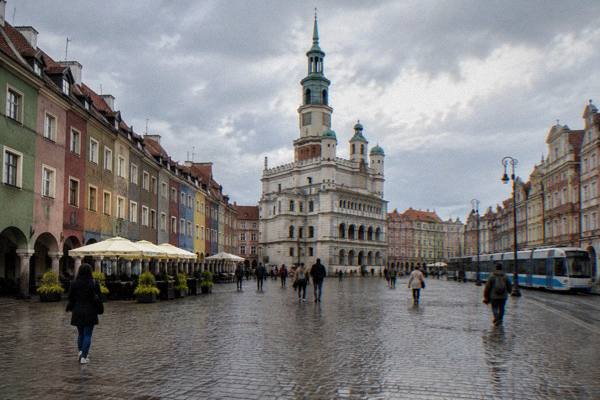
That combination, cold nights and barely-above-freezing afternoons, is the shape of a Poznan winter. The same normals give January a mean daily high of 2.1 C and a mean daily low of -2.9 C, with December at 3.2 C and -1.4 C. Snow falls, it settles for a while, then a mild Atlantic-driven airflow often strips it away again within days. Visitors who arrive in mid-January may find the Old Market Square white; visitors two weeks later may find it wet and grey.
Precipitation tells the same two-sided story. December records 40.1 mm of precipitation across 9.1 days with 1 mm or more, and January 37.7 mm across 9.1 such days. That is a genuinely wet winter pattern, not a dry one, and with mean temperatures hovering around freezing, some of that moisture arrives as snow and some as rain. Anyone promising a snowy Christmas card scene on a specific date is promising something the climate record does not support.
For travellers weighing the city against other Polish destinations, the honest framing is that Poznan is a lowland, western city: its winters are milder and slushier than Krakow's or the mountain south's, and snow that does fall rarely survives the whole season. The trade-off is that winter Poznan is cheap to enjoy on foot, compact, and lit by a Christmas market that runs well into January.
How Cold Does Poznan Get In Winter?
WMO's 1991-2020 normals put January, the coldest month, at a mean daily high of 2.1 C and a mean daily low of -2.9 C, with a monthly mean of -0.4 C. February averages 3.7 C by day and -2.4 C by night, December 3.2 C and -1.4 C. Frost touches 19.7 days in January and 17.9 in February, and the deepest cold usually arrives in January rather than at Christmas.
Those numbers describe a moderate continental winter, softened by Poznan's position in the west of Poland. The normals count 87.3 frost days across the year, and the great majority of them fall between November and March: 9.2 in November, then the January and February peaks, then 14.1 in March, when nights still drop to an average of 0.0 C even as afternoons reach 8.1 C.
| Month | Mean daily high C | Mean daily low C | Monthly mean C | Precipitation mm | Days with 1 mm+ | Frost days |
|---|---|---|---|---|---|---|
| November | 7.1 | 1.8 | 4.4 | 33.6 | 7.3 | 9.2 |
| December | 3.2 | -1.4 | 0.9 | 40.1 | 9.1 | 17.5 |
| January | 2.1 | -2.9 | -0.4 | 37.7 | 9.1 | 19.7 |
| February | 3.7 | -2.4 | 0.5 | 30.7 | 7.6 | 17.9 |
| March | 8.1 | 0.0 | 3.8 | 39.9 | 8.6 | 14.1 |
Two readings of that table matter for a trip. First, February is slightly warmer than January by day but drier (30.7 mm against 37.7 mm), so a late-winter visit has marginally better odds of dry pavement and worse odds of fresh snow. Second, March is not a winter month in the statistics: afternoons average above 8 C, and while frost still visits on about 14 nights, lasting snow is unlikely after the first half of the month.
One correction worth making to a lot of online copy: winters here are not dry. July is the wettest month of the whole year at 84.4 mm, but December's 40.1 mm is close behind the shoulder months, and April, at 28.6 mm, is the driest month on the calendar. Snow-seekers should plan around temperature, not around a fictional dry season.
A guided walk is one way to use short winter days efficiently, and the city's roster includes an Old Town option with a licensed guide. The listing carries its own current price and availability, and a Check availability link shows the live details before you commit. For more on the city as a whole, see the companion piece on whether Poznan is worth visiting.
What Does Snow Mean For Sightseeing In Poznan?
Snow in Poznan changes the texture of a visit more than the itinerary: the Old Market Square and Cathedral island photograph beautifully under frost, while the same near-freezing highs that produce snow also produce slush, so waterproof footwear matters more than arctic clothing. Closures to plan around are seasonal rather than weather-driven, including the Maltanka park railway, whose 2026 season ended on 27 September with no 2027 date published yet.
The headline outdoor sights take winter in stride. Ostrow Tumski, the island holding Poznan Cathedral, keeps its crypts and viewing tower open to tourists from 1 March to 15 November only, so deep-winter visitors see the cathedral's interior but not the tower climb; the cathedral's own page sets the tower at 14 zl normal and 12 zl reduced in season. The goats on the Town Hall facade appear every day at noon and, since recently, also at 3 pm, though nobody can promise the show on a given day while facade works continue, and the Town Hall museum interior itself is closed for renovation with no published reopening date. The goats' timetable deserves its own planning note.
Indoor anchors are strong in cold weather. The Enigma Cipher Centre is open Tuesday to Friday 9:00-18:00 and weekends 10:00-19:00, closed Mondays, at 35 zl normal and 29 zl reduced. The Imperial Castle welcomes visitors daily from 12:00 to 19:00, with entry at 10 zl with a map or 20 zl with an audio guide. The National Museum's branches, including the Royal Castle and the Gallery of Painting and Sculpture, are free on Tuesdays, which is a genuinely useful fact for a frozen afternoon. The interactive PRL museum in the tour selection below is another covered option, a time-capsule of communist-era interiors.
Practical winter notes the research-and-reporting desk can state from primary sources: trams and buses still take timed ZTM tickets (the shortest ticket is 5 zl, a 45-minute one 7 zl), contactless bank-card payment on board is not yet available, and the fine for travelling without a valid ticket is 350 zl, or 175 zl if paid within 7 days. There is no city bike system to fall back on; it ran from 2012 to 2022 and has not returned.

Does It Snow In Poznan At Christmas?
It can snow at Christmas in Poznan, and frost is likely, with 17.5 frost days in December and a mean nightly low of -1.4 C, but a white Christmas is not something any honest guide can promise. What is certain is the market: Betlejem Poznanskie 2026/27 opens on 14 November 2026 and runs to 6 January 2027, with the Stary Rynek site open from 21 November 2026.
The market's own site gives the full geometry: the MTP fair grounds host stalls from 14 November to 20 December 2026, Plac Wolnosci from 20 November 2026 to 6 January 2027, and the Old Market Square from 21 November 2026 to 6 January 2027. That means the two most central sites stay open through Epiphany, so early-January visitors, statistically the coldest snap of the season, still get the mulled wine and the lights.
December also stacks two ice-centred events into one weekend. The 20th POZnan Ice Festival runs 11 to 13 December 2026: a small sculpture contest on the 11th from 16:00, Speed Ice Carving from 11:00 on the 12th, and the main competition on the 13th from 9:00 to 17:00 with children's workshops from 12:00. Whether the ice is accompanied by falling snow is up to the weather; the carving happens either way.
For anyone converting a snowy-market fantasy into a full trip, the length-of-stay question is worth settling early, and the companion answer on how many days in Poznan is enough covers it. A winter weekend is a legitimate format: two market sites, one museum afternoon, one Cathedral-island walk.
What Should You Pack For A Snowy Poznan Trip?
Pack for hovering-around-zero conditions rather than deep cold: waterproof boots for slush, a proper insulated coat, hat and gloves for 19-plus frost nights in January, and layers you can shed indoors, because museums, trams and the Christmas market huts are heated hard. The normals say the mean daily low never drops below -2.9 C even in the coldest month, so extreme-weather gear is unnecessary.
The practical failure mode for winter visitors is footwear. With around 9 precipitation days in each winter month and afternoon highs above freezing, pavement snow repeatedly melts and refreezes; insulated, waterproof soles beat fashion choices every time. The second failure mode is underestimating wind on open ground: the Warta river corridor and the wide western approaches to the Old Market Square can make 0 C feel notably sharper.
A short packing-to-conditions table, drawn straight from the normals:
| If you visit in | Typical afternoon | Typical night | What the record says to bring |
|---|---|---|---|
| November | 7.1 C | 1.8 C | Autumn coat, scarf, compact umbrella |
| December | 3.2 C | -1.4 C | Insulated coat, waterproof boots, gloves |
| January | 2.1 C | -2.9 C | Full winter kit, layers for heated interiors |
| February | 3.7 C | -2.4 C | Winter kit, slightly lighter than January |
| March | 8.1 C | 0.0 C | Layers, boots for leftover slush, umbrella |
One local food note for cold days, since it is the city's signature: the rogall swietomarcinski, the St Martin's croissant, is registered in the EU as a Protected Geographical Indication under Commission Regulation (EC) No 1070/2008 of 30 October 2008, and it is at its most visible around 11 November, when St Martin Street celebrates its name day. The 2025 edition replaced the traditional parade with an all-day "Miasteczko Imieninowe", so the honest advice is to follow the CK Zamek programme rather than expect a parade. The croissant itself needs no parade.
Common Questions About Snow In Poznan
Does it snow in Poznan?
Yes. The WMO 1991-2020 normals for the Poznan station show roughly 17 to 20 frost days in each of December, January and February, with mean daily highs of 2.1 to 3.7 C, so snow falls regularly but thaws between cold spells and a lasting white cover is never guaranteed.
Which month is most likely to have snow in Poznan?
January. It has the most frost days of any month, 19.7, the lowest mean daily low, -2.9 C, and the only negative monthly mean in the record, -0.4 C, making it the month when fallen snow has the best chance of staying put.
Does it snow in Poznan in November or March?
Occasionally, but it rarely lasts. November records 9.2 frost days and March 14.1, yet afternoon means of 7.1 C and 8.1 C respectively mean any snow usually melts within a day or two.
Is a white Christmas likely in Poznan?
It is possible but cannot be promised. December averages 17.5 frost days with nights around -1.4 C, so conditions allow snow, but the Betlejem Poznanskie market, which in 2026/27 runs from 14 November to 6 January, happens regardless of the weather.
Do Poznan's attractions close when it snows?
Snow itself does not close them. Winter closures are seasonal or scheduled: the Maltanka railway's 2026 season ended on 27 September, the Town Hall museum interior and the Ethnographic Museum are closed for renovation, and the Palm House is closed for rebuilding, with part due back towards the end of 2028.
How cold does Poznan get compared with the rest of Poland?
Poznan is a lowland city in western Poland, so its winters are milder than Krakow's or the mountain south's. Its coldest month, January, averages 2.1 C by day and -2.9 C by night, moderate figures for Polish standards, with slush more common than deep snow.
Cold, bright and occasionally white is the honest summary. Poznan in winter rewards visitors who plan around frost rather than around a snowfall that may or may not arrive, and the market calendar, unlike the weather, is published well in advance. For a fuller seasonal weighing-up, the Poznan Travel Guide homepage collects the city's highlights, and the companion answer on what Poznan is famous for adds the year-round case for a visit.