A Short History Of Poznan
Poznan, the capital of the Wielkopolskie voivodeship in western Poland, packs a thousand years of Polish statehood into a compact city on the Warta river. Here is the history that the museums, the crypts and the square can actually document.

Short answer
Poznan's documented story runs from the tombs of Mieszko I and Boleslaw Chrobry in the cathedral crypts, through a Town Hall first built in the early 14th century, the Wielkopolska Uprising of 1918-1919, the destruction of 1945 and the workers' protests of June 1956, to a modern regional capital of 534,239 residents.
Poznan, the capital of the Wielkopolskie voivodeship (Greater Poland) in western Poland, sits on the Warta river and holds 534,239 residents, according to the Statistical Office in Poznan. It is a city where the deep history of the Polish state is visible in stone: royal tombs in a cathedral crypt, a merchant Town Hall whose clock has hosted fighting goats since their first installation in September 1551, and a modern era bracketed by the Wielkopolska Uprising of 1918-1919 and the workers' revolt of June 1956. This guide walks through that story using only what official museum pages and city sources actually document, and it flags the gaps honestly, because several "facts" repeated about Poznan online have no source behind them.
What Is The History Of Poznan?
Poznan's documented history centres on three layers: a cathedral island, Ostrow Tumski, where the crypts hold the tombs of Mieszko I and Boleslaw Chrobry and a 10th-century baptismal bowl; a merchant city whose Town Hall on the Old Market Square dates to the early 14th century and whose famous goat clock was first installed in September 1551; and a turbulent modern era marked by the Wielkopolska Uprising of 1918-1919, the tower collapse of 1945, the June 1956 protests and the Enigma codebreakers Rejewski, Rozycki and Zygalski.
Notice what that summary does not say. It does not give a founding year, it does not mention the baptism of 966, and it does not call Poznan the first capital of Poland. None of those claims appear in the verified fact pack behind this page, and a history guide that invents dates is worse than one that admits the gaps. What the city's own institutions do publish is rich enough: the National Museum documents its buildings, the Archcathedral Basilica documents its crypts, and the Enigma Cipher Centre documents its three mathematicians.
The city's population figure is exact because the statistical office publishes it exactly: 534,239 people. Poznan is today the capital of the Wielkopolskie voivodeship, the region whose name simply means Greater Poland, and it remains the commercial heart of western Poland, home to the Poznan International Fair grounds at MTP.
For visitors, the practical payoff of this history is a walkable core. The Old Market Square (Stary Rynek), the cathedral island and the Citadel park, described by the city portal as the largest park in Poznan and a relic of a 19th-century fortress that was the largest artillery fort in Europe at the time, fit inside a day. The free things to do in Poznan include several of these historic sites, and a self-guided walking tour of the same material exists on this site.
What Can The Cathedral Crypts Tell You About Early Poznan?
The Poznan Archcathedral Basilica of St Peter and St Paul on Ostrow Tumski holds the most tangible early history in the city: its crypts contain the relics of the tombs of Mieszko I and Boleslaw Chrobry and a 10th-century baptismal bowl, and the crypts and viewing tower are open to tourists from 1 March to 15 November, weekdays 9:00-16:00 and Sundays 14:00-18:00, with crypt tickets at 10 zl normal and 8 zl reduced.
The archcathedral's own page for visitors states these hours and prices plainly, and it adds one operational detail worth planning around: tourist access is suspended when an extra service is on. The tower is a separate ticket, 14 zl normal and 12 zl reduced, and the page records that the tower has been open since 1 June 2026. Family tickets exist for both, at 25 zl for the crypts and 40 zl for the tower.
Ostrow Tumski is the island between the two arms of the Warta, and it is the one place in Poznan where the earliest Polish statehood is physically present rather than merely narrated. The neighbouring interpretive centre, Porta Posnania at ul. Gdanska 2, presents that story in a modern building; its page lists Tue-Fri 9:00-18:00 and Sat-Sun 10:00-19:00, Monday closed, entries every 20 minutes, tickets at 35 zl normal and 29 zl reduced. This site has a fuller guide at Ostrow Tumski and Porta Posnania and a dedicated Poznan Cathedral page.
Want to walk the island with a guide who knows the story? Book a private walking tour here.
Across the footbridge, the Genius Loci Archaeological Reserve on ul. Ks. I. Posadzego 3, a branch of the Archaeological Museum, shows excavated remains on the spot; its price page lists 20 zl normal, 15 zl reduced and a 50 zl family ticket, plus a combined ticket with the Archaeological Museum in Palac Gorkow at 30 zl.
A history walk that covers this arc, crypts to fortress, is easiest with a guide. The city's story from its Golden Age to the upheavals of 1918-1919, 1945 and 1956 and its rebirth is the explicit theme of a guided tour you can check here: Check availability.
| Site on Ostrow Tumski | Season and hours | Normal ticket | Reduced ticket |
|---|---|---|---|
| Cathedral crypts | 1 Mar to 15 Nov, weekdays 9:00-16:00, Sundays 14:00-18:00 | 10 zl | 8 zl |
| Cathedral viewing tower | Same season, same hours | 14 zl | 12 zl |
| Porta Posnania | Tue-Fri 9:00-18:00, Sat-Sun 10:00-19:00, Mon closed | 35 zl | 29 zl |
| Genius Loci reserve | Hours unsourced | 20 zl | 15 zl |

How Old Is The Town Hall, And What Happened To Its Tower?
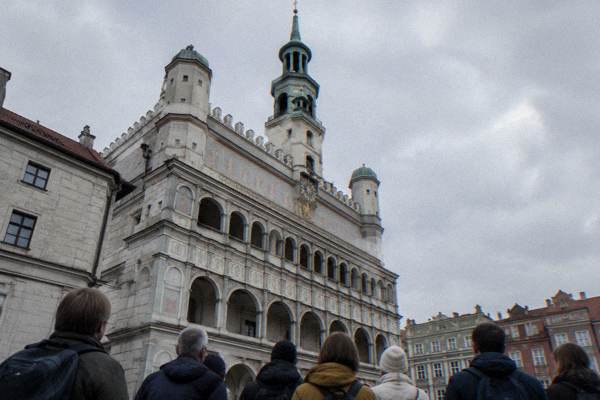
The Town Hall on Stary Rynek 1 is documented by the National Museum as a building of the early 14th century, conserved between 1910 and 1913, with a tower that collapsed in 1945; it has housed the Museum of the History of the City of Poznan since 1954, and its famous clock with goats was first installed in September 1551 by the clockmaker Bartel Wolff of Gubin, replaced by a new clock in 1913.
That chain of dates comes straight from the National Museum's own pages on the Town Hall and the goats, and it is worth dwelling on because internet copy about the building is routinely wrong. The museum does not publish a founding year for the city, and it does not say the goat clock survives from 1551: the current arrangement dates to the 1913 clock, and the National Museum records that the goats reappeared on 25 August 1922 after a repair.
The goats themselves are the city's best-loved historical theatre. The official wording is that two metal goats appear on the facade every day at noon, "and since recently also at 3 pm", locking horns above the clock. One honest caveat: the Town Hall's museum interior is closed for renovation, the visit page lists every weekday as closed, no reopening date is published, and whether the goats perform during the current facade works is not stated anywhere official, so check on the day rather than building an itinerary around the show. This site keeps a full page on the Town Hall and the goats and on the Old Market Square itself.
The square around the Town Hall carries more documented history in three museums, all closed Mondays, all free on Tuesdays, and all listed by their own pages:
| Museum on Stary Rynek | Address | Hours | Tickets |
|---|---|---|---|
| Greater Poland Military Museum | Stary Rynek 9 | Tue-Sun 10:00-17:00 | 15 / 10 zl, Tue free |
| Museum of Musical Instruments | Stary Rynek 45 | Tue-Wed to 16:00, Thu to 18:00, Fri to 20:00, Sat-Sun to 17:00 | 15 / 10 zl, Tue free |
| Museum of the Wielkopolska Uprising 1918-1919 | Stary Rynek 3 (Odwach) | Nov-Feb Tue-Sun 10:00-16:00 | 15 / 10 zl, Tue free |

What Was The Wielkopolska Uprising Of 1918-1919?
The Wielkopolska Uprising of 1918-1919 was a regional rising in which the Polish population of Poznan and surrounding Greater Poland took control of the area, and its story is told today in a dedicated museum in the Odwach building at Stary Rynek 3, where tickets are 15 zl normal and 10 zl reduced, Tuesdays are free, and winter hours run Tue-Sun 10:00-16:00 from November to February.
What a visitor gets at the Odwach, a former guardhouse on the square's western side, is the narrative of how Poznan's Polish majority organised itself in the weeks after the First World War.
The uprising is the reason Poznan's regional identity is so strong. It is commemorated in the city's very name for its voivodeship, Wielkopolskie, and in street names and monuments across the centre. The museum is small and inexpensive, and combined with the Military Museum at Stary Rynek 9 it makes a single square into a two-museum history lesson for the price of two cinema tickets.
Visitors planning museum-heavy days should also read the site's guide to the Poznan City Card: the card, at 65 zl for 24 hours with transport or 59 zl without, gives free entry to most museums, though partners such as the Enigma Cipher Centre and Porta Posnania give a discount rather than free entry, at 21 and 21 zl respectively on their own pages.

Who Were The Enigma Codebreakers From Poznan?
The Enigma Cipher Centre at ul. Sw. Marcin 78 names three Poznan mathematicians on its timeline, Marian Rejewski, Jerzy Rozycki and Henryk Zygalski, who studied at Poznan University and went on to crack the German Enigma cipher before the Second World War; the centre is closed Mondays, opens Tue-Fri 9:00-18:00 and Sat-Sun 10:00-19:00, and charges 35 zl normal, 29 zl reduced and 75 zl for a family of two adults and three children.
The centre's own plan-your-visit page lists those hours and prices, a 21 zl Poznan City Card price with a 17 zl reduced rate, and exhibitions and audio guides in Polish, English, German, Russian and Ukrainian. Last admission falls one hour before closing. The building sits on Sw. Marcin, the same street as the Imperial Castle, so the two pair naturally in a morning.
The story the centre tells is one of Poznan's proudest exports. The three codebreakers were recruited as students in Poznan and their pre-war breakthroughs fed the later Allied codebreaking effort. For anyone whose interest in Polish history runs to ciphers and machines rather than kings and crypts, this museum is arguably the best single stop in the city, and it is fully bilingual in practice thanks to the English audio guide.
A short walk north, the Imperial Castle Cultural Centre's own page gives daily visiting from 12:00 to 19:00, tickets sold until 18:00, at 10 zl normal with a map and 7 zl reduced, or 20 zl and 15 zl with an audio guide. The castle's construction years and architect are not confirmed on its own site, so this page leaves them out rather than repeat a number the source does not carry. See the site's fuller guides to the Enigma Cipher Centre and the Imperial Castle.

What Happened In Poznan In June 1956?
In June 1956 Poznan was the scene of workers' protests that were suppressed by force, an event the city commemorates today with a monument on the Adam Mickiewicz Square; the verified pack carries no visiting details for a dedicated 1956 museum, so this page mentions the events and the monument without promising a museum visit, unlike guides that list hours nobody has sourced.
That last clause needs unpacking, because it is exactly the kind of honesty gap this site exists to close. The Independence Museum network's current price and hours pages list three branches and a June 1956 museum is not among them, so its address, hours and admission cannot be printed here. The events themselves, workers from the city's largest plants striking in June 1956 and the revolt being put down, are undisputed history that any visit to the monument engages with directly.
The 1956 monument stands on Adam Mickiewicz Square in front of the Imperial Castle, two crossed anchors and a cross rising above the crowds. It pairs naturally with the Castle visit described above, and with a walk along Sw. Marcin, the street that saw the protests and that today hosts both the castle cultural centre and the Enigma centre, a one-street summary of Poznan's journey from 1918 to 1956.
Poznan's wartime years were destructive as well as defiant: the National Museum records that the Town Hall tower collapsed in 1945, and the Citadel park preserves the earthworks of a 19th-century fortress described by the city portal as the largest artillery fort in Europe at the time, later a battlefield cemetery park. The site's Citadel Park guide covers its two military museums, the Museum of Armaments (15 zl normal, Tuesday free) and the Museum of the "Poznan" Army (10 zl, also Tuesday free).

Which Museums Tell The City's Story Today?
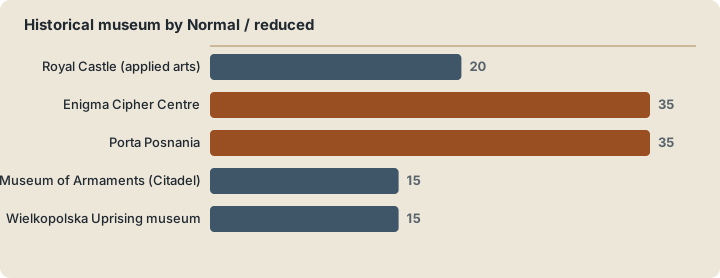
The National Museum in Poznan and the Independence Museum network between them tell the city's story across a dozen buildings, and the practical pattern is consistent: almost all branches close on Mondays and are free on Tuesdays, with normal tickets at 15 or 20 zl; exceptions include the Royal Castle at 20 zl normal and 13 zl reduced and the Town Hall museum, whose interior is currently closed entirely.
Two National Museum branches are worth singling out for history visitors. The Royal Castle Museum of Applied Arts on Gora Przemysla 1, Tue-Wed 10:00-16:00, Thu 10:00-18:00, Fri 10:00-20:00, Sat-Sun 10:00-17:00, charges 20 zl normal and 13 zl reduced with Tuesday free, and its current programme includes a display of ukiyo-e Japanese woodblock prints, "Japonska Fala", running 1 September to 15 November 2026. The Gallery of Painting and Sculpture on Aleje Marcinkowskiego 9, an eclectic building of 1904 plus a new wing, does not have its hours and prices on a currently reachable page, so check before going.
| Historical museum | Normal / reduced | Free day | Monday |
|---|---|---|---|
| Royal Castle (applied arts) | 20 / 13 zl | Tuesday | Closed |
| Enigma Cipher Centre | 35 / 29 zl | None listed | Closed |
| Porta Posnania | 35 / 29 zl | None listed | Closed |
| Museum of Armaments (Citadel) | 15 / 10 zl | Tuesday | Closed |
| Wielkopolska Uprising museum | 15 / 10 zl | Tuesday | Closed |
| Town Hall museum | Interior closed, no reopening date | Tuesday when open | Closed |
One warning for planners: the Ethnographic Museum at Grobla 25 is closed due to renovation, per the National Museum's own visit page, and the Palm House in Park Wilsona, which its operator calls the oldest and largest garden of its type in Poland, is closed for rebuilding with part of the pavilions due back towards the end of 2028 and works until 2030. Neither belongs on a current itinerary, whatever older guidebooks say. The site's rainy day guide to Poznan lists what is actually open.
For food history rather than political history, the Croissant Museum at Stary Rynek 41/2, entrance from Klasztorna 23, stages its "croissant and goat show" in English at 14:00, daily in July and August and on weekends all year, with a 15:30 English show added when 14:00 is full; the museum's own page carries show times but no ticket prices, which are only in the booking widget. The St Martin's croissant the show celebrates is a Protected Geographical Indication under Commission Regulation (EC) No 1070/2008 of 30 October 2008. More on that in the site's Croissant Museum and St Martin's croissant guides.

How Has Poznan Changed In Recent Years?
Modern Poznan is a regional capital of 534,239 residents that keeps renewing itself in visible ways: the cathedral tower reopened to tourists on 1 June 2026, the Palm House is mid-rebuild until 2030, the ZTM transit system signed a PEKA modernisation contract in 2026 that will bring contactless bank-card payment expected in 2028, and the airport gained new routes including airBaltic flights to Gran Canaria from 26 October 2026.
Even the transport system has a history worth a paragraph. Timed tickets valid in all zones cost 5 zl for 15 minutes, 7 zl for 45 and 9 zl for 90, with a 24-hour zone A ticket at 18 zl, and the fine for riding without a valid ticket is 350 zl, or 175 zl if paid within 7 days. The PEKA card, 27 zl of which 12 zl is a refundable deposit and 15 zl is travel credit, is the local way to pay until contactless arrives. The site's public transport guide covers it in full.
The city's event calendar is also part of its living history. St Martin's Day on 11 November is organised by CK Zamek as the St Martin Street Name Day, but the 2025 edition had no parade, it was replaced by an all-day "Miasteczko Imieninowe", so never promise yourself a parade; check the CK Zamek programme. The Betlejem Poznanskie Christmas market runs 14 November 2026 to 6 January 2027 across three sites, with Stary Rynek joining from 21 November 2026, and the POZnan Ice Festival marks its 20th edition on 11 to 13 December 2026. The site has guides to St Martin's Day and the Christmas market.
| Documented date | What happened |
|---|---|
| September 1551 | Clock with goats first installed by Bartel Wolff of Gubin |
| 1913 | New Town Hall clock installed; the tradition continues |
| 1918-1919 | Wielkopolska Uprising, commemorated at Stary Rynek 3 |
| 1945 | Town Hall tower collapses |
| 1954 | Museum of the History of the City of Poznan housed in the Town Hall |
| June 1956 | Workers' protests, commemorated on Adam Mickiewicz Square |
| 2008 | Rogal swietomarcinski registered as a PGI, Regulation 1070/2008 |
Travellers who want history beyond the city limits can reach Gniezno by train in about 25 to 45 minutes, where the Museum of the Origins of the Polish State opens daily 9:00-16:00 from October to April with free admission on Sundays, or Biskupin, the archaeological museum open 9:00-16:00 November to March at 28 zl normal and 19 zl reduced. This site has full guides to Gniezno and Biskupin. The essentials for arriving are in the Poznan airport guide and the airport to city centre page, with buses 148 and 159 linking the station and Lawica every 7 to 8 minutes at peak.

Common Questions About Poznan History
What is the history of Poznań, Poland?
Poznan's documented story includes the tombs of Mieszko I and Boleslaw Chrobry in the cathedral crypts on Ostrow Tumski, a Town Hall of the early 14th century whose goat clock dates to September 1551, the Wielkopolska Uprising of 1918-1919, the tower collapse of 1945, the June 1956 protests and the Enigma codebreakers Rejewski, Rozycki and Zygalski.
How old is the Poznan Town Hall?
The National Museum dates the building to the early 14th century, records its conservation in 1910-1913 and the collapse of its tower in 1945, and notes it has housed the Museum of the History of the City of Poznan since 1954. The museum interior is currently closed and no reopening date is published.
When did the Town Hall goats first appear?
A clock with goats was first installed in September 1551 by the clockmaker Bartel Wolff of Gubin. The current clock dates to 1913, and the goats reappeared on 25 August 1922 after a repair. They appear daily at noon and, since recently, also at 3 pm, subject to any facade works.
Which Poznan museums are free on Tuesdays?
National Museum branches and Independence Museum branches, including the Royal Castle, the Museum of Armaments and the Wielkopolska Uprising museum, are free on Tuesdays. In Gniezno, the Museum of the Origins of the Polish State is free on Sundays instead.
Who cracked Enigma, and were they from Poznan?
The Enigma Cipher Centre's timeline names three Poznan mathematicians: Marian Rejewski, Jerzy Rozycki and Henryk Zygalski. Their pre-war work on the German Enigma cipher is presented at the centre at ul. Sw. Marcin 78, open Tue-Sun with 35 zl normal admission.
What happened in Poznan in June 1956?
Workers' protests broke out in Poznan in June 1956 and were suppressed by force. The city commemorates the events with a monument on Adam Mickiewicz Square in front of the Imperial Castle; no verified visiting details for a dedicated 1956 museum exist in current official listings.
Poznan rewards visitors who read its history on its own terms: a square whose clock has staged the same two goats since their first appearance in September 1551, a crypt holding the earliest Polish rulers, and a modern story of uprising in 1918, war damage in 1945 and defiance in 1956, all within walking distance of each other, and this page at Poznan Travel Guide keeps every date aligned with what the museums themselves publish.