What Is The Oldest Church In Poland?
Poland's oldest church question points to Poznan, where the cathedral on Ostrow Tumski preserves relics of Mieszko I and Boleslaw Chrobry. A reporting guide to the claims, the crypts and how to visit.
Poland's oldest church question has one address that keeps coming up: Poznan, the capital of the Wielkopolskie voivodeship (Greater Poland) in western Poland, on the Warta river, a city of 534,239 residents according to the Statistical Office in Poznan. The claim gathers around Poznan Cathedral on Ostrow Tumski, the island quarter east of the Old Market Square, and around the interpretive centre that explains it, Porta Posnania. This page reports what the official sources say, flags where the record is genuinely uncertain, and gives the practical visiting details the venues themselves publish.

What Is The Oldest Church In Poland?
No single Polish church carries an official "oldest" title, and the claim is debated, but the strongest and most repeated candidate is Poznan Cathedral on Ostrow Tumski, whose crypts preserve relics of the tombs of Mieszko I and Boleslaw Chrobry alongside a 10th-century baptismal bowl, according to the cathedral's own visitor page.
That sentence needs unpacking, because honest answers here beat tidy ones. Wood churches rot and stone churches get rebuilt, so "oldest" can mean the oldest foundation, the oldest surviving walls, or the oldest building still in use, and each definition crowns a different church. What Poznan can document, on its own terms, is the material in the cathedral crypts: relics of the tombs of the first two Piast rulers and a baptismal bowl dated to the 10th century. The cathedral's page for tourists lists exactly that, and it is the reason the island draws the oldest-church conversation.
What this desk will not do is print a founding year, a coronation date or the phrase "first capital of Poland", none of which appear in the verified sources behind this page. Visitors who want the full narrative should read it where it is properly told, at Porta Posnania (Brama Poznania), the interpretive centre at ul. Gdanska 2 facing the island, whose exhibitions and audio walks cover the origins of the Polish state on Ostrow Tumski. The Poznan Cathedral guide on this site collects the same verified visiting detail, and the broader question of what Poznan is famous for starts from the same island.
Where Is Poznan Cathedral And How Do You Visit It?
Poznan Cathedral stands on Ostrow Tumski, the cathedral island a short walk east of the Old Market Square across the Warta, and its crypts and viewing tower open to tourists from 1 March to 15 November, weekdays 9:00-16:00 and Sundays 14:00-18:00, unless an extra service is on, according to the cathedral's page for tourists.
To see the crypts and tower with the story explained, book a private guided cathedral tour here.
The seasonal window matters more than many people might assume. Come between mid-November and the end of February and the crypts and tower are shut, while the church itself remains a place of worship. Prices, again from the cathedral's own page: crypts 10 zl normal and 8 zl reduced, family 25 zl; tower 14 zl normal and 12 zl reduced, family 40 zl. The page also states the tower has been open since 1 June 2026, which is worth knowing if you read older coverage.
For the full picture around the church, Porta Posnania is the gateway. Its visitor page lists Tuesday to Friday 9:00-18:00 and Saturday to Sunday 10:00-19:00, Monday closed, with entries every 20 minutes in groups of up to 30 and the last entry one hour before closing. Tickets are 35 zl normal and 29 zl reduced, and 21 zl with the Poznan City Card, which makes it one of the partners where the card gives a discount rather than free entry. The Porta Posnania guide covers the audio walks of the island, which run Tuesday to Friday 9:00-16:00 and Saturday to Sunday 10:00-17:00, weekends only in winter.
A guided walk is a sensible way to put the island in context, since the story spans rulers, tombs and a rebuilt skyline. The highlights walk from the operator's live listing covers the core of the old town and the riverside approach, and Check availability shows the current times. Independent visitors can do the same route on foot: the Old Market Square, the Warta crossings, then the island.
What Can You See Inside The Crypts Of Poznan Cathedral?
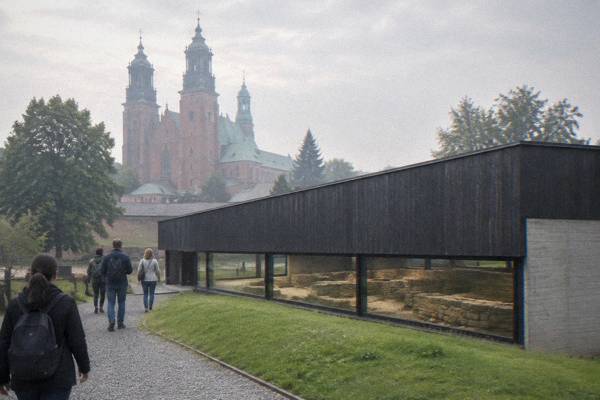
Inside the crypts of Poznan Cathedral visitors can see relics of the tombs of Mieszko I and Boleslaw Chrobry and a 10th-century baptismal bowl, per the cathedral's visitor page, and the Golden Chapel housing the rulers' monuments sits within the church, with the archaeological reserve Genius Loci a few streets away preserving the islands early medieval layers.
The crypts are the substance behind the oldest-church claim. Excavation under and around the cathedral exposed the remains of earlier church buildings on the same footprint, and that layered sequence is what makes the site a national landmark rather than just a large Gothic church. Genius Loci, the archaeological reserve of the Archaeological Museum at ul. Ks. I. Posadzego 3, protects part of those layers in situ. Its price list gives 20 zl normal, 15 zl reduced and 50 zl family for up to six people, and a combined ticket with the Archaeological Museum in Palac Gorkow at 30 zl normal and 25 zl reduced; its opening hours are not published in the sources this page uses, so check the museum's site before going. The full index of guides sits on Poznan Travel Guide.
Across the river, Srodka, the small former suburb facing the island, makes a natural extension. The tenement at ul. Srodka 3 carries the mural "Opowiesc srodecka z trebaczem na dachu i kotem w tle", which the city portal dates to 2015, and the district is one of the quiet pleasures of a self-guided walking tour of Poznan.

| Site on or near Ostrow Tumski | What the official pages list | Admission (zl) |
|---|---|---|
| Poznan Cathedral crypts | Relics of the tombs of Mieszko I and Boleslaw Chrobry, 10th-century baptismal bowl | 10 normal, 8 reduced, 25 family |
| Cathedral viewing tower | Open 1 March to 15 November, weekdays 9:00-16:00, Sundays 14:00-18:00 | 14 normal, 12 reduced, 40 family |
| Porta Posnania | Exhibitions and audio walks on the origins of the Polish state | 35 normal, 29 reduced, 21 with City Card |
| Genius Loci reserve | In-situ archaeological layers; combined ticket with Palac Gorkow | 20 normal, 15 reduced, 50 family |
Is The Fara Poznan's Oldest Church?
The Fara, the Collegiate Basilica of Our Lady of Perpetual Help, St Mary Magdalene and St Stanislaus at ul. Golebia 1 off the Old Market Square, is Poznan's grandest Baroque church but carries no "oldest" claim in any official source this desk has read, and its parish page simply lists it open daily 6:00 to 19:30 with no sightseeing during Mass and no entry ticket.
Visitors ask because the Fara is a church people actually walk into, and its interior stops them mid-step. The practical details are refreshingly simple: the parish site's visiting page gives daily opening from 6:00 to 19:30, asks that sightseers stay away during Mass, and lists no ticket at all. The same site notes Saturday organ concerts at 12:15 followed by a guided tour, though tour prices are not published in the sources used here, so treat the concert as the reliable half of that offer. The Fara church guide carries the full detail.
The distinction between the two churches is worth holding onto. The Fara is the masterpiece you visit for art and music; the cathedral island is where you go for depth of history. Neither the Fara's founding date nor any "oldest in Poland" label appears in the verified pack for this page, and a guide that prints one is guessing.
| Poznan church | What it is known for | Visiting basics from official pages |
|---|---|---|
| Poznan Cathedral, Ostrow Tumski | Rulers' tombs, crypts, viewing tower | Crypts and tower 1 March to 15 November; Mon to Sat 9:00-16:00, Sun 14:00-18:00 |
| The Fara, ul. Golebia 1 | Baroque interior, Saturday organ concerts at 12:15 | Open daily 6:00-19:30, no sightseeing during Mass |
| Porta Posnania, ul. Gdanska 2 | Interpretive centre on the island's history | Tue-Fri 9:00-18:00, Sat-Sun 10:00-19:00, Mon closed |
How Do Other Historic Polish Churches Compare?
Other Polish cities field their own candidates, from Romanesque and early Gothic churches in Gniezno, Wroclaw and Krakow, but this desk reports the Poznan record and leaves the national ranking open; Gniezno's cathedral hill, a train ride of about 25 to 45 minutes from Poznan, is the closest comparable site.
Gniezno is the honest comparator. Its cathedral hill groups the cathedral, museum and viewing terrace, and the official price list shows the cathedral, museum and terrace open Monday to Saturday 9:00-17:00 from 1 May to 31 October, with an important catch: on Sundays the cathedral and museum are closed to tourists and only the terrace opens, from 13:00 to 15:00 and 16:00 to 17:30. Individual tickets run from 12 zl for the terrace to 16 zl for the Gniezno Doors, with an all-inclusive pass at 48 zl. The Museum of the Origins of the Polish State in Gniezno is open daily 9:00-16:00 from October to April, and Sunday is its free-admission day, a detail worth building a weekend around. The Gniezno day trip guide lays out the visit.
Back in Poznan, one caution from the corrections file: the Ethnographic Museum at Grobla 25 is closed for renovation, and the Town Hall museum interior on the Old Market Square is closed with no published reopening date, so plan a church-and-island itinerary rather than a museum-heavy one. The Old Market Square itself, the goats at noon and, recently, 3 pm on the Town Hall facade, and the Croissant Museum with its 14:00 English show all remain in business, and the Old Market Square guide puts them in order.
Common Questions About Old Churches In Poland
What is the oldest church in Poland?
No church holds an official title, but the strongest documented candidate is Poznan Cathedral on Ostrow Tumski, whose crypts preserve relics of the tombs of Mieszko I and Boleslaw Chrobry and a 10th-century baptismal bowl, according to the cathedral's visitor page.
Can you visit the crypts of Poznan Cathedral?
Yes, from 1 March to 15 November, weekdays 9:00-16:00 and Sundays 14:00-18:00. Crypt tickets are 10 zl normal and 8 zl reduced, family 25 zl; the viewing tower is 14 zl normal and 12 zl reduced.
Is the Fara free to enter?
The Fara's parish page lists no entry ticket. It is open daily 6:00 to 19:30, and sightseeing is not allowed during Mass. Saturday organ concerts start at 12:15.
What is Porta Posnania?
Porta Posnania is the interpretive centre at ul. Gdanska 2 facing Ostrow Tumski, with exhibitions and audio walks on the origins of the Polish state. It is closed Mondays, open Tue-Fri 9:00-18:00 and Sat-Sun 10:00-19:00, tickets 35 zl normal and 29 zl reduced.
Is Gniezno Cathedral open on Sundays?
From 1 May to 31 October, no: on Sundays the cathedral and museum are closed to tourists, and only the viewing terrace opens, 13:00-15:00 and 16:00-17:30. Visit Monday to Saturday, 9:00-17:00, for the full site.
Whether you come for the oldest-church debate or simply for two of the finest church interiors in western Poland, Poznan answers the question better than most cities can: not with a plaque, but with the tombs themselves, open to view on an island in the Warta from the first of March until the middle of November.