Is Poznań More Polish Or German?
Poznan is a Polish city today, the capital of Wielkopolskie in western Poland, but its past includes long stretches of Prussian and German rule. Here is what that layered history means for visitors.
Poznan, the capital of the Wielkopolskie voivodeship (Greater Poland) in western Poland, on the Warta river, answers the identity question plainly on the ground: Polish is the language of the street, the zloty is the only currency in the till, and the Statistical Office in Poznan counted 534,239 residents at the end of 2025. The question "Is Poznań more Polish or German?" still gets asked, and for a fair reason. The city spent long stretches of its past under Prussian and then German administration, and that era left buildings, street layouts and museum galleries behind. The honest answer is that Poznan is Polish in its present and layered in its past, and this page walks through both halves with the verified details.

The distinction matters for planning a visit. The Poland you experience in Poznan, the food, the prices, the transport, is entirely present-day Polish. The Germany you encounter is a historical subject, housed inside specific museums and visible in a handful of grand buildings. Treat the two as separate layers and the city makes sense quickly.
Is Poznań More Polish Or German?
Poznan is Polish, politically and in everyday life: it is the capital of the Wielkopolskie voivodeship in western Poland, its residents speak Polish, and the zloty (PLN) is the only currency at the till. Its past is more layered, though, because the city spent long periods under Prussian and then German administration before the Wielkopolska Uprising of 1918-1919 and again during the Second World War, and that history still shows in its architecture.
The Polish half of the story runs deep. The cathedral on Ostrow Tumski holds the tombs of Mieszko I and Boleslaw Chrobry in its crypts, alongside a 10th-century baptismal bowl, which anchors the city's place in the earliest Polish state. The Museum of the Wielkopolska Uprising 1918-1919, on the Old Market Square at Stary Rynek 3, commemorates the rising in which the region broke from Prussian rule. The Enigma Cipher Centre celebrates three Polish codebreakers, Marian Rejewski, Jerzy Rozycki and Henryk Zygalski.
The German half is real too, but it is a museum subject rather than a living identity. The grand buildings along Sw. Marcin street, including the Imperial Castle, now house Polish cultural institutions. The city portal presents Poznan as a Polish regional capital, and nothing in the city's daily life runs in German.
| What you find in Poznan today | The verified detail |
|---|---|
| Country and region | Capital of the Wielkopolskie voivodeship (Greater Poland), western Poland |
| Population | 534,239 at the end of 2025, per the Statistical Office in Poznan |
| Language | Polish |
| Currency | The zloty (PLN); Poland is outside the euro area |
| Emergency number | 112, free of charge and works from a phone without a SIM card |
| Tap water | Safe to drink, as the city utility Aquanet states |
| River | The Warta |
That table is the present tense of the city. Everything German about Poznan belongs to the past, and the next two sections put dates and places on that past.
Was Poznan Part Of Germany?
Yes, for two separate stretches: the city lived under Prussian and then German rule until the Wielkopolska Uprising of 1918-1919, which the Museum of the Wielkopolska Uprising on Stary Rynek commemorates, and it was under German rule again during the Second World War, the period in which the Town Hall tower collapsed in 1945. The museums on the Old Market Square tell that timeline; today Poznan is Polish.
The uprising is the pivot of the story, and Poznan commemorates it in a dedicated museum. The Museum of the Wielkopolska Uprising 1918-1919 occupies the Odwach building at Stary Rynek 3, on the square itself. Admission is 15 zl normal and 10 zl reduced, Tuesday is the free day, and in the November to February season it opens Tuesday to Sunday from 10:00 to 16:00 with Mondays closed. The museum's subject is the rising in which Wielkopolska, the region around Poznan, ended Prussian rule and joined the reborn Polish state.
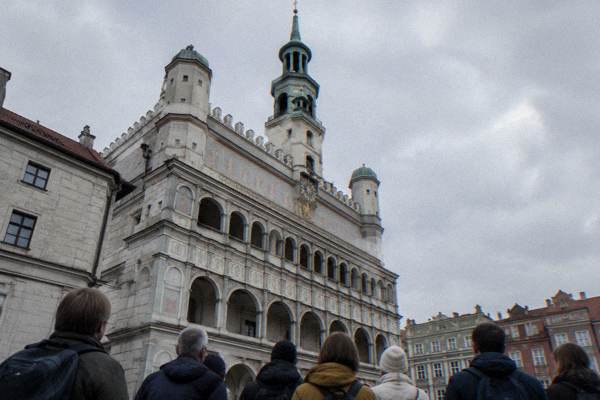
The Second World War layer is darker. The Town Hall's tower collapsed in 1945, and the building, dated to the early 14th century and conserved in 1910-1913, has housed the Museum of the History of the City of Poznan since 1954. That museum interior is currently closed for renovation, with the National Museum's visit page listing every weekday as closed and no reopening date published, so the square, the facade and the famous goats remain the visible attractions. For the wartime destruction in detail, read how the Second World War hit Poznan on this site's dedicated answer page.
For the naming side of the question, two sibling pages go deeper: why Poznan has a German name, and whether Prussians were German or Polish. The old name of Poland explained covers the state-level naming history. The partitions that put the city under Prussian administration belong to those longer histories; the museum on the square is the place to see them laid out with documents and exhibits.
What Does Poznan Feel Like For A Visitor Today?
A visitor finds a Polish regional capital: the city portal presents Poznan as the capital of Wielkopolskie, street signs, menus and museum labels are in Polish, with English available at the major museums, and every price is quoted in zloty. The German past is something you learn about inside museums, not something you hear on the street.
The Enigma Cipher Centre shows how the two layers sit side by side. It stands at ul. Sw. Marcin 78, in the same street as the Imperial Castle, and its exhibition and audio guides come in Polish, English, German, Russian and Ukrainian. Admission is 35 zl normal and 29 zl reduced, with a family ticket at 75 zl; it closes on Mondays, opens Tuesday to Friday from 9:00 to 18:00 and Saturday to Sunday from 10:00 to 19:00, with last admission an hour before closing. The story inside is thoroughly Polish: the three codebreakers on the centre's timeline, Rejewski, Rozycki and Zygalski, worked on the German Enigma cipher, and the centre presents their achievement as a Polish contribution to the Allied war effort.
Practical life in the city is Polish without qualification. Transport tickets come from ZTM, the regional operator, in zloty: a 15-minute timed ticket costs 5 zl, 45 minutes costs 7 zl and 90 minutes costs 9 zl, with 24-hour tickets at 18 zl for zone A and 24 zl for all zones. The Poznan City Card, sold by the city's tourism office, bundles public transport with free entry to most museums. Poland is in the EU and in Schengen, but it keeps the zloty, so visitors from the euro area still exchange money.
| Museum telling the story | Address | Key hours | Admission |
|---|---|---|---|
| Museum of the Wielkopolska Uprising 1918-1919 | Stary Rynek 3 | Nov-Feb Tue-Sun 10:00-16:00, Mon closed | 15 / 10 zl, Tuesday free |
| Enigma Cipher Centre | ul. Sw. Marcin 78 | Tue-Fri 9:00-18:00, Sat-Sun 10:00-19:00, Mon closed | 35 / 29 zl, City Card 21 / 17 zl |
| Imperial Castle visiting route | ul. Sw. Marcin 80/82 | Daily 12:00-19:00, tickets until 18:00 | 10 / 7 zl with a map, 20 / 15 zl with audio guide |
| Royal Castle, Museum of Applied Arts | Gora Przemysla 1 | Tue-Wed 10:00-16:00, Thu to 18:00, Fri to 20:00, Sat-Sun to 17:00 | 20 / 13 zl, Tuesday free |
A private guided walk is the most efficient way to hear both halves of the story in one outing. The Srodka district and Cathedral Island private walking tour, bookable through the operator's live listing, covers the island where the Polish origins are concentrated, and a guide can point out where the German-era city begins on the other bank.
What German Traces Can You Still See In Poznan?
The most visible traces are architectural: the Imperial Castle on Sw. Marcin, a building from the city's Prussian-German era that now runs as a cultural centre open daily from 12:00 to 19:00, and the grand institutional buildings along the same street. The Stary Browar gallery, whose name means Old Brewery, occupies a converted complex on Polwiejska, and the Town Hall itself was conserved in 1910-1913 with its tower lost in 1945. The layering is the point: Polish institutions now occupy buildings the German era left behind.
The Imperial Castle is the clearest single example. Its own visiting page gives daily opening from 12:00 to 19:00, with tickets sold until 18:00, and admission of 10 zl normal or 7 zl reduced with a map, or 20 zl and 15 zl with an audio guide, issued until 18:00 and returned by 19:00. The building's construction years and architect are not published on the castle's own pages, so treat the structure as a period landmark rather than a dated monument. Today it is CK Zamek, a Polish cultural centre, which is exactly the answer to this page's question in miniature: the shell is German-era, the content is Polish. The wider set of guides lives on Poznan Travel Guide.
Stary Browar makes the same point on the shopping side. The gallery at ul. Polwiejska 42 opens Monday to Saturday from 9:00 to 21:00 and on trading Sundays from 10:00 to 20:00, mixing retail with arts spaces. The Royal Castle on Gora Przemysla, home to the Museum of Applied Arts, rounds out the set with temporary exhibitions such as the medal work of Anna Krzymanska and a display of ukiyo-e woodblock prints, both running into the winter season.
| Site from the German era | Address | What it houses today | Hours |
|---|---|---|---|
| Imperial Castle | ul. Sw. Marcin 80/82 | CK Zamek cultural centre | Daily 12:00-19:00 |
| Stary Browar | ul. Polwiejska 42 | Shopping and arts gallery | Mon-Sat 9:00-21:00, trading Sundays 10:00-20:00 |
| Royal Castle | Gora Przemysla 1 | Museum of Applied Arts | Mon closed, Tue-Sun from 10:00, Fri to 20:00 |
None of these buildings functions as anything but a Polish venue today. That is the practical answer to the identity question: the German era supplied architecture, and the Polish present supplies everything that happens inside it.
How Polish Is Everyday Poznan?
Deeply: the Poznan Cathedral crypts on Ostrow Tumski hold the tombs of Mieszko I and Boleslaw Chrobry, early Polish rulers, and a 10th-century baptismal bowl, the Town Hall goats descend from a clock first installed in September 1551 by Bartel Wolff of Gubin, and the Enigma Cipher Centre celebrates the Polish codebreakers Marian Rejewski, Jerzy Rozycki and Henryk Zygalski. The city's signature pastry, the rogale swietomarcinski, is EU-protected as a Protected Geographical Indication.
The cathedral is the anchor. The crypts and the viewing tower open to tourists from 1 March to 15 November, weekdays from 9:00 to 16:00 and Sundays from 14:00 to 18:00, unless an extra service is on. Crypt tickets cost 10 zl normal and 8 zl reduced, with a family ticket at 25 zl; the tower costs 14 zl and 12 zl, family 40 zl. Porta Posnania, the interpretation centre at ul. Gdanska 2, tells the island's early Polish story with timed entries every 20 minutes; it closes on Mondays, opens Tuesday to Friday from 9:00 to 18:00 and Saturday to Sunday from 10:00 to 19:00, and charges 35 zl normal and 29 zl reduced, or 21 zl with the Poznan City Card.
The goats on the Town Hall facade are the city's signature ritual. The National Museum's page states they appear every day at noon, and since recently also at 3 pm. The clock tradition dates to September 1551, when clockmaker Bartel Wolff of Gubin installed the first goat clock, with a new clock installed in 1913. Facade works are under way on the building, and whether the goats run on any given day is not guaranteed, so check on the day rather than planning the hour around them.
The Croissant Museum at Stary Rynek 41/2, entered from Klasztorna Street 23, turns the pastry into theatre, with an English "Croissant and goat show" at 14:00, about 65 minutes long, running daily in July and August and on weekends all year, with other days shown in the booking calendar. The rogale swietomarcinski itself is registered as a Protected Geographical Indication under Commission Regulation (EC) No 1070/2008 of 30 October 2008, a Polish regional product with EU protection, not a German one.
The June 1956 events, when Poznan workers rose against the communist authorities, belong to this Polish story too, and the monument commemorating them stands in the city; the museum dedicated to the events has no visiting details published in the current sources, so the monument is the reliable landmark. For the fullest Polish-origins experience, the private walking tour below covers Srodka and Ostrow Tumski with a guide, and it can be checked through the operator's live listing.
How Many Days Do You Need To See Both Sides?
Two days is a realistic minimum for both stories: day one for the Old Market Square, the goats, the uprising museum and the Croissant Museum; day two for Ostrow Tumski, the cathedral crypts and Porta Posnania, plus the Sw. Marcin strip where the Imperial Castle and the Enigma Cipher Centre sit. The how-many-days guide on this site covers the pacing in detail.
Day one stays in the centre. The square itself, the goats at noon or 3 pm, the uprising museum at Stary Rynek 3 and the Croissant Museum fill a full day without transport, and the Greater Poland Military Museum at Stary Rynek 9 and the Museum of Musical Instruments at Stary Rynek 45 sit on the same square, both 15 zl normal and 10 zl reduced, both free on Tuesdays, both closed on Mondays.
Day two crosses the river. Ostrow Tumski holds the cathedral crypts, the tower and Porta Posnania, and the Srodka district on the far bank adds the mural at ul. Srodka 3, which the city marked as ten years old in October 2025. The Imperial Castle and the Enigma Cipher Centre on Sw. Marcin can slot into either day, since both open into the evening, the castle until 19:00 daily and the Enigma centre until 18:00 on weekdays.
For readers still weighing the trip, the pages on whether Poznan is worth visiting and what Poznan is famous for go deeper on the present-day city, and the pronunciation guide helps with the name itself, which is Polish, with the final syllable spelled and said the Polish way.

Common Questions About Poznan's Polish And German Identity
Poznan is Polish today and German only in its history: it is the capital of the Wielkopolskie voivodeship, its 534,239 residents speak Polish and pay in zloty, and its Prussian-German past survives in buildings and museums rather than in daily life. The questions below cover the German name, the wartime destruction, the partitions and how the city's Polish identity is rooted in Ostrow Tumski.
Is Poznań more Polish or German?
Poznan is Polish. It is the capital of the Wielkopolskie voivodeship in western Poland, on the Warta river, with 534,239 residents at the end of 2025. The German element belongs to history: the city lived under Prussian and then German rule until the Wielkopolska Uprising of 1918-1919 and again during the Second World War, and that past is presented in Polish museums today.
Was Poznan part of Germany?
Yes, for two periods. The city was under Prussian and then German administration until the Wielkopolska Uprising of 1918-1919, commemorated at the museum on Stary Rynek 3, and it was under German rule again during the Second World War, when the Town Hall tower collapsed in 1945. Since the uprising, Poznan has been a Polish city.
Do people in Poznan speak German?
No, Polish is the language of the city. German appears only as a museum option: the Enigma Cipher Centre offers exhibition and audio guides in Polish, English, German, Russian and Ukrainian. Visitors get by with English at the major museums and tourist services.
Does Poznan still use its German name?
Not in modern Polish usage, and this site keeps to the Polish spelling throughout. The German name and its history are covered in full on the German name of Poznan explained, while the Prussian side of the story has its own page on whether Prussians were German or Polish.
Which sights show Poznan's Polish story best?
The cathedral crypts on Ostrow Tumski, which hold the tombs of Mieszko I and Boleslaw Chrobry and a 10th-century baptismal bowl, together with Porta Posnania next door. Add the Museum of the Wielkopolska Uprising 1918-1919 on the Old Market Square and the Enigma Cipher Centre on Sw. Marcin, which covers the codebreaking work of Rejewski, Rozycki and Zygalski.
What currency does Poznan use?
The zloty (PLN). Poland is in the EU and in Schengen but not in the euro area, so every ticket and admission in the city is quoted in zloty, from the 5 zl timed tram ticket to the 35 zl entry at Porta Posnania.
The short version stands: come to Poznan for a Polish city with a German-era architectural inheritance, and let the museums on the square and the island explain how the two layers fit together.