Is Poznań A Big City?
Is Poznan a big city? Poznan in western Poland has 534,239 residents, a 262 km2 footprint and a walkable core. Here is what its size means for a visit.
Poznan, the capital of the Wielkopolskie voivodeship (Greater Poland) in western Poland, sits on the Warta river and is home to 534,239 residents according to the Statistical Office in Poznan (GUS), counting everyone registered. That number places it firmly among Poland's largest cities, yet the part many people come to see, the Old Town and its surroundings, folds into a space you can cross on foot in under half an hour. The question "is Poznan a big city?" therefore has two honest answers, and this page works through both: the statistics that say yes, and the ground-level experience that feels smaller than the figures suggest. If you are still weighing whether the city deserves your time at all, start with our longer take on whether Poznan is worth visiting.

Is Poznań A Big City?
Yes, Poznan is a big city by Polish standards: its population of 534,239, published by the Statistical Office in Poznan (GUS), makes it one of the largest cities in the country, and its reported footprint of 262 km2 spreads well beyond the historic centre into distinct districts such as Jezyce, Lazarz, Wilda and Srodka, each with its own market square and character.
Half a million residents is the figure that settles the statistical side of the question, and it comes from the official regional statistics office rather than from a tourism brochure. To put that in perspective, only a handful of Polish cities clear the half-million mark, and Poznan is the capital of one of the country's voivodeships, a regional seat of government, a university town and a trade-fair city whose MTP fairgrounds draw international business traffic year round. The city portal and the fair calendar both treat Poznan as a major regional hub, not a provincial town.
The feel on the ground is different, and this is the part that surprises first-time visitors. The attractions that fill most itineraries cluster tightly: the Old Market Square (Stary Rynek), the goats on the Town Hall facade, the Fara parish church, Ostrow Tumski with its cathedral, and the shopping galleries around Stary Browar all sit within easy walking distance of one another. Citadel Park, described by the city's own visitor site as the largest park in Poznan, is about a 15-minute walk from the Old Market Square. A city of 534,239 people whose headline sights fit into a walkable core is a genuinely comfortable combination: big-city services, small-city geography.
The scale question also explains something practical: Poznan has the transport network, museums and nightlife of a major city, including a National Museum with multiple branches, an Enigma Cipher Centre, two zoos and a thermal-bath complex on the shore of Lake Malta, and at the same time none of it demands the long cross-town journeys that Warsaw or Berlin impose. That balance is why our guide to how many days in Poznan is enough usually lands on a short, dense city break rather than a week.
How Large Is Poznan Next To Other Polish Cities?
Poznan ranks among the biggest cities in Poland on both people and land: its 534,239 residents (GUS, 31 December 2025) put it ahead of every Polish city except Warsaw, Krakow, Wroclaw, Lodz and the Katowice-area giants in most recent comparisons, and its reported area of 262 km2 is comparable to other voivodeship capitals, so in national terms it is unambiguously a large city, second-tier only to the capital region.
The GUS population figure is the one number on this page that the statistics office publishes directly for Poznan, and it is the figure to quote if anyone asks. The area figure of 262 km2 is reported by the same statistical office's city profile rather than measured here, so treat it as the official reported area.
What can be said from the sourced material is that Poznan functions as one of Poland's significant urban centres. It hosts a major international fair complex (MTP), whose 2026 calendar includes Poznan Game Arena on 23 to 25 October and Cavaliada on 10 to 13 December, and its airport carries enough traffic that Ryanair has based a fifth aircraft there for winter 2026/27 with new routes to Barcelona, Porto, Shannon and Tirana. Cities of that calibre are not small towns.
| Measure | Figure for Poznan | Source basis |
|---|---|---|
| Population (31 Dec 2025) | 534,239 | Statistical Office in Poznan (GUS) |
| Reported city area | 262 km2 | GUS city profile (reported) |
| Administrative role | Capital of Wielkopolskie voivodeship | Regional statistical office remit |
| River | The Warta | Official IMGW gauge at Most Rocha |
| Fair calendar 2026 | Game Arena 23-25 Oct, Cavaliada 10-13 Dec | MTP calendar |
For travellers comparing destinations, the size question usually hides a different one: which city feels better to visit? Our side-by-side pieces on Poznan versus Wroclaw and Poznan versus Krakow take that comparison further.
Does Poznan Feel Big When You Walk It?
No, the central Poznan that visitors actually walk feels compact rather than big: the Old Market Square, the Town Hall with its famous goats, the Fara church, the Croissant Museum entrance off Klasztorna Street and the riverside path toward Ostrow Tumski all lie within a short stroll of one another, and Citadel Park, the city's largest park, is a 15-minute walk from the Old Market Square according to the official visitor site.
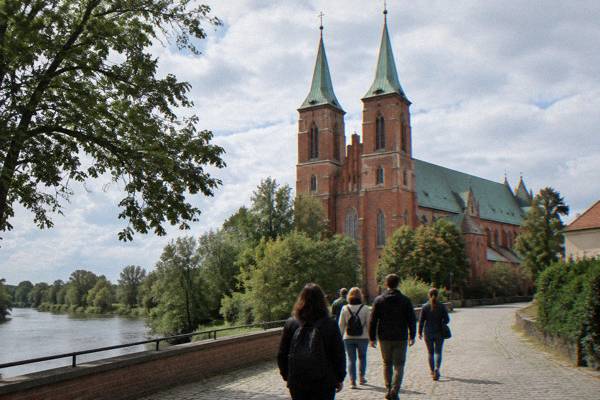
That walkability is the practical payoff of the city's layout. The historic core is dense and flat, with the Warta cutting past Ostrow Tumski and the districts of Srodka and Jezyce sitting just across the water. Srodka in particular is known for its 2015 mural on the tenement at ul. Srodka 3, which the city itself celebrated on its tenth anniversary in 2025, and it sits a short bridge-crossing from the cathedral island. Jezyce adds its own market square (Rynek Jezycki, trading Monday to Saturday 6:00-20:00), a genuinely local corner of a half-million-strong city.
Big-city amenities still show up at walking scale. The Enigma Cipher Centre on Sw. Marcin, the Imperial Castle (open daily 12:00-19:00, 10 zl with a map or 20 zl with an audio guide per the castle's own visiting page) and the shopping complex at Stary Browar (gallery hours Mon-Sat 9:00-21:00, Sunday 10:00-20:00) string along a single axis from the Old Town westward. You can cover the spine of the city on foot and still be inside a top-five-sized Polish urban area.
Two honest caveats belong here. The Town Hall museum interior is closed every day for renovation, with no reopening date published by the National Museum, so the square's biggest building is currently an exterior attraction; the facade, the square and the noon and 3 pm goats are separate from the museum. And the Palm House in Park Wilsona is closed for rebuilding, with part of the pavilions due back towards the end of 2028, so do not build a walk around it. A guided introduction makes the compact core even easier to digest: Check availability for the Old Town walking tour, which covers the tightest and most storied part of the city in English.
How Does A Big City Move: Getting Around Poznan?
Poznan runs the transit network of a large city, and the ZTM price list confirms it: timed tickets valid in all zones cost 5 zl for 15 minutes, 7 zl for 45 minutes and 9 zl for 90 minutes, a 24-hour zone A ticket is 18 zl (24 zl all zones), and lines 148 and 159 link Poznan Glowny station with the airport every 7 to 8 minutes at peak, so the city's size never becomes a barrier once you have a ticket.
The ticket structure matters because it shows how the city is zoned: a single timed ticket covers all zones A, B, C and D with transfers allowed, which is unusual generosity compared with cities that charge per distance. The fine for riding without a valid ticket is steep, 350 zl, dropping to 175 zl if paid within 7 days, so validate before you board. One current limitation is worth knowing in advance: you cannot yet tap a contactless bank card on a tram or bus. The ZTM signed the PEKA modernisation contract in 2026, with card payment expected in 2028; today you buy timed tickets from machines, apps or a PEKA card (the bearer card costs 27 zl, of which 12 zl is a refundable deposit and 15 zl is travel credit).
| ZTM ticket | Price | Notes |
|---|---|---|
| 15 minutes | 5 zl (reduced 2.50) | All zones, transfers allowed |
| 45 minutes | 7 zl (reduced 3.50) | All zones, transfers allowed |
| 90 minutes | 9 zl (reduced 4.50) | All zones, transfers allowed |
| 24 h zone A | 18 zl (reduced 9) | Valid until midnight next day if validated Fri evening |
| 24 h all zones | 24 zl (reduced 12) | Zones A+B+C+D |
| Fine, no ticket | 350 zl | 175 zl if paid within 7 days |
There is no city bike system to recommend: the Poznan City Bike ran from 2012 to 2022 and has not returned, with only a council discussion in July 2026 about reviving it. Ride-hailing questions are covered separately in our answer on whether you can use Uber in Poznan, and the wider money picture, including the zloty versus the euro, sits in our pages on the currency Poznan uses and whether Poznan is expensive.
Is Poznan Big Enough For A Full City Break?
Yes, Poznan is big enough to fill several full days without repeating yourself: the city's own institutions list enough open attractions, from the cathedral crypts and tower on Ostrow Tumski (open 1 March to 15 November, crypts 10 zl, tower 14 zl) to the Enigma Cipher Centre at 35 zl, two zoos and the National Museum's branches, that a half-million-person regional capital with a trade-fair calendar keeps producing new reasons to stay an extra day.
The cathedral's visitor page gives the seasonal detail that catches people out: the crypts, which hold the tombs of Mieszko I and Boleslaw Chrobry, and the viewing tower welcome tourists only from 1 March to 15 November, weekdays 9:00-16:00 and Sundays 14:00-18:00. Porta Posnania, the interpretation centre on the cathedral island, is closed Mondays and charges 35 zl normal, 29 zl reduced. The zoos split the difference in scale: the Old Zoo on Zwierzyniecka street is free to enter, while the New Zoo charges by season, from 20 zl flat in winter months to 45 zl and up in summer.
Seasonal events amplify the big-city feel in winter. Betlejem Poznanskie, the Christmas market, runs across three sites in 2026/27: the MTP grounds from 14 November to 20 December, Plac Wolnosci from 20 November and the Old Market Square from 21 November, both to 6 January 2027. The POZnan Ice Festival follows on 11 to 13 December with its ice-sculpture competitions and children's workshops. A city that mounts a three-site Christmas market and an international ice-carving festival in the same month is not coasting on its Old Town.
Climate is the final piece of the planning picture, and the WMO 1991-2020 normals for the Poznan station give a fair summary: July is both the warmest month (mean daily high 25.2 C) and the wettest (84.4 mm of rain), April is the driest (28.6 mm), and January averages a low of -2.9 C with close to 20 frost days.
| Month | Mean high C | Mean low C | Precipitation mm |
|---|---|---|---|
| January | 2.1 | -2.9 | 37.7 |
| April | 15.0 | 4.0 | 28.6 |
| July | 25.2 | 14.1 | 84.4 |
| October | 13.3 | 5.4 | 35.4 |

Common Questions About Poznan's Size
Is Poznań a big city?
Yes. Poznan has 534,239 residents according to the Statistical Office in Poznan (GUS), making it one of Poland's largest cities and the capital of the Wielkopolskie voivodeship, though its walkable historic core feels far more compact than the population suggests.
Is Poznan bigger than Wroclaw?
This pack does not carry a sourced population figure for Wroclaw, so no ranking is printed here. Poznan counts 534,239 residents; for a like-for-like comparison of the two cities as destinations, see our Poznan versus Wroclaw guide.
Can you walk across Poznan's centre?
Yes. The Old Market Square, the Town Hall, the Fara, Stary Browar and the route toward Ostrow Tumski all sit within a short walk of one another, and Citadel Park is about a 15-minute walk from the Old Market Square per the official visitor site.
Do you need public transport in Poznan?
Only for outer sights such as the New Zoo or Lake Malta. ZTM timed tickets cost 5, 7 or 9 zl by duration and cover all zones with transfers; you cannot yet tap a bank card on board, with contactless payment expected in 2028.
Is Poznan crowded like a capital city?
Not on the scale of Warsaw or Krakow. Poznan draws trade-fair visitors and festival crowds, but its Old Town stays manageable outside peak events such as the Betlejem Poznanskie Christmas market from mid-November to early January.
The short version for anyone still asking: Poznan is a big city on paper, 534,239 residents and a full regional capital's toolkit, and a small one underfoot, with a core you can learn in a day and districts worth crossing the Warta for, a combination this desk's sibling pages on what Poznan is famous for and the rest of Poznan Travel Guide explore in depth.