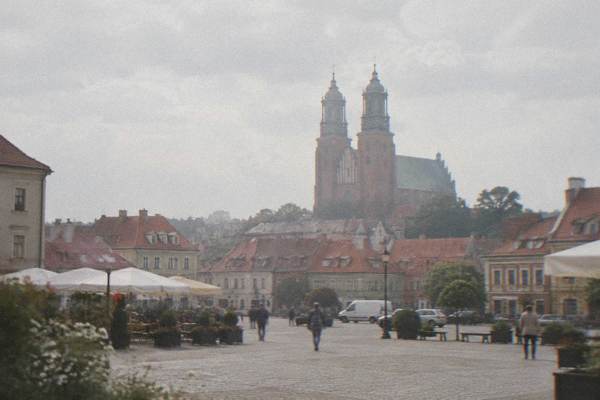
Which City Was The First Capital Of Poland?
Gniezno holds the traditional title of first capital of Poland, but Poznan's cathedral island makes an equal claim. Here is what the official museums on both sides actually say, with hours, prices and how to visit both.
Poznan, the capital of the Wielkopolskie voivodeship in western Poland, sits on the Warta river and shares with its neighbour Gniezno the most contested title in Polish history: first capital of Poland. Ask the question in Gniezno and you get one answer. Ask it on Poznan's cathedral island, Ostrow Tumski, and you get another, backed by the tombs of the earliest Piast rulers still lying in Poznan Cathedral's crypts. This page lays out what the official institutions on both sides actually claim, what you can see today, and how to visit both cities on one trip.

Which City Was The First Capital Of Poland?
The traditional answer is Gniezno, east of Poznan, whose Museum of the Origins of the Polish State presents the city as the cradle of the Polish state and the seat of its first dynasty. Poznan makes an equal claim: its Porta Posnania exhibition on Ostrow Tumski presents the cathedral island as the seat of the same rulers, whose tombs, those of Mieszko I and Boleslaw Chrobry, still lie in Poznan Cathedral. Poland had no single official capital in that era, so both cities hold a documented piece of the story.
The question sounds simple and the honest answer is that it is not. The modern idea of a capital, one city where government sits, did not exist in the early Piast period. Rulers moved between strongholds, and the two strongest of them were Poznan and Gniezno, roughly an hour apart in today's terms. Whichever city a guide crowns, the claim rests on the same small circle of medieval sites, and the museums that tell the story sit on both sides of the divide.
That is why this page does not pick a winner. Instead it reports what each city's own institutions say, lists the sites you can actually visit, and gives the verified hours and prices for the key locations in both. Readers who want the wider context can start with where Poznan sits in Poland and the question of what Poland was called before it was Poland.
Why Gniezno Holds The Traditional Title
Gniezno's claim is told by the Museum of the Origins of the Polish State, ul. Kostrzewskiego 1, which frames the city as the heart of the early Polish state. The museum is open daily, 9:00-18:00 from May to September and 9:00-16:00 from October to April, and Sunday is its free-admission day. On the hill above it stand Gniezno Cathedral and the famous bronze Gniezno Doors, whose individual tickets are listed at 16 zl normal and 14 zl reduced.
Gniezno leans on its cathedral hill, Wzgorze Lecha, as the physical proof of its status. The site's own price list offers several ways in: the Gniezno Doors at 16/14 zl, the cathedral vaults at 14/12 zl, the viewing terrace on the tower at 12/10 zl, the Museum of the Archdiocese at 18/16 zl, or an all-inclusive pass with audio guide at 48/42 zl. A guide for individuals costs 4 zl per person.
One planning detail catches almost every visitor. In the May to October season, the cathedral and its museum are closed to tourists on Sundays; only the viewing terrace opens, in two windows, 13:00-15:00 and 16:00-17:30. From November to April the museum runs Monday to Saturday, 9:00-16:00. If a Sunday visit is fixed in your itinerary, plan the terrace, not the interior.
| Site on Gniezno's cathedral hill | Normal ticket | Reduced ticket |
|---|---|---|
| Gniezno Doors | 16 zl | 14 zl |
| Cathedral vaults | 14 zl | 12 zl |
| Viewing terrace (tower) | 12 zl | 10 zl |
| Museum of the Archdiocese | 18 zl | 16 zl |
| All-inclusive pass with audio guide | 48 zl | 42 zl |
Why Poznan Makes An Equal Claim
Poznan's case rests on Ostrow Tumski, the cathedral island between the branches of the Warta, where Poznan Cathedral's crypts hold the relics of the tombs of Mieszko I and Boleslaw Chrobry and a 10th-century baptismal bowl. Porta Posnania, the visitor centre at ul. Gdanska 2, presents that story in a permanent exhibition, open Tue-Fri 9:00-18:00 and Sat-Sun 10:00-19:00, closed Mondays, with tickets at 35 zl normal and 29 zl reduced.
The cathedral itself opens its tourist visits seasonally. The crypts and the viewing tower welcome visitors from 1 March to 15 November, weekdays 9:00-16:00 and Sundays 14:00-18:00, unless an extra service is on. Crypt tickets cost 10 zl normal and 8 zl reduced, with a family ticket at 25 zl; the tower costs 14/12 zl, family 40 zl. The cathedral's own page notes the tower has been open since 1 June 2026.
A third Poznan site deepens the story. Genius Loci, the archaeological reserve at ul. Ks. I. Posadzego 3, preserves excavated remains under a branch of the Archaeological Museum. Tickets are 20 zl normal, 15 zl reduced and 50 zl for a family of up to six, and a combined ticket with the Archaeological Museum in Palac Gorkow costs 30/25 zl. Its opening hours are not published in the sources this desk uses, so check before going.
| Ostrow Tumski site | Season or days | Normal / reduced ticket |
|---|---|---|
| Poznan Cathedral crypts | 1 Mar to 15 Nov, weekdays 9:00-16:00, Sun 14:00-18:00 | 10 / 8 zl |
| Cathedral viewing tower | Same season | 14 / 12 zl |
| Porta Posnania exhibition | Tue-Fri 9:00-18:00, Sat-Sun 10:00-19:00, Mon closed | 35 / 29 zl |
| Genius Loci reserve | Hours not published in verified sources | 20 / 15 zl |
One more detail saves money. Porta Posnania's last entry of the day, 17:00 on weekdays and 18:00 on weekends, is sold at a lower price the venue calls Happy Hours, and a Poznan City Card gets you in for 21 zl instead of 35.
What Else In Poznan Ties Into The Story
The Old Market Square holds the second layer of the city's early-state narrative: the Town Hall, Stary Rynek 1, a building dated to the early 14th century that has housed the Museum of the History of the City of Poznan since 1954, and the Odwach at Stary Rynek 3, home of the Museum of the Wielkopolska Uprising 1918-1919, tickets 15 zl normal and 10 zl reduced, free on Tuesdays.
Be careful with the Town Hall itself. The museum interior is closed for renovation: the National Museum's own visit page lists every weekday as closed, and no official reopening date is published. The square, the facade and the famous goats are separate from the interior. The goats appear on the facade every day at noon, and since recently also at 3 pm, per the museum's official wording, but whether they run during the current facade works is not confirmed, so check on the day rather than promising yourself the show. A clock with goats was first installed in September 1551 by the clockmaker Bartel Wolff of Gubin, and the current clock dates from 1913.
The square's other museums are open and cheap. The Greater Poland Military Museum at Stary Rynek 9 runs Tuesday to Sunday, 10:00-17:00, at 15/10 zl. The Museum of Musical Instruments at Stary Rynek 45 keeps longer Thursday and Friday hours, to 18:00 and 20:00 respectively, at the same prices. Tuesday is the free day at all of these, which pairs neatly with a Monday spent on Ostrow Tumski, where Porta Posnania is closed Mondays but open the rest of the week.
The Croissant Museum at Stary Rynek 41/2, entered from Klasztorna Street 23, adds a lighter layer: its English "croissant and goat show" runs at 14:00, daily in July and August and on weekends all year, with other days shown in the booking calendar, and the show ends with a view of the Town Hall goats from the museum windows. Ticket prices come from the booking widget, so this desk prints none. For a deeper look at the square itself, see the companion pages on whether Poznan is worth visiting and how many days in Poznan are enough.
How To Combine Gniezno And Poznan In One Trip
The two claimants sit close enough to visit both in a single stay: the train between Poznan and Gniezno takes about 25 to 45 minutes according to the Koleje Wielkopolskie timetable, so the practical plan is to base yourself in Poznan, where the hotels, restaurants and transport hub are, and give Gniezno a full day, using the morning for the cathedral hill and the free Sunday admission at the Museum of the Origins of the Polish State when timing allows.
Inside Poznan, the ZTM network covers the whole city on timed tickets valid in all zones: 5 zl for up to 15 minutes, 7 zl for 45 minutes and 9 zl for 90 minutes, with a 24-hour zone A ticket at 18 zl. Note that contactless bank-card payment on trams and buses is not available yet; the PEKA modernisation that will enable it is expected to show effects in 2028, so buy timed tickets from machines or an app, or carry a PEKA card.
The order of days matters more than most itineraries admit. Porta Posnania is closed on Mondays, and Gniezno Cathedral is closed to tourists on Sundays in the summer season, so a Monday-plus-Tuesday pairing works well: Ostrow Tumski on Monday for the outdoor island and cathedral exterior, the square museums on Tuesday when they are free. Wednesday to Saturday then leaves Gniezno fully open, terrace included.
Driving is also workable. A hire car makes the run east simple, and this desk's planning page for car hire covers the options: compare Poznan car hire rates before committing. Visitors who prefer to explore at their own pace can also look at self-guided audio tours of Poznan, which suit the early-history theme well.

Which City Should You Actually Visit?
Visit Poznan first and give it at least two full days, because it carries the cathedral island, the crypts of Mieszko I and Boleslaw Chrobry, Porta Posnania and the whole Old Market Square layer, then take one day for Gniezno's cathedral hill, whose all-inclusive pass at 48 zl covers the Doors, the vaults, the terrace and the museums in a single walkable cluster. If you have time for only one, Poznan wins on depth and on everything else the city offers around it.
That recommendation is practical, not patriotic. Poznan is the regional capital, the transport hub and the bigger city, with a population of 534,239 according to the Statistical Office in Poznan. Gniezno's sights concentrate on one hill and can be seen in a day. The converse is not true: Ostrow Tumski, the square, the Croissant Museum and the Enigma Cipher Centre, which tells the story of the codebreakers Marian Rejewski, Jerzy Rozycki and Henryk Zygalski, fill two days easily.
For travellers building a first Poland itinerary around this question, the answer is the same the first-time visitor route page gives: start west, in the Wielkopolska region where the state began, then move east. And for anyone still unsure whether the detour pays off, the question is Poznan worth visiting has its own answer elsewhere on this site.
Common Questions About Poland's First Capital
Which city was the first capital of Poland?
The traditional answer is Gniezno, whose own Museum of the Origins of the Polish State makes that case. Poznan disputes it: Ostrow Tumski holds the tombs of Mieszko I and Boleslaw Chrobry in the cathedral crypts, and Porta Posnania presents the island as the seat of the same rulers. With no single official capital in the early Piast era, both claims stand on documented ground.
How far is Gniezno from Poznan?
By train the run takes about 25 to 45 minutes according to the Koleje Wielkopolskie timetable. Check the operator's timetable for your specific departure, since frequencies vary through the day.
Can you see the tombs of the first Polish rulers?
Yes, in Poznan. Poznan Cathedral's crypts hold the relics of the tombs of Mieszko I and Boleslaw Chrobry plus a 10th-century baptismal bowl. The crypts open to tourists from 1 March to 15 November, weekdays 9:00-16:00 and Sundays 14:00-18:00, tickets 10 zl normal and 8 zl reduced.
Is Gniezno Cathedral open on Sundays?
In the May to October season, no: the cathedral and its museum are closed to tourists on Sundays, and only the viewing terrace opens, 13:00-15:00 and 16:00-17:30. Plan the cathedral itself for a weekday or a Saturday.
What is the cheapest way to see the early-history sites?
Use the free days. Sunday is free at Gniezno's Museum of the Origins of the Polish State, and Tuesday is free at the National Museum and Independence Museum branches in Poznan, including the square museums. Porta Posnania's Happy Hours entry and its 21 zl City Card price also cut costs.
The first-capital question will keep both cities arguing for another thousand years, and that argument is the best reason to see both: the Warta island with the rulers' tombs, the hill with the bronze doors, and a train ride of under an hour between them. If Poznan is your base, Poznan Travel Guide covers the rest of the city, from the goats on the Town Hall facade to the shores of Lake Malta.