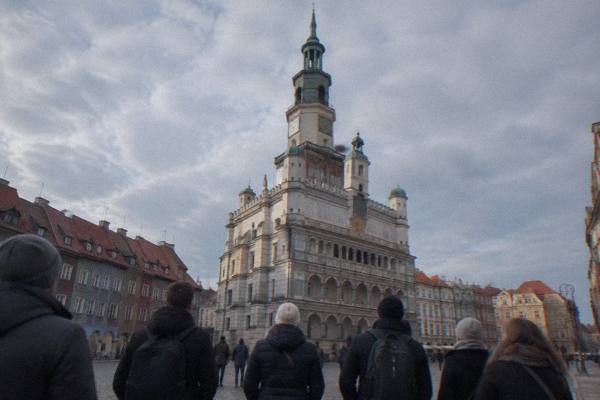
How Do You Pronounce Poznań?
The Polish city Poznan is pronounced POZH-nan, with a soft nasal n at the end. A plain English-friendly guide to the stress, the ń, and the place names you will actually say aloud.
Poznan, the capital of the Wielkopolskie voivodeship (Greater Poland) on the Warta river in western Poland, is one of those city names that looks harder than it is. Ask a room of English speakers to read it aloud and you will hear three different versions before anyone agrees. The correct Polish pronunciation, the one used by the city's own residents among the 534,239 people the Statistical Office counted at the end of 2025, is close to POZH-nan: two syllables, stress on the first, a "zh" sound like the s in "measure", and a soft, nasal finish. This page breaks the word down sound by sound, explains the accented letter that trips people up, and covers the other names you will actually need to say on a visit, from Ostrow Tumski to Srodka.

How Do You Pronounce Poznań?
Poznan is pronounced roughly "POZH-nan": two syllables, stress firmly on the first, the middle consonant sounding like the "zh" in "measure" or the "s" in "pleasure", and a soft, nasal "n" closing the word, made by pressing your tongue as if to say "ny" in "canyon". Written with the accent, Poznań, the name ends on that softened n, not a plain English n. Say POZH-nan with the accent on POZH and you have it.
The safest English-friendly rendering is "POZH-nan". Some phrasebooks simplify the middle sound to a plain "z", giving "POZ-nan", and that version is perfectly understood anywhere in the city. What marks a newcomer is not the zh, it is the stress. Polish is a fixed-stress language: with almost no exceptions, the stress falls on the penultimate (second-from-last) syllable of a word. Poznan has two syllables, so the stress lands on the first one, POZH, and the final syllable is light and quick.
A common mistake is treating the final n as silent or swallowing it, ending on "POZH-nah". The ń at the end of Poznań is not decorative. It signals palatalisation, a softening, so the tongue sits further forward and the sound leans toward "ny". Practise it with "canyon" or "onion": the n and the y blur together into one movement. That is the sound Polish spelling writes as ń.
What Does The Soft N Actually Do To The Sound?
The letter ń in Poznań is a palatalised n, pronounced like the "ny" blend in English "canyon", "onion" or "lasagna", a single smooth sound rather than an n followed by a separate vowel. Without the accent the word ends in a plain hard n, which is why the spelling "Poznan" nudges English readers toward "POZ-nan". The accent also does nothing to the stress, which stays on the first syllable regardless of the mark.
Polish uses several accented letters, and ń is one of the simplest for an English speaker. Unlike the nasals ą and ę, which add a faint nasal hum and have no clean English equivalent, ń maps almost perfectly onto sounds you already make. If you can say "Lasagna" you can say the end of Poznań. The International Phonetic Alphabet writes the whole city name as roughly [ˈpɔznaɲ], and you can see the stress mark sitting before the first syllable.
One practical point for travellers: you will rarely need the accented form at all. Ticket machines, hotel bookings and signposts in the city work fine with plain ASCII, and this site itself writes Poznan without the accent in every heading, following the convention most English-language travel publishing uses. The accent matters for pronunciation, not for communication. Nobody in a tram or a bakery will pause over it.
| Piece of the name | How it sounds | English anchor word |
|---|---|---|
| Po | "po" as in "pore" | pore |
| z + n | "zh" then "n", run together | measure |
| ań | soft nasal "ny" ending | canyon |
| Whole word | POZH-nan, stress on POZH | measure + canyon |
If you want a walking structure for a first visit while you practise, a small-group guided walk such as Check availability pairs well with our Poznan self-guided walking tour guide, and hearing a local guide say the city's name all day is the fastest ear-training there is.
How Do English Speakers Usually Say It?
Most English speakers settle on one of three versions: "POZ-nan" with a plain z and first-syllable stress, "po-ZHAAN" with a French-sounding ending, or the fuller "POZH-nan". The first is the most common and the least accurate; the second overdoes the ending; the third is the one to aim for. All three will get you understood in Poznan itself, because residents of a busy university and trade-fair city hear mangled versions of the name constantly.
British and American media have never standardised the name the way they have for Warsaw or Krakow. Sports commentary, where Lech Poznan appears regularly in European football coverage, tends toward "POZ-nan", and that version has spread furthest. It is not wrong in any way that matters. The z in Polish is genuinely closer to the "zh" sound, but a hard z is a small distortion, not a different word.
The version to avoid is stressing the second syllable, "poz-NAN", which some readers produce because English likes to stress final syllables in borrowed words. In Polish that pattern sounds odd because the stress rule is fixed: penultimate syllable, always. When in doubt, hit the first syllable and let the rest fall away.

Why Do You See Both Poznan And Poznań?
The form with the accent, Poznań, is the correct official Polish spelling, used on Polish documents, street signs and the city's own pages. The plain form, Poznan, is the standard international rendering, used in English-language publishing, at airports, on train timetables abroad and across most of the internet, because plain ASCII drops diacritics. Both spellings point to the same city in western Poland on the Warta river, and using either one is not an error.
The reason is technical rather than political. Accented characters like ń live outside the basic Latin alphabet, and for decades computer systems, domain names and airline booking engines handled them badly. International convention therefore stripped the accents, the same way München became Munich in older systems and Köln became Cologne in English. Modern software copes with the accents, but the plain form had already stuck in English travel writing, including on this site. Other pages covering the same trip are gathered on Poznan Travel Guide.
Do not confuse any of this with the city's historical German name, a separate matter we cover on the page about the German name for Poznan. That name belongs to the city's past under Prussian rule and appears on old maps; it is not a spelling variant of Poznan, and modern copy does not use it. The spelling question is Poznań versus Poznan, full stop.
How Do You Pronounce Other Names You Will Use In Poznan?
The names travellers say most often are Stary Rynek ("STAH-ri RY-nek", the Old Market Square), Ostrow Tumski ("OSS-troff TOOM-skee", the cathedral island), Srodka ("SHRO-dkah", the dining quarter across the bridge) and Jezyce ("yeh-ZY-tseh", the market and tenement district). As with the city name itself, stress lands on the second-from-last syllable, and the letter combination "rz" sounds like the "zh" in "measure".
The single most useful rule for any Polish place name is that fixed penultimate stress. Apply it and most names fall into place, even when the consonant clusters look hostile. The second most useful rule is that "rz" and "ż" both make the "zh" sound, so Srodka begins more like "SHRO" than "SRO". A third: "w" is English "v", which is why Warta, the river through the city, is "VAR-tah".
| Name you will use | Rough pronunciation | What it is |
|---|---|---|
| Stary Rynek | STAH-ri RY-nek | Old Market Square |
| Ostrow Tumski | OSS-troff TOOM-skee | Cathedral island |
| Srodka | SHRO-dkah | Old dining quarter east of the square |
| Jezyce | yeh-ZY-tseh | Western district with a daily market |
| Warta | VAR-tah | The river through Poznan |
| Wielkopolskie | vyel-ko-PAWL-skyeh | The voivodeship, Greater Poland |
| Rogal swietomarcinski | RO-gal shvyen-to-mar-CHEEN-skee | The protected St Martin croissant |
| Pyry z gzikiem | PY-ri z GZEE-kyem | Potatoes with cottage cheese, the local dish |
Two of those names deserve a note. Rogal swietomarcinski is the croissant the city bakes for St Martin's Day on 11 November, registered in the EU as a Protected Geographical Indication, and it appears on every bakery window in the weeks around the name-day celebrations, which the CK Zamek cultural centre organises on St Martin Street. Pyry z gzikiem is the potato-and-quark dish you will see on traditional restaurant menus; our guide to Poznan food covers where the versions worth ordering are. Neither name needs perfect delivery, but the effort is noticed.
Will Anyone Mind If You Say It Wrong?
No. Poznan is a working university city and a major trade-fair venue, and its residents hear the city name pronounced every way from "POZ-nan" to "po-ZAHN" year round, particularly during the winter fair season. Making an attempt at the first-syllable stress signals goodwill; getting the nasal ending right is a bonus, not a requirement. Polish hospitality norms reward the effort, and correcting a visitor's pronunciation unprompted is not part of the local culture.
The situations where pronunciation actually matters are few. Reading a destination to a tram driver or taxi dispatcher works better with the stress on the first syllable, because "poz-NAN" can sound like a different word fragment. Asking for a rogaland being understood matters less than pointing, since most bakeries in the old town sell them by sight. Everything else, museum counters, hotel desks, restaurants, operates in English without friction in the centre.
If you want to hear the name before you travel, any of the city's guided products narrated by locals will give you hours of exposure. The trio below includes a half-day city tour, a candlelit Chopin piano concert in the city centre, and a private airport transfer, three settings where you will hear "Poznan" said properly, by people who live there, within an hour of arriving.
Common Questions About Pronouncing Poznan
How do you pronounce Poznań?
Roughly "POZH-nan": two syllables, stress on the first, a "zh" sound like the s in "measure" in the middle, and a soft nasal "ny" ending like the middle of "canyon". The accent over the n softens the final sound; it does not move the stress.
Is it rude to say POZ-nan with a plain z?
No. The plain-z version is the most common English rendering and is understood everywhere in the city. The gap between it and the Polish pronunciation is small, and residents of a trade-fair and university city hear far stranger versions regularly.
Which syllable is stressed in Poznan?
The first one, always. Polish stresses the second-from-last syllable of a word as a fixed rule, and Poznan has exactly two syllables, so the stress falls on "POZH" and the final syllable stays light.
Why is the name sometimes written without the accent?
The accented form Poznań is the official Polish spelling. Plain ASCII systems historically dropped the accent, and the plain form became the standard international rendering in English publishing, air travel and web addresses. Both spellings name the same city in western Poland.
How do you pronounce Stary Rynek?
"STAH-ri RY-nek", with stress on the first syllable of each word. It means Old Market Square, the Renaissance square at the centre of the old town where the Town Hall and its famous noon goats are found.
How do you pronounce Ostrow Tumski?
"OSS-troff TOOM-skee". The "w" at the end of Ostrow sounds like English "f", and the stress sits on the first syllable of each word. It is the cathedral island district east of the old town, home of Poznan Cathedral and the Porta Posnania visitor centre.
Say the city name with the stress forward and a soft ending, and you are already ahead of most guidebooks.